PEAQ-ITC (Isothermal Titration Calorimetry, Malvern Panalytical)
The Fisher DDRC Technology Guides are designed to help investigators understand what information a technology can provide, when it is most useful, and how it fits into the broader experimental workflow. Rather than describing an instrument in isolation, these guides emphasize experimental design, interpretation, and practical considerations that contribute to successful research.
Overview
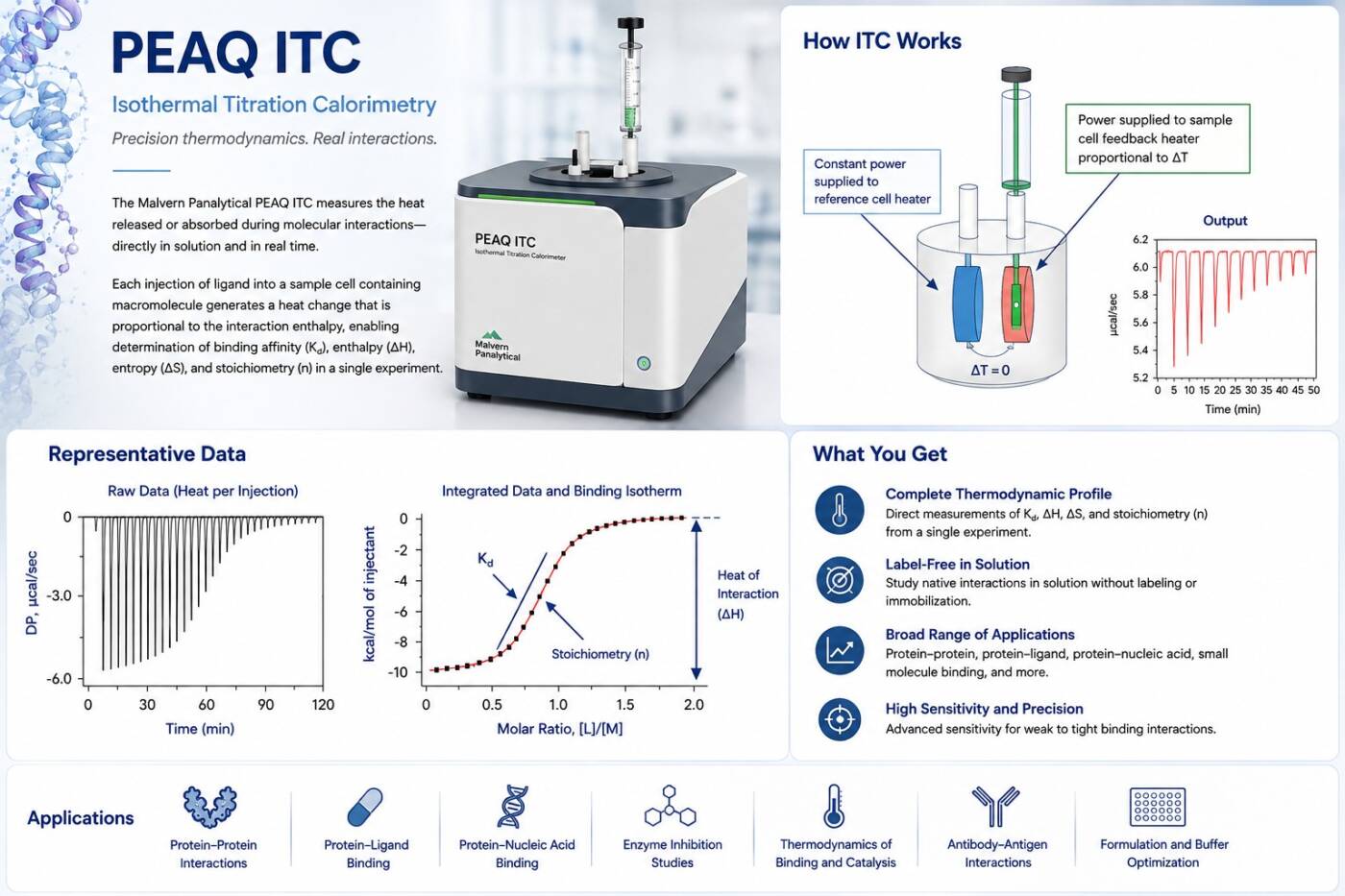
Isothermal Titration Calorimetry (ITC) is a label-free biophysical technique that directly measures the heat released or absorbed during molecular interactions. Unlike most binding assays, ITC does not rely on fluorescence, radioactivity, optical detection, or surface immobilization. Instead, it directly measures the thermodynamic consequences of molecular binding.
At the Fisher Drug Discovery Resource Center, the MicroCal PEAQ-ITC is used to characterize interactions involving proteins, peptides, antibodies, nucleic acids, small molecules, and other biomolecular systems. In a single experiment, ITC can determine binding affinity (KD), binding stoichiometry (n), enthalpy (ΔH), entropy (ΔS), and Gibbs free energy (ΔG), providing one of the most complete descriptions of molecular recognition available from a single experiment.
When Should I Choose ITC?
ITC is the method of choice when a complete thermodynamic description of a molecular interaction is required. In addition to binding affinity, ITC measures binding stoichiometry, enthalpy, and entropy without requiring fluorescent labels or immobilization.
If sample quantity is limited or kinetic information is the primary objective, complementary techniques such as Surface Plasmon Resonance (SPR) or Microscale Thermophoresis (MST) may be more appropriate.
At a Glance
| Parameter | Typical Starting Point |
|---|---|
| Primary Application | Thermodynamic characterization of molecular interactions |
| Detection Principle | Direct measurement of heat |
| Detection Labels | None required |
| Surface Immobilization | Not required |
| Typical Cell Volume | Approximately 200 µL (prepare approximately 250–300 µL for loading) |
| Typical Syringe Volume | Approximately 40 µL |
| Typical Experiment Time | 30–90 minutes |
| Typical Sample Types | Proteins, peptides, antibodies, nucleic acids, and small molecules |
Scientific Questions
- Do these molecules bind?
- How strong is the interaction?
- What is the binding stoichiometry?
- Is binding driven primarily by enthalpy or entropy?
- How does a mutation alter binding energetics?
- Does a ligand change the thermodynamic profile of an interaction?
- Do two compounds bind through similar mechanisms?
Physical Principle
The MicroCal PEAQ-ITC measures the minute quantities of heat released or absorbed during successive injections of one binding partner into another while maintaining a constant temperature.
Each injection produces a heat pulse that reflects the extent of molecular binding. As binding sites become saturated, progressively smaller heat changes are observed until only the heat of dilution remains.
By integrating these heat changes and fitting appropriate thermodynamic models, ITC determines binding affinity (KD), stoichiometry (n), enthalpy (ΔH), entropy (ΔS), and Gibbs free energy (ΔG).
Experimental Workflow
- Evaluate sample quality (Prometheus Panta, Circular Dichroism, SEC, etc.).
- Prepare both binding partners in identical buffer.
- Accurately determine sample concentrations.
- Degas samples before loading.
- Load the sample cell and injection syringe.
- Perform the titration.
- Inspect the raw thermograms.
- Fit an appropriate binding model.
- Interpret the thermodynamic results within the biological context.
Typical Sample Requirements
| Parameter | Typical Starting Point |
|---|---|
| Sample Purity | High; homogeneous and biologically active |
| Protein Concentration (Cell) | Typically 10–20 µM for many protein receptors (application dependent) |
| Titrant Concentration (Syringe) | Typically 10–20 times the concentration of the sample in the cell |
| Sample Volume | Approximately 250–300 µL to fill the 200 µL sample cell |
| Syringe Volume | Approximately 40 µL |
| Buffer Matching | Essential. Both samples should be prepared in identical buffer whenever possible. |
| Sample Homogeneity | Aggregation should be minimal. |
| Degassing | Strongly recommended. |
| Small Molecules | Confirm adequate solubility at the required syringe concentration before beginning the experiment. |
These values are intended as practical starting points. Actual concentrations depend upon the affinity of the interaction, molecular weights, sample availability, and experimental objectives.
Typical Applications
- Protein-small molecule interactions
- Protein-protein interactions
- Protein-peptide interactions
- Protein-DNA interactions
- Protein-RNA interactions
- Antibody characterization
- Mutational analysis
- Lead optimization
Strengths
- Direct measurement of molecular binding through heat.
- No fluorescent or radioactive labels required.
- No surface immobilization required.
- Complete thermodynamic characterization.
- Determination of binding stoichiometry.
- Broad applicability to many biomolecular systems.
Experimental Considerations
- ITC generally requires more purified material than SPR or MST.
- Accurate concentration measurements are essential.
- Buffer matching is critical.
- Heat of dilution should always be considered.
- Sample aggregation should be minimized.
- Small-molecule solubility may become limiting at the concentrations required for syringe loading.
The quality of an ITC experiment depends as much on thoughtful experimental design and careful sample preparation as it does on instrument performance.
Lessons from the Bench
ITC is often limited by sample availability.
Compared with SPR or MST, ITC requires relatively large amounts of purified material. Before beginning an experiment, confirm that sufficient sample is available at the required concentration and volume.
ITC measures heat—not affinity.
Binding affinity, stoichiometry, enthalpy, and entropy are all calculated from the measured heat signal. Understanding this distinction helps investigators appreciate both the strengths and limitations of the technique.
Buffer matching is essential.
Differences in salts, pH, glycerol, DMSO, reducing agents, or other buffer components between the syringe and sample cell generate heat unrelated to molecular binding and may complicate interpretation.
Concentration accuracy matters.
Errors in concentration directly influence calculated stoichiometry and thermodynamic parameters. Careful concentration determination is one of the most important aspects of a successful ITC experiment.
Check compound solubility early.
Because the titrant is often prepared at concentrations 10–20 times higher than the sample in the cell, compound solubility may become the limiting factor, particularly for weakly soluble small molecules.
What ITC Does Not Tell You
- Association and dissociation kinetics
- Three-dimensional structural information
- Cellular activity
- Mechanism of action
ITC is most informative when interpreted alongside complementary structural, biophysical, and functional experiments.
Related Technologies
- NanoTemper Prometheus Panta
- Cytiva Biacore 8K Surface Plasmon Resonance
- Microscale Thermophoresis
- Circular Dichroism
Related Discovery Guides
- Preparing for Biophysical Characterization
- Choosing the Right Experimental Approach
- From Screening Hit to Evidence