BioTek MultiFlo Dispensers
Automated liquid dispensing for rapid, reproducible reagent addition and higher-throughput microplate processing.
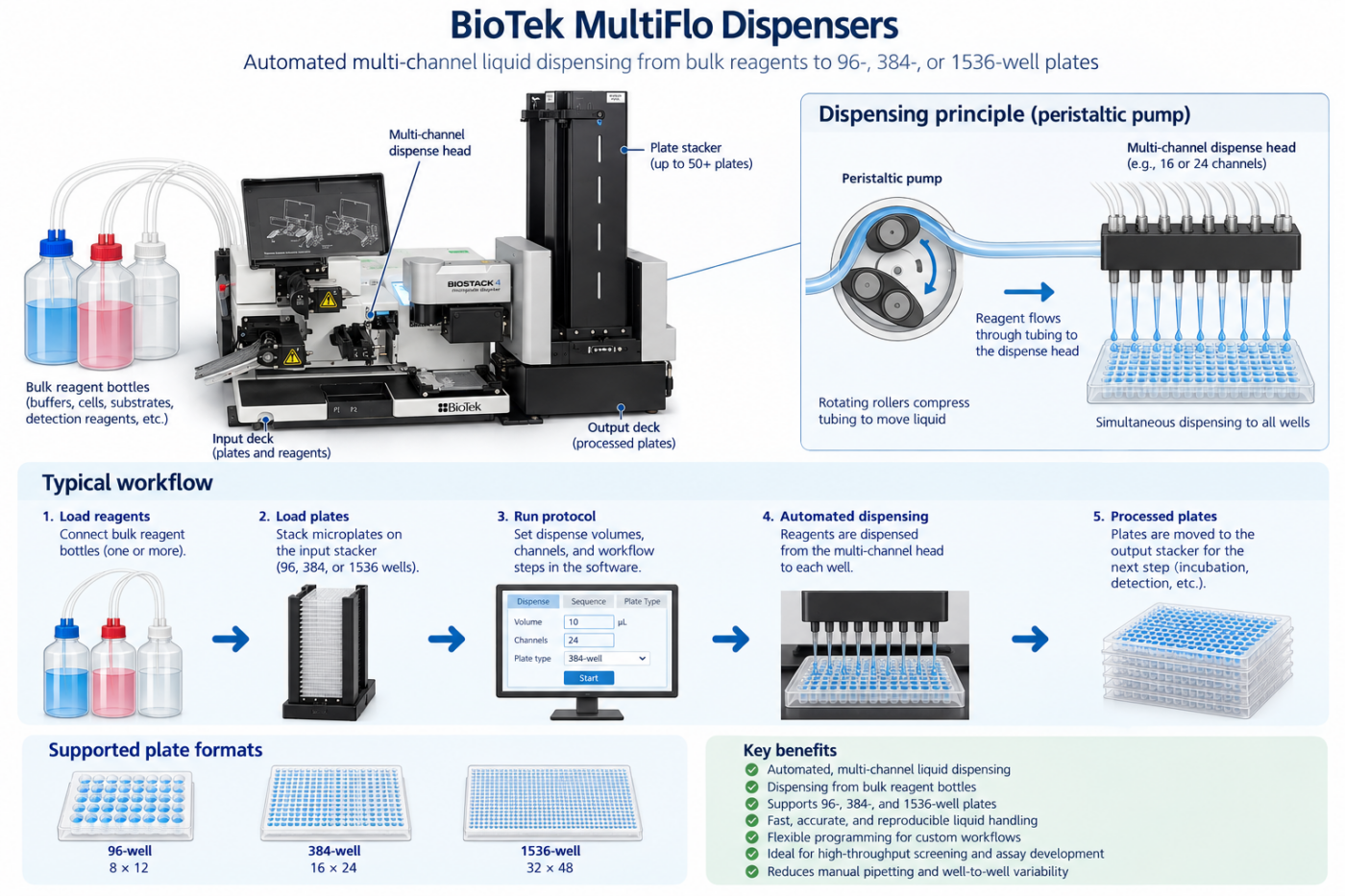
The DDRC operates two BioTek MultiFlo automated dispensers equipped with plate stackers, providing automated reagent addition for multi-plate workflows. The systems can rapidly dispense reagents across 96- and 384-and 1536-well microplates, reducing manual pipetting and improving the consistency and throughput of screening and assay-development experiments.
Technical Question
How can I add reagents rapidly and reproducibly across many microplates?
Many screening and assay-development workflows require the same reagent to be added to hundreds or thousands of wells. Automated dispensing makes this process faster and more consistent than manual pipetting, while reducing hands-on time and well-to-well variability.
With plate stackers, multiple plates can be processed sequentially, allowing extended workflows to run with minimal operator intervention.
When Is It Useful?
MultiFlo dispensing is particularly useful for:
- High-throughput compound screening
- Automated compound or reagent addition
- Cell-based assay preparation
- Biochemical assay development
- Addition of substrates, cofactors, buffers, or detection reagents
- Serial or sequential reagent additions
- Processing large numbers of microplates
- Reducing manual pipetting and improving reproducibility
How It Works
Microplates and reagent reservoirs are loaded onto the dispensing system and the dispensing protocol is programmed for the desired plate format and reagent volumes.
The MultiFlo dispenser then delivers reagent rapidly and consistently across the wells of each plate. With the plate stackers, multiple plates can be processed sequentially without requiring an operator to load each plate individually.
The processed plates can then proceed directly to incubation, washing, detection, or other downstream assay steps.
High-Throughput Screening
Automated dispensing is an important component of the DDRC’s screening workflow.
For example, a typical screening assay may require the addition of cells, assay buffer, substrate, compound, or detection reagent to hundreds of microplates. Automating these repetitive liquid-handling steps allows the DDRC to process larger numbers of plates while maintaining consistent timing and reagent delivery.
This is particularly important when assay timing itself is part of the experiment.
Why Use the DDRC?
The DDRC combines automated liquid handling with plate-based screening and detection technologies, allowing researchers to build complete assay workflows rather than simply perform individual dispensing steps.
Our two MultiFlo dispensers and plate stackers provide additional capacity for parallel and sequential plate processing, supporting both routine screening campaigns and flexible assay-development workflows.
Related Technologies
Janus Automated Pipetting Workstation
Provides more complex automated liquid handling and sample preparation when precise transfers between different labware formats are required.
Synergy Neo Plate Reader
Provides downstream fluorescence, luminescence, and absorbance measurements following automated reagent addition.
FDSS uCell
Enables rapid kinetic measurements of cellular responses following automated agonist or antagonist addition.
EL406 Microplate Washer
Provides automated washing for assays requiring repeated aspiration and reagent exchange.
Operetta High-Content Imaging
Provides cellular imaging and phenotypic analysis following automated assay preparation.
Together, these technologies allow the DDRC to move from automated assay preparation → screening → detection → data analysis within an integrated microplate-based workflow.