Instrumentation
The Fisher Drug Discovery Resource Center provides shared access to specialized
instrumentation for assay development, screening, automated liquid handling,
biophysical characterization, high-content imaging, and analytical measurements.
DDRC staff can help investigators select an appropriate technology, develop and
optimize experimental methods, and integrate multiple approaches when needed.
Many instruments are available for independent use following training, while more
specialized experiments can be performed with DDRC staff support.
If you are unsure which technology is appropriate for your project, we encourage
you to discuss the scientific question with us before selecting an instrument.
Assays & Experimental Readouts
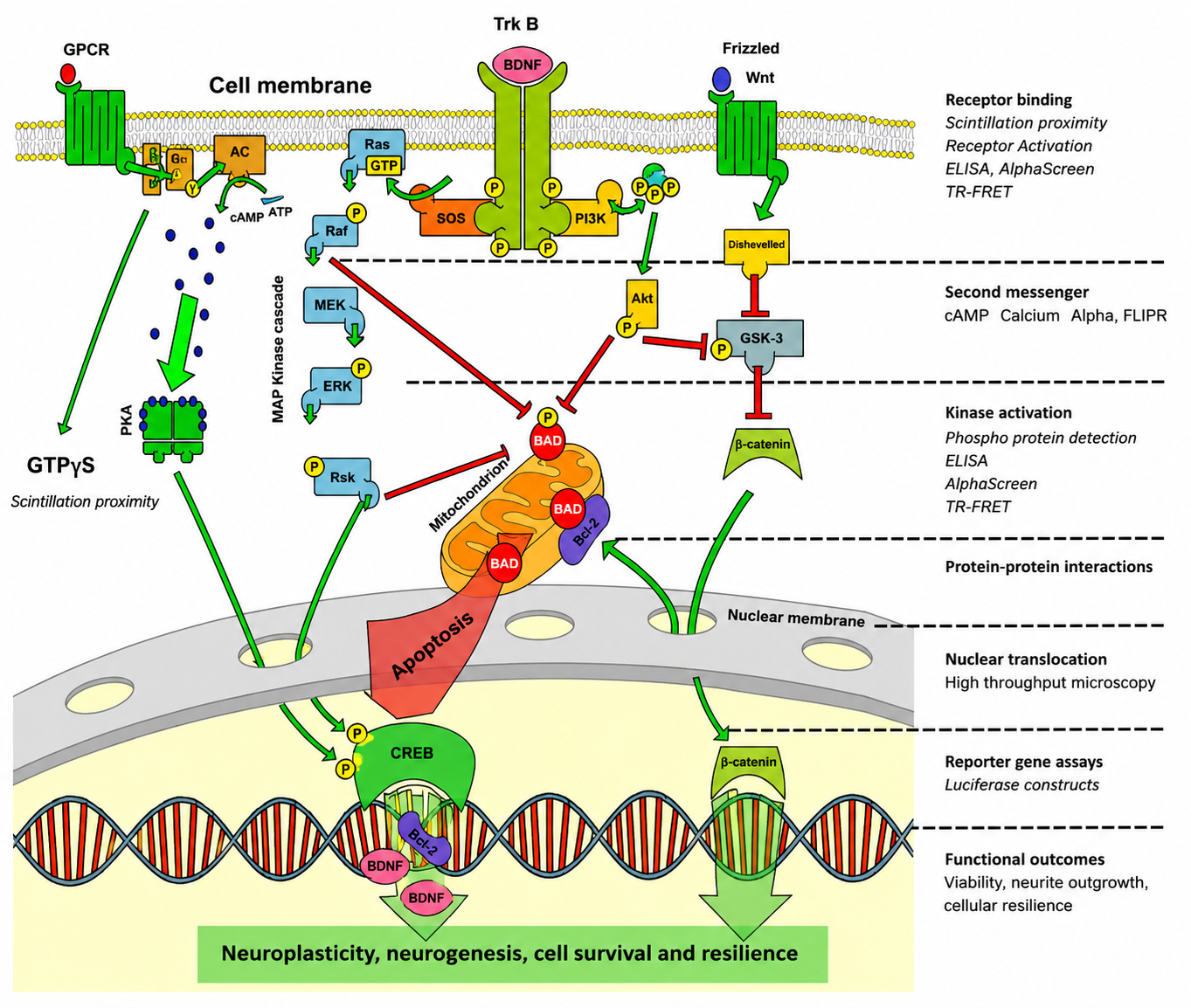
DDRC assay development and screening can interrogate biological activity at multiple
levels, from receptor activation and intracellular signaling to protein interactions,
transcriptional responses, and cellular phenotypes. The appropriate instrumentation
and assay technology depend on the biological question being addressed.
Assay Detection & Screening
The DDRC provides microplate-based detection technologies for biochemical and
cellular assay development, optimization, and screening. Available detection modes
include absorbance, fluorescence, fluorescence polarization, time-resolved
fluorescence, TR-FRET, luminescence, and related assay formats.
BioTek Synergy NEO and NEO2 Microplate Readers
Three multifunction microplate readers for assay development and screening using
multiple fluorescence-, luminescence-, and absorbance-based detection technologies.
Hamamatsu FDSS uCell
Kinetic microplate reader for real-time cellular measurements and assays requiring
rapid detection of changes following compound or reagent addition.
MicroBeta TriLux
Microplate reader for luminescence and scintillation-based assays.
LI-COR Odyssey M
Infrared imaging and detection system for gels, blots, microplates, and other
infrared fluorescence applications.
High-Content & Cellular Analysis
PerkinElmer Operetta High-Content Imaging System
Automated microscopy platform for high-content imaging, quantitative cellular
analysis, phenotypic assays, and image-based screening.
Agilent Seahorse Cellular Metabolic Analyzer
Cellular metabolic analysis using oxygen consumption and extracellular
acidification measurements to investigate mitochondrial function, glycolysis,
and cellular energy metabolism.
Automated Liquid Handling & Screening Automation
Automated liquid handling supports assay miniaturization, compound screening,
reagent dispensing, plate preparation, and reproducible processing of large
numbers of samples.
PerkinElmer JANUS Automated Pipetting Workstations
Three automated pipetting workstations for programmable liquid handling,
plate preparation, assay setup, compound transfer, and high-throughput workflows.
Integra Assist Plus
Automated pipetting workstation for reproducible multichannel liquid handling
and assay preparation.
Integra Welljet Dispensers
Two automated reagent dispensers for rapid, reproducible dispensing into
microplates.
BioTek MultiFlo Dispensers
Two automated liquid dispensers with plate stackers for reagent addition and
higher-throughput plate processing.
Thermo Scientific Multidrop Combi Dispensers
Two automated microplate dispensers for rapid reagent addition across a range
of plate formats and assay volumes.
BioTek EL406 Plate Washer and Dispenser
Automated microplate washing and reagent dispensing for plate-based assays and
screening workflows.
Agilent PlateLoc Microplate Sealers
Two semi-automated plate sealers supporting compound storage, assay preparation,
and screening workflows.
Thermo Scientific IEC FL40R Plate Centrifuge
Centrifuge for microplates and other plate-based experimental workflows.
Biophysical Characterization
The DDRC provides complementary biophysical technologies for investigating molecular
interactions, binding affinity and kinetics, protein stability, sample homogeneity,
and molecular behavior in solution.
Biacore Surface Plasmon Resonance Systems
Two SPR systems for label-free analysis of molecular interactions, including
binding affinity, association and dissociation kinetics, and comparative
characterization of biomolecular and small-molecule interactions.
MicroCal ITC
Isothermal titration calorimetry for direct characterization of molecular
interactions in solution, including binding affinity, stoichiometry, and
thermodynamic parameters.
NanoTemper MST
Microscale thermophoresis for quantitative analysis of molecular interactions
using low sample volumes in solution.
NanoTemper Dianthus
Temperature-related fluorescence intensity change (TRIC) measurements for
rapid quantitative analysis of molecular interactions.
NanoTemper Prometheus Panta
Multiparameter protein characterization combining thermal stability measurements
with dynamic light scattering to evaluate protein stability, aggregation, and
sample quality.
Tycho NT.6
Rapid label-free thermal stability analysis for evaluating protein quality,
stability, and the effects of buffer or formulation conditions.
Bio-Rad CFX Thermal Stability Systems
Two CFX384 systems and one CFX96 system for differential scanning fluorimetry
and thermal stability measurements.
Chirascan V100 Circular Dichroism Spectrometer
Circular dichroism spectroscopy for characterization of protein secondary
structure, conformational changes, and thermal stability.
Wyatt DynaPro DLS Detector II
Dynamic light scattering for characterization of particle size, sample
homogeneity, aggregation, and other solution properties.
Analytical & Sample Characterization
Agilent HPLC
High-performance liquid chromatography for analytical separation and
characterization of compounds and samples.
Agilent TOF Mass Spectrometer
Time-of-flight mass spectrometry for molecular mass determination and analytical
characterization.
Thermo Scientific NanoDrop OneC
Spectrophotometric quantitation and characterization of proteins and nucleic acids
using small sample volumes.
QIAGEN QIAcuity One Digital PCR System
Digital PCR for sensitive and quantitative nucleic acid measurements.
Instrument Access & Training
Access depends on the instrument and the requirements of the experiment.
Many systems can be operated independently after appropriate training, while
other experiments benefit from direct involvement of DDRC staff.
For new projects, we recommend discussing the experimental objective with DDRC
staff before scheduling instrument time. This allows us to determine whether the
selected technology is appropriate, identify sample and reagent requirements,
and plan any necessary training or method development.
Not sure which instrument you need? Contact the DDRC and tell us
what you are trying to measure. We can help identify an appropriate experimental
approach.