Synergy Neo2 Hybrid Multimode Reader (Agilent-Biotek Technolgies)
The Fisher DDRC Technology Guides are intended to help investigators understand
what information a technology can provide, when it is most useful, and how it
fits into the broader experimental workflow. Rather than describing an
instrument in isolation, these guides focus on the scientific questions each
technology can help answer.
Overview
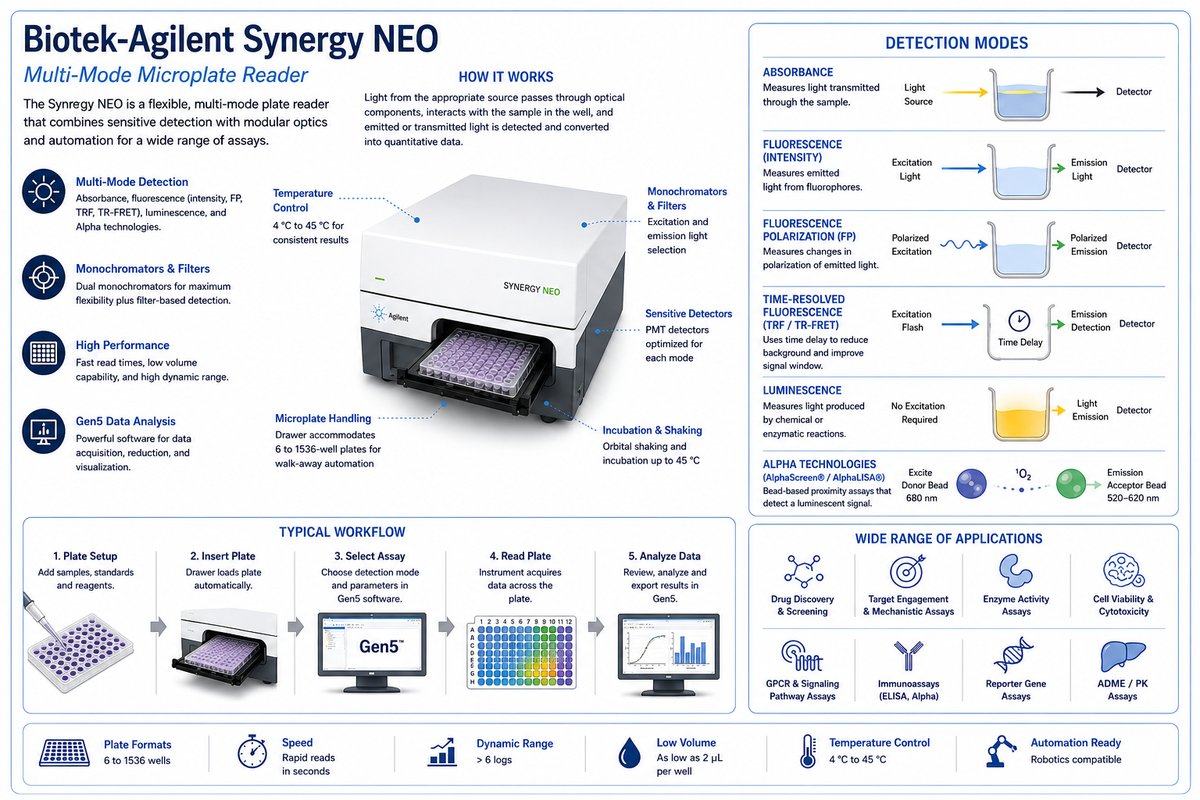
The Agilent BioTek Synergy Neo2 is a multifunctional hybrid multimode
microplate reader that serves as one of the primary assay platforms within the
Fisher Drug Discovery Resource Center. Its strength lies not in a single
measurement technology, but in its ability to support a wide range of
biochemical, biophysical, and cell-based assays within a small-volume,
microplate format suitable for everything from assay development to
high-throughput screening.
Our system is equipped with an automated plate stacker, reagent injectors,
temperature control, orbital shaking, and multiple optical detection modes,
allowing rapid, reproducible measurements across hundreds or thousands of
samples with minimal operator intervention. These capabilities make the
instrument equally valuable for routine laboratory experiments and large-scale
screening campaigns. Vendor features such as hybrid optics, dual PMTs,
variable-bandwidth monochromators, laser-based Alpha and TRF detection, reagent
injectors, temperature control, and BioStack automation further expand its
flexibility for diverse assay formats.
Scientific Questions
The Synergy Neo2 is commonly used to answer questions such as:
- Does a compound inhibit or activate an enzyme?
- Does a ligand bind to its molecular target?
- Is a signaling pathway activated?
- Does a reporter gene respond to treatment?
- How does a compound affect cell viability?
- Can an assay be miniaturized for high-throughput screening?
- Is an observed biological response reproducible across many samples?
A Flexible Detection Platform
Unlike technologies designed for a single measurement, the Synergy Neo2
supports numerous optical detection methods. The underlying physics differs
between these modes, but they all share a common goal: converting biological
events into quantitative optical signals.
| Detection Mode | Typical Applications |
|---|---|
| Absorbance | ELISA, enzyme kinetics, protein assays, microbial growth |
| Fluorescence Intensity | Reporter dyes, enzyme assays, nucleic acids, GFP |
| Fluorescence Polarization | Binding assays, competitive binding, peptide-protein interactions |
| Time-Resolved Fluorescence | Lanthanide assays with reduced background |
| TR-FRET / HTRF | Protein interactions, kinase assays, receptor assays |
| AlphaScreen / AlphaLISA | Homogeneous proximity assays for biomolecular interactions |
| Luminescence | Reporter genes, ATP assays, luciferase, cell viability |
Building Robust Assays
Although the Synergy Neo2 measures optical signals, the scientific value of
the experiment depends upon assay design rather than the detector itself.
Successful assays require appropriate controls, optimization of assay
conditions, sufficient signal-to-background ratios, and careful interpretation
of the biological question being addressed.
For this reason, the Synergy Neo2 is frequently used during assay development
before being deployed in high-throughput screening campaigns.
Typical Applications at the Fisher DDRC
- High-throughput screening
- Assay development and optimization
- Fluorescence polarization assays
- AlphaScreen® and AlphaLISA® assays
- TR-FRET and HTRF assays
- Reporter gene assays
- Enzyme activity measurements
- Cell viability assays
- Kinetic measurements using onboard reagent injectors
Typical Sample Requirements
| Parameter | Typical Range |
|---|---|
| Plate Formats | 6–1536 well microplates |
| Typical Assay Volume | 5–300 μL |
| Temperature Control | Yes |
| Reagent Injection | Available |
| Automated Plate Handling | BioStack plate stacker |
| Kinetic Measurements | Supported |
Strengths
- Supports numerous assay formats on a single platform
- Excellent for assay development and optimization
- Suitable for both routine experiments and high-throughput screening
- Small-volume microplate format conserves valuable reagents
- Automation improves reproducibility and throughput
- Temperature control and reagent injection enable kinetic assays
Limitations
- Optical measurements remain susceptible to assay artifacts.
- Compound fluorescence, quenching, precipitation, and interference must always be considered.
- The detector cannot compensate for poor assay design.
- Different assay formats require different controls and optimization strategies.
Lessons from the Bench
The instrument measures light. The experiment measures biology.
A well-designed assay produces interpretable biology. A poorly designed assay
can generate beautiful data that lead to incorrect conclusions. Instrument
performance is only one component of successful assay development.
Always inspect the raw data.
Automatic gain adjustment, normalization, or background subtraction can mask
important experimental artifacts. Whenever possible, examine the primary data
before relying on processed results.
Related Technologies
- AlphaScreen® / AlphaLISA®
- TR-FRET / HTRF
- Fluorescence Polarization
- Operetta High Content Imaging
- Prometheus Panta
- Surface Plasmon Resonance
Related Discovery Guides:
- Developing a Robust Assay
- Preparing for High-Throughput Screening
- From Screening Hit to Evidence