Licor Odyssey M
What Scientific Questions Can It Answer?
The Odyssey M is particularly useful when the scientific question requires quantitative measurement of protein abundance or changes in protein expression with high sensitivity and a broad linear dynamic range.
Typical questions include:
- How much of a particular protein is present in a sample?
- How does protein expression change following treatment or between experimental conditions?
- Can changes in protein abundance be normalized to a loading control?
- Can two proteins or biomarkers be measured simultaneously?
- Can a low-abundance protein be quantified without saturating the signal from more abundant proteins?
- Can a Western blot be archived and re-analyzed later?
When Is Infrared Detection Particularly Useful?
Infrared fluorescence is particularly valuable when quantitative Western blotting is more important than simply demonstrating the presence or absence of a protein.
Traditional chemiluminescent Western blots can require careful control of exposure time because the relationship between signal and protein abundance can become nonlinear as the detector approaches saturation. Infrared fluorescence provides a broad linear range that is well suited to quantitative measurements over a wide range of protein concentrations.
This can make the Odyssey M especially useful for comparing relative protein expression, measuring changes in signaling pathways, and quantifying biomarkers where reproducibility and normalization are important.
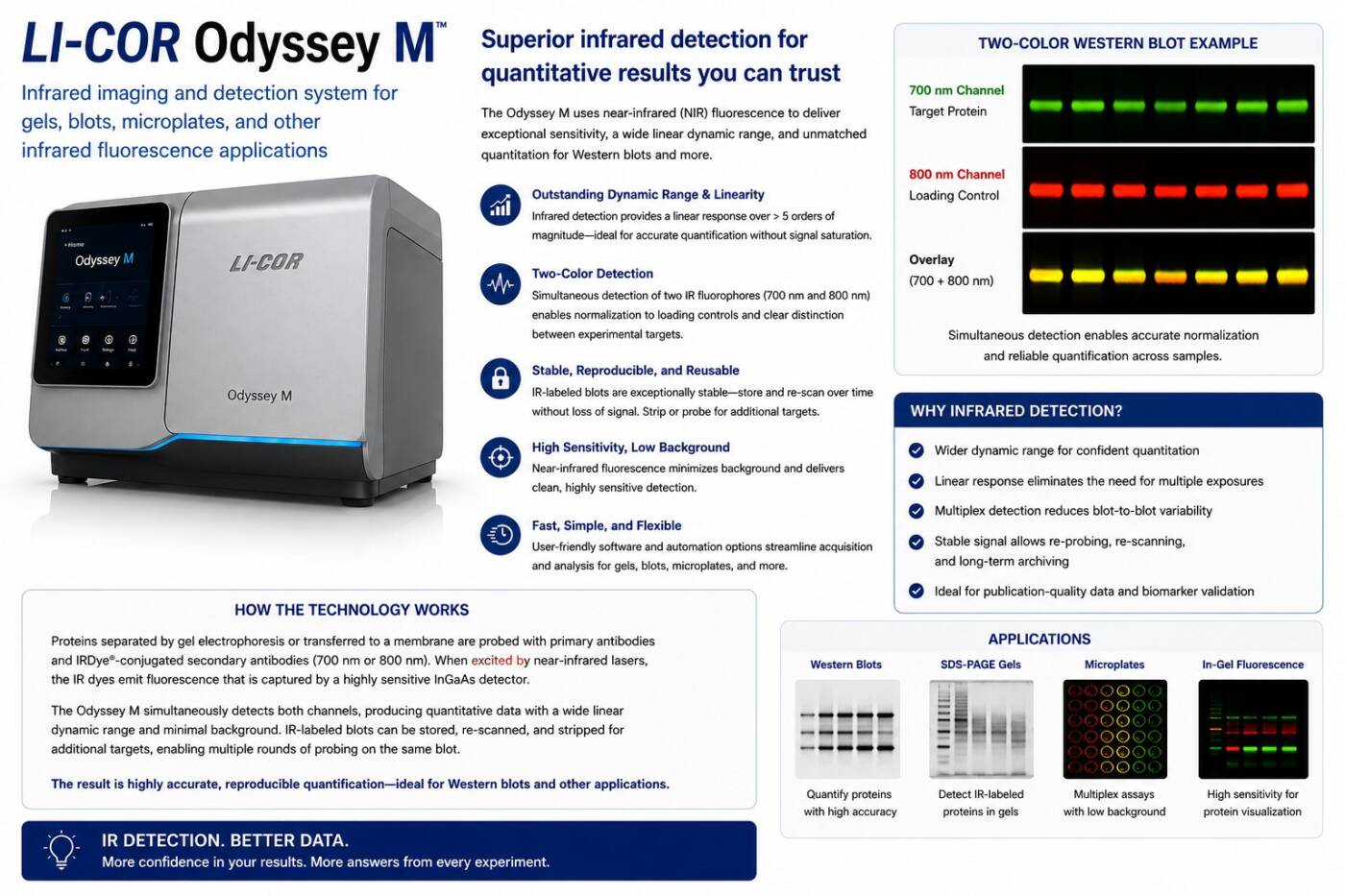
Two-Color Detection and Normalization
A major advantage of the Odyssey M is the ability to detect two infrared fluorescence channels simultaneously. Different antibodies can be labeled with fluorophores emitting at different infrared wavelengths, allowing a target protein to be measured together with a loading control or another protein of interest.
This provides an internal reference within the same sample and can improve the reliability of quantitative comparisons. Two-color detection can also be used to distinguish different proteins or biological signals within the same experiment.
For quantitative Western blotting, this is particularly useful because the experimental signal can be normalized against a control measured on the same blot rather than relying solely on comparisons between separate blots.
Stable Signals and Reusable Blots
Infrared fluorescence also changes the practical workflow of Western blotting. Unlike chemiluminescent detection, where signal is typically captured during a relatively short imaging window, infrared-labeled blots can provide a stable record of the experiment.
Blots can be stored, re-imaged, and, when appropriate, stripped and reprobed for additional targets. This makes the original experiment available for re-analysis and can reduce the need to repeat Western blots simply because an additional measurement is needed later.
For projects involving longitudinal studies, biomarker panels, or repeated analysis of valuable samples, the ability to archive and revisit a blot can be particularly useful.
When Would We Choose the Odyssey M?
We typically recommend infrared imaging when the objective is to obtain reproducible quantitative protein measurements rather than simply a qualitative Western blot result.
The combination of broad linear dynamic range, low background, two-color detection, and stable fluorescence makes the system particularly well suited to:
- Quantitative Western blot analysis
- Protein expression and signaling studies
- Biomarker quantification
- Comparison of protein abundance across experimental conditions
- Normalization to loading or reference proteins
- Multiplexed protein measurements
- Analysis of low-abundance proteins
- Long-term archiving and re-analysis of Western blots
Odyssey M as Part of a Broader Screening Strategy
The Odyssey M can also complement other DDRC technologies by providing a quantitative protein-level readout following cellular or biochemical experiments.
For example, a compound identified in a cellular screening assay may produce a change in a signaling pathway that is ultimately reflected in the abundance or phosphorylation state of a particular protein. Infrared Western blotting can provide a quantitative method for confirming and characterizing that response.
Conversely, Western blotting can be used during assay development to establish the biological response before translating the measurement into a higher-throughput format.
Related Technologies
The Odyssey M and high-content imaging with the Operetta address complementary biological questions.
The Odyssey M provides highly quantitative measurements of specific proteins using infrared-labeled antibodies, making it particularly valuable when the identity and abundance of the protein are known.
High-content imaging, in contrast, provides spatial and single-cell information. The Operetta can determine where a protein is located within a cell, whether its localization changes in response to treatment, and how cellular phenotypes vary across a population of cells.
In many projects, these approaches are complementary: the Odyssey M provides quantitative protein measurements, while high-content imaging provides spatial and cellular context.
DDRC Perspective
For us, the most important feature of the Odyssey M is not simply that it produces an infrared image. It is that infrared fluorescence provides a stable, quantitative signal with a broad linear dynamic range.
That makes Western blotting much more useful as a quantitative analytical technique. Two-color detection provides an additional level of experimental control by allowing normalization and multiplexing within the same sample.
When the scientific question is fundamentally about how much protein is present, how that amount changes, or how one protein compares with another, infrared detection can provide a particularly robust and reproducible answer.