Compound Collections & Chemical Discovery
Beyond Our Compound Library
A Flexible Approach to Chemical Discovery
The Fisher Drug Discovery Resource Center has developed and continues to maintain a carefully curated, high-quality small-molecule screening collection that has supported numerous successful drug discovery programs, publications, patents, and translational research efforts.
Today, however, the landscape of early drug discovery continues to evolve. Important starting points for therapeutic discovery increasingly arise from investigator-owned collections, commercial screening libraries, medicinal chemistry programs, DNA-encoded libraries (DELs), virtual screening, fragment libraries, natural products, and AI-assisted molecular design.
Our goal is not simply to provide access to a compound collection. We help investigators identify, validate, and understand biologically meaningful chemical matter, regardless of where candidate molecules originate. In addition to screening our in-house collection, the DDRC has conducted complete high-throughput screening campaigns using collaborator-owned libraries and provides assay development, biophysical characterization, and analytical support for compounds identified through computational and emerging discovery technologies.
The DDRC Screening Collection
The DDRC screening collection has been assembled to maximize both chemical diversity and experimental utility. Rather than simply accumulating compounds, the collection emphasizes structural diversity, favorable physicochemical properties, and broad representation of commercially available chemical space while retaining compounds suitable for experimental screening and subsequent lead discovery.
The collection currently contains 638,637 compounds, including diverse screening compounds, approved and investigational drugs, natural products, macrocycles, fragment libraries, and covalent screening compounds.
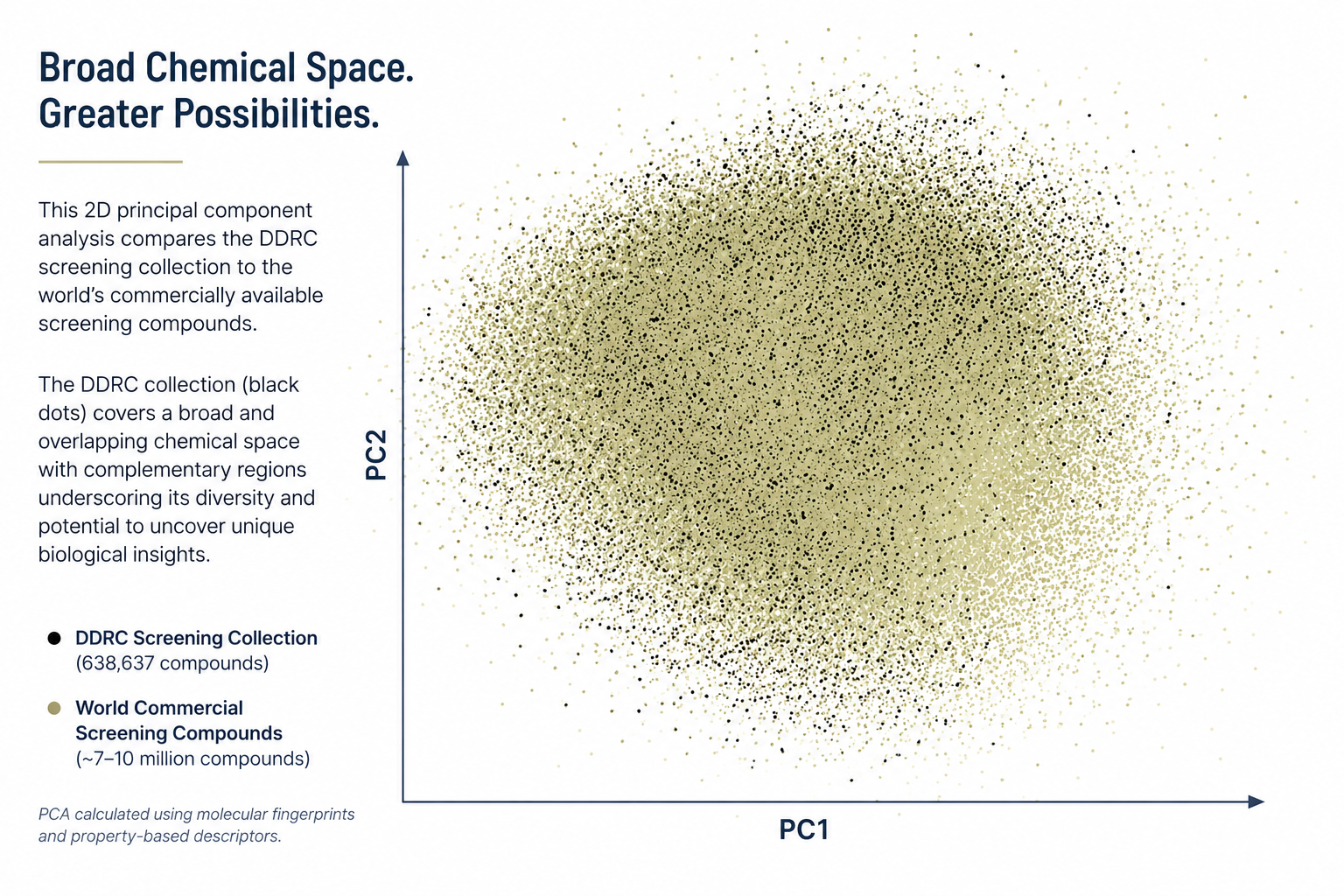
Figure 1. Principal component analysis (PCA) comparing the Fisher DDRC screening collection (black) with commercially available screening compounds (gold). The DDRC collection provides broad coverage of commercially accessible chemical space while maintaining chemical diversity suitable for screening and lead discovery.
Although the DDRC collection represents only a fraction of commercially available compounds, it samples a broad region of chemically relevant space suitable for unbiased screening campaigns. Maximizing chemical diversity increases the likelihood of identifying structurally distinct starting points for biological investigation and medicinal chemistry optimization.
Specialized Screening Collections
The collections described below represent only a portion of the chemical matter supported by the DDRC. In addition to these in-house resources, we routinely work with investigator-supplied compounds, medicinal chemistry series, commercial screening libraries, and compounds identified through computational approaches, virtual screening, or DNA-encoded libraries (DELs). The appropriate starting point depends upon the scientific question rather than the source of the compounds.
Primary Screening Collection — 638,637 compounds
The primary DDRC screening collection provides broad chemical diversity for unbiased high-throughput screening campaigns. The library has been assembled from multiple commercial sources and curated using molecular property calculations, structural diversity analysis, clustering methods, and filters for potentially undesirable structural features. The objective is to maximize coverage of biologically relevant chemical space while maintaining compounds appropriate for experimental screening and subsequent lead optimization.
Macrocycle Collection — 11,049 compounds
Macrocycles occupy chemical space intermediate between conventional small molecules and biologics. Their conformational rigidity and extended molecular surfaces make them valuable for challenging targets, including protein-protein interactions and binding sites that are often difficult to address using traditional small molecules.
Natural Product Collection — approximately 1,800 compounds
Natural products have historically provided many important therapeutic agents and continue to represent a rich source of chemically diverse bioactive molecules. The DDRC collection expands structural diversity by incorporating natural products and related compounds representing scaffolds rarely encountered in conventional synthetic libraries.
Drug Repurposing Collection — 9,747 samples representing 7,043 compounds
The repurposing collection contains approved drugs, investigational compounds, and well-characterized preclinical molecules that are valuable for drug repurposing, target validation, mechanism-of-action studies, and chemical biology. Existing pharmacological and clinical information can substantially accelerate interpretation of screening results.
- 1,294 approved drugs from North America, Europe, and Japan
- 756 investigational drugs that have entered clinical studies
- 4,937 preclinical compounds described in the scientific and patent literature
Fragment Library — 1,056 compounds
The fragment collection consists of low-molecular-weight compounds with measured solubility suitable for fragment-based drug discovery. Fragment screening is frequently combined with biophysical methods such as Surface Plasmon Resonance (SPR), Isothermal Titration Calorimetry (ITC), Microscale Thermophoresis (MST), and X-ray crystallography to identify low-affinity starting points for medicinal chemistry optimization.
Covalent Screening Collection — 4,500 compounds
The covalent screening collection contains compounds designed to explore selective covalent interactions with target proteins. Covalent screening can provide an effective strategy for discovering ligands against challenging therapeutic targets containing appropriately positioned nucleophilic residues.
Selecting Compounds for Your Project
Because the DDRC supports projects spanning many biological systems and target classes, we generally do not maintain target-specific focused libraries. Instead, investigators may screen the complete collection or select subsets based upon project scale, assay format, available resources, or scientific objectives.
Compound subsets may be assembled using structural diversity, molecular-property criteria, Quantitative Estimate of Drug-likeness (QED), physicochemical descriptors, or other cheminformatics approaches. These strategies allow efficient exploration of chemical space while minimizing unnecessary redundancy.
DDRC scientists are available to assist investigators in selecting appropriate compound collections and developing screening strategies tailored to individual projects.
Library Properties
The following summary describes molecular properties of the 638,637-compound collection as analyzed in August 2024.
| Property | Mean | StdDev | Min | Max | Median |
|---|---|---|---|---|---|
| Molecular Weight (MW) | 351.64 | 70.21 | 6.94 | 2554.07 | 346.43 |
| ALOGP | 2.40 | 1.35 | -13.29 | 18.77 | 2.41 |
| Hydrogen Bond Acceptors (HBA) | 4.17 | 1.45 | 0.00 | 51.00 | 4.00 |
| Hydrogen Bond Donors (HBD) | 1.06 | 0.86 | 0.00 | 36.00 | 1.00 |
| Polar Surface Area (PSA) | 79.56 | 28.08 | 0.00 | 999.59 | 77.05 |
| Rotatable Bonds (ROTB) | 4.61 | 1.84 | 0.00 | 43.00 | 5.00 |
| Aromatic Rings (AROM) | 2.05 | 0.95 | 0.00 | 10.00 | 2.00 |
| Weighted QED | 0.74 | 0.15 | 0.01 | 0.95 | 0.77 |
| Synthetic Accessibility / Complexity Score | 0.20 | 0.14 | 0.00 | 1.98 | 0.18 |
| Fraction sp3 (Fsp3) | 0.39 | 0.19 | 0.00 | 1.00 | 0.38 |
The DDRC screening collection includes approved drugs, investigational compounds, natural products, macrocycles, fragments, and other specialized compound classes. Consequently, a small proportion of compounds intentionally fall outside the physicochemical ranges typically associated with conventional drug-like screening molecules.
Approximately 0.66% of the collection contains structural features flagged as potentially undesirable or nuisance chemotypes. These annotations are retained to assist interpretation of screening data rather than to automatically exclude compounds from screening.
Planning a Screen
Successful screening campaigns begin with thoughtful experimental design rather than library size alone. The number and type of compounds screened should reflect the biological question, assay performance, available resources, and the overall strategy for confirming and characterizing resulting hits.
The Fisher Drug Discovery Resource Center works closely with investigators to select appropriate compound collections, optimize assay conditions, define screening strategies, and establish follow-up plans before large-scale screening begins. Pilot studies are frequently valuable for assessing assay robustness, expected hit rates, and practical considerations before committing to a full screening campaign.
Equally important is planning for what happens after active compounds are identified. Orthogonal confirmation, dose-response studies, counter-screens, biophysical characterization, and mechanistic experiments should be considered part of the overall discovery strategy rather than activities performed after screening has concluded.
From Chemical Matter to Biological Understanding
Identifying an active compound is often the beginning rather than the end of a drug discovery program. Whether candidate molecules originate from the DDRC screening collection, investigator-owned libraries, commercial collections, virtual screening, DNA-encoded libraries (DELs), AI-assisted molecular design, or other discovery approaches, meaningful progress depends upon careful experimental validation.
The Fisher Drug Discovery Resource Center supports orthogonal hit confirmation, assay development, biophysical characterization, and mechanistic studies using complementary technologies including Surface Plasmon Resonance (SPR), Isothermal Titration Calorimetry (ITC), Microscale Thermophoresis (MST), NanoTemper Prometheus Panta, fluorescence polarization, TR-FRET, AlphaScreen®, high-content imaging, reporter gene assays, and other biochemical and cell-based approaches.
By integrating high-throughput screening, assay development, quantitative biophysics, automation, and data analysis, the DDRC helps investigators transform promising chemical matter into well-characterized starting points for therapeutic discovery.