Surface Plasmon Resonance (SPR) (Cytiva Biacore 8K )
The Fisher DDRC Technology Guides are designed to help investigators understand what information a technology can provide, when it is most useful, and how it fits into the broader experimental workflow. Rather than describing an
instrument in isolation, these guides emphasize experimental design, interpretation, and practical considerations that contribute to successful research.
Overview
Surface Plasmon Resonance (SPR) is a highly sensitive optical technique used to measure molecular interactions in real time. Unlike endpoint assays, SPR
continuously monitors molecular association and dissociation, allowing investigators to determine whether two molecules interact, how rapidly they associate and dissociate, and the overall affinity of the interaction.
At the Fisher Drug Discovery Resource Center, SPR is routinely used to characterize interactions involving proteins, antibodies, peptides, nucleic
acids, membrane proteins, small molecules, and other biomolecular systems. Applications include hit validation, affinity determination, kinetic analysis, fragment screening, epitope binning, competition studies, and biologics characterization.
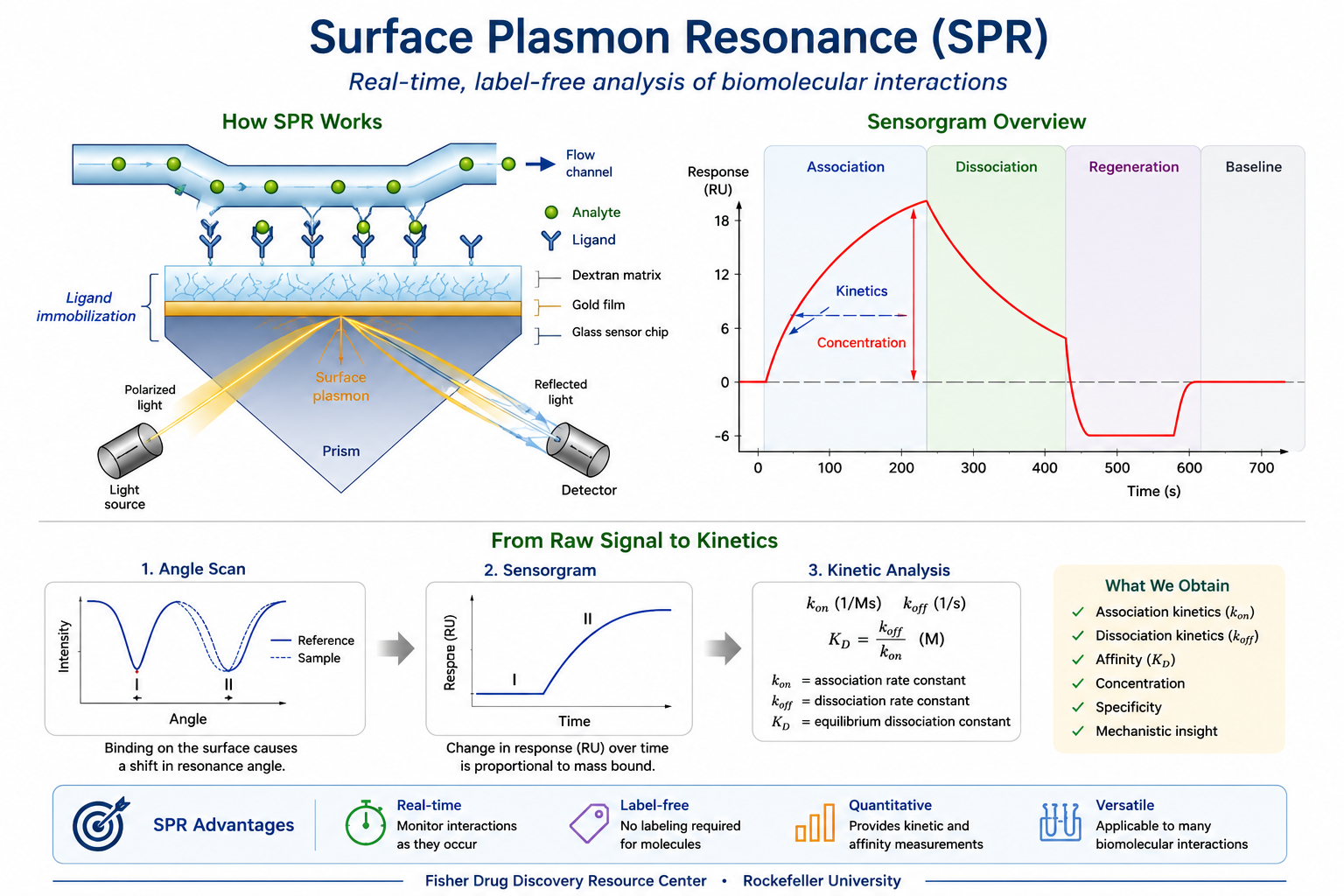
Figure 1. Principles of Surface Plasmon Resonance (SPR). Binding of analyte molecules to an immobilized ligand changes the local refractive index at the sensor surface, producing a real-time sensorgram from which association kinetics (kon), dissociation kinetics (koff), and equilibrium affinity (KD) can be determined.
Although we and others describe SPR as a label-free technique, because solution-phase fluorescent labelling is not required, successful experiments require one interaction partner to be immobilized onto the sensor surface. Selecting an appropriate immobilization strategy while preserving biological activity is one of the most important aspects of successful assay development.
At a Glance
| Parameter | Typical Starting Point |
|---|---|
| Primary Application | Quantitative characterization of molecular interactions |
| Detection Principle | Optical detection of refractive index changes |
| Detection Labels | None required |
| Surface Immobilization | Usually required for one interaction partner |
| Typical Ligand Concentration | 10–100 µg/mL (50–100 µg/mL is a common starting point) |
| Typical Ligand Volume | 50–100 µL |
| Typical Analyte Concentration | Approximately 0.1×–10× the expected KD |
| Typical Sample Types | Proteins, antibodies, peptides, nucleic acids, membrane proteins, small molecules |
Scientific Questions
- Do these molecules interact?
- What is the equilibrium binding affinity (KD)?
- How rapidly do they associate (ka)?
- How rapidly do they dissociate (kd)?
- Does a mutation alter binding?
- Does a cofactor influence the interaction?
- Do two ligands compete for the same binding site?
- How do related compounds compare?
Physical Principle
SPR measures changes in refractive index immediately adjacent to a thin gold sensor surface. When molecules bind to an immobilized ligand, the local refractive index changes, producing a measurable optical signal expressed as
Response Units (RU).
Importantly, SPR does not measure molecular binding directly. Instead, it measures an optical phenomenon that reflects changes occurring at the sensor surface. Binding affinity and kinetic parameters are inferred by fitting appropriate mathematical models to the observed sensorgrams.
Immobilization Strategy
One interaction partner is typically immobilized on the sensor surface before
binding measurements begin.
Common immobilization strategies include:
- Amine coupling (EDC/NHS)
- Streptavidin-biotin capture
- His-tag capture
- Protein A/G capture
- Thiol coupling
- Capture antibodies
- Specialized affinity sensor surfaces
The immobilization strategy influences ligand orientation, accessibility,
biological activity, regeneration, nonspecific binding, and overall assay
performance.
DDRC Perspective
SPR is often described as a label-free technology, but in practice the immobilization strategy is one of the most important experimental variables. Successful assay development frequently depends more upon selecting an appropriate surface chemistry than on instrument settings.
Experimental Workflow
- Evaluate sample quality and stability (Panta, CD, SEC, etc.).
- Select an immobilization strategy.
- Optimize ligand coupling conditions.
- Establish appropriate reference surfaces.
- Optimize analyte concentrations.
- Acquire binding data.
- Inspect raw sensorgrams.
- Fit appropriate kinetic models.
- Interpret the biology—not just the numbers.
Typical Sample Requirements
| Parameter | Typical Starting Point |
|---|---|
| Ligand Purity | High; homogeneous and biologically active |
| Ligand Working Concentration | Typically 10–100 µg/mL (50–100 µg/mL is a common starting point) |
| Typical Ligand Volume | 50–100 µL |
| Target Immobilization Level | Application dependent (typically tens to several thousand RU) |
| Analyte Concentration | Serial dilution centered around the expected KD (approximately 0.1×–10× KD) |
| Running Buffer | Carefully matched between ligand and analyte |
| Regeneration | Frequently required between binding cycles |
These values are intended as practical starting points. Actual conditions
depend upon the molecular system, immobilization strategy, desired response
level, and experimental objectives.
Typical Applications
- Hit validation
- Fragment screening
- Affinity determination
- Kinetic characterization
- Antibody characterization
- Epitope binning
- Competition assays
- Protein-protein interactions
- Protein-peptide interactions
- Protein-nucleic acid interactions
- Membrane protein characterization
Strengths
- Real-time interaction measurements
- Quantitative kinetic analysis
- No fluorescent or radioactive detection labels required
- Broad applicability across many biomolecular systems
- High sensitivity
- Low sample consumption
- Multiple experimental formats
Experimental Considerations
- Sample purity and homogeneity
- Immobilization chemistry
- Buffer matching
- Reference subtraction
- Surface regeneration
- Mass transport limitations
- Nonspecific binding
The Biacore faithfully reports changes occurring at the sensor surface. It is
the investigator’s responsibility to determine whether those changes represent
biologically meaningful interactions.
Lessons from the Bench
Always inspect the raw sensorgrams.
Curve fitting can produce convincing kinetic constants from experiments that
contain significant artifacts. Always examine the raw binding curves before
interpreting fitted parameters.
Water quality matters.
During sensitive small-molecule experiments, we observed elevated baseline
noise that was ultimately traced to contaminants introduced from inadequately
cleaned water reservoirs. Acid washing glass reservoirs and using high-purity
water significantly improved baseline stability.
Respect the biology.
Natural cofactors, reducing agents, membrane environments, and protein
oligomeric state frequently influence binding behavior. Whenever possible,
preserve the biological context of the interaction.
What SPR Does Not Tell You
- Whether binding is biologically relevant
- Cellular activity
- Mechanism of action
- Three-dimensional structural information
- Functional consequences of binding
SPR is most powerful when interpreted alongside complementary biochemical,
biophysical, structural, and functional experiments.
Related Technologies
- NanoTemper Prometheus Panta
- Circular Dichroism
- Microscale Thermophoresis
- Isothermal Titration Calorimetry
- Agilent BioTek Synergy Neo2
Related Discovery Guides
- Preparing for Biophysical Characterization
- Choosing the Right Experimental Approach
- From Screening Hit to Evidence