Agilent Seahorse Cellular Metabolic Analyzer
Real-time analysis of cellular energy metabolism
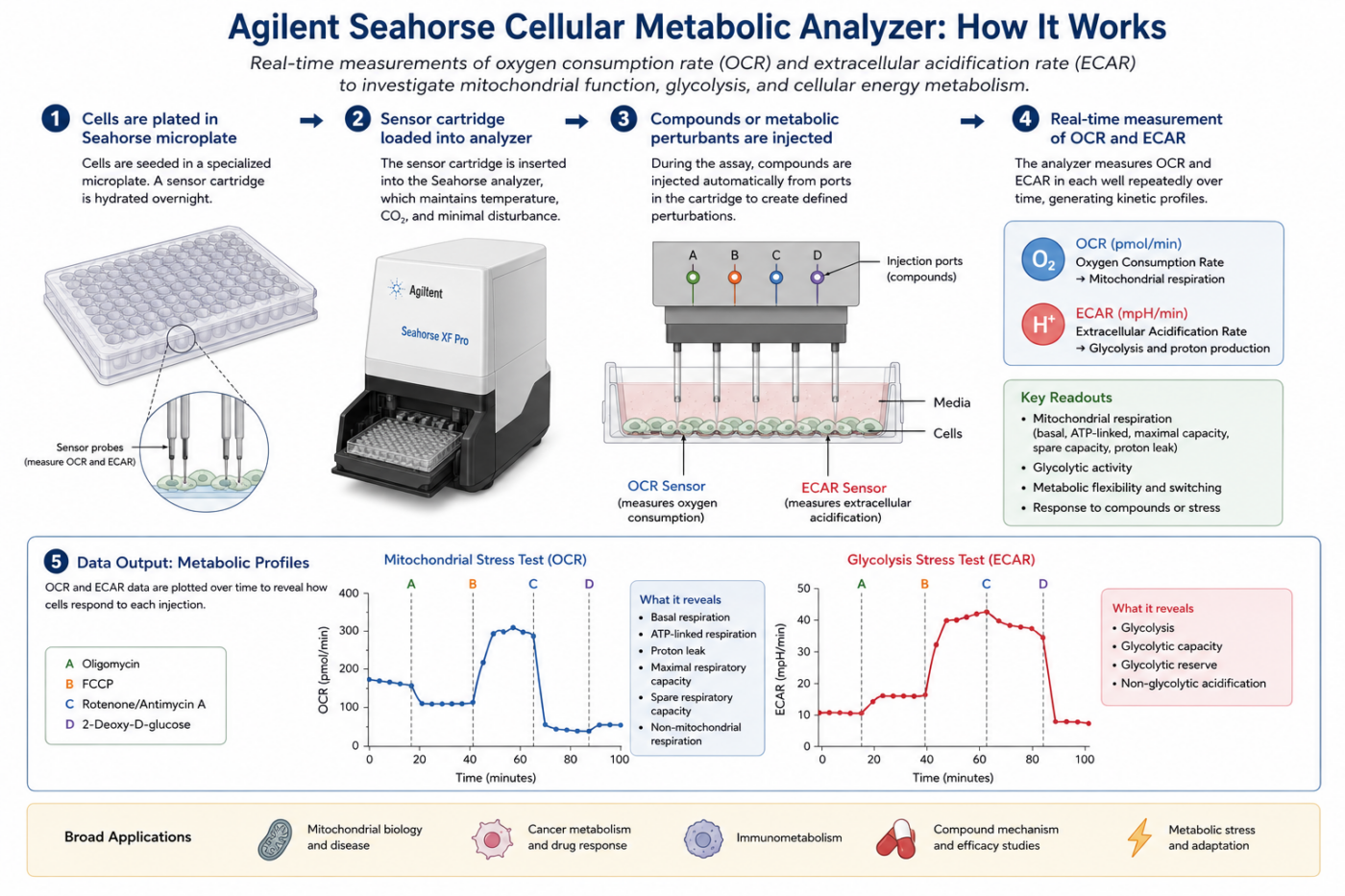
The Agilent Seahorse Cellular Metabolic Analyzer measures cellular metabolism in real time by monitoring oxygen consumption rate (OCR) and extracellular acidification rate (ECAR). These measurements provide complementary information about mitochondrial respiration, glycolysis, and how cells produce and use energy.
At the DDRC, Seahorse analysis can be used to investigate how compounds, genetic perturbations, or other experimental conditions alter mitochondrial function and cellular energy metabolism.
What scientific questions can it answer?
Seahorse analysis is useful when the goal is to understand how cells generate energy and how that metabolism changes in response to a perturbation.
Typical applications include:
- Measuring mitochondrial respiration
- Measuring glycolytic activity
- Characterizing cellular energy metabolism
- Assessing mitochondrial dysfunction or stress
- Determining how compounds affect cellular respiration or glycolysis
- Comparing metabolic phenotypes between cell types or experimental conditions
- Investigating cellular responses to metabolic stress
- Characterizing changes in energy production associated with disease, signaling, or drug treatment
Because measurements are collected kinetically, the system can reveal how cellular metabolism changes over time, rather than providing only an endpoint measurement.
How does it work?
Cells are cultured in a specialized microplate containing sensor probes positioned above the cells. The analyzer measures two key parameters:
Oxygen Consumption Rate (OCR) — provides a measure of cellular oxygen consumption and is commonly used as a readout of mitochondrial respiration.
Extracellular Acidification Rate (ECAR) — measures changes in the acidity of the extracellular environment and provides information about glycolytic activity and cellular proton production.
Compounds or metabolic perturbants can be introduced during the experiment, allowing the cellular response to be measured before and after treatment. The resulting kinetic profiles can be used to determine how different components of cellular energy metabolism are affected.
Mitochondrial function
A major application of Seahorse analysis is characterization of mitochondrial respiratory function.
By measuring changes in oxygen consumption following sequential metabolic perturbations, researchers can distinguish components of cellular respiration and assess properties such as:
- Basal respiration
- ATP-linked respiration
- Proton leak
- Maximal respiratory capacity
- Spare respiratory capacity
- Non-mitochondrial oxygen consumption
This provides a functional view of mitochondrial performance that complements measurements of mitochondrial abundance, protein expression, or individual enzyme activities.
Glycolysis and metabolic flexibility
Cells can shift between different sources of energy depending on their environment and energetic requirements. Simultaneous analysis of oxygen consumption and extracellular acidification provides a way to investigate these changes.
For example, cells can be characterized according to their relative reliance on mitochondrial oxidative phosphorylation versus glycolysis, and researchers can determine whether a treatment alters the ability of cells to adapt their energy metabolism.
This can be particularly informative in studies of cancer biology, immunology, metabolic disease, mitochondrial biology, and drug-induced cellular stress.
When is it useful?
Seahorse analysis is especially useful when a conventional viability or endpoint assay raises a question about why cells are responding to a treatment.
A compound that reduces cell growth, for example, may affect mitochondrial respiration, glycolysis, ATP production, or the ability of cells to compensate metabolically. Seahorse measurements can help distinguish these possibilities by providing a functional metabolic phenotype.
The technology is therefore well suited to mechanistic studies, compound profiling, assay development, and follow-up characterization of cellular responses.
From molecular activity to cellular phenotype
Metabolic measurements provide a different level of information from biochemical and biophysical assays. A compound may interact with a molecular target, but the ultimate biological consequence may involve changes in cellular energy production, mitochondrial function, or metabolic adaptation.
Seahorse analysis can therefore complement other DDRC capabilities by helping connect molecular perturbation → cellular pathway response → functional metabolic phenotype.
Related technologies
Seahorse analysis can be combined with other DDRC technologies to build a more complete picture of cellular response.
High-content imaging — provides information about cell morphology, number, localization, and other phenotypic changes that can accompany metabolic alterations.
Calcium and ion-flux assays — measure rapid functional cellular responses that may occur upstream of changes in cellular metabolism.
Biochemical assays — can identify changes in the activity of individual metabolic enzymes or signaling pathways.
Cell viability and cytotoxicity assays — help distinguish metabolic changes associated with cellular adaptation from effects caused by loss of cell viability.
Together, these approaches can help determine not only whether a compound affects cells, but how and why cellular function changes.