Bio-Rad CFX Real-Time PCR System
Protein thermal stability and quantitative PCR platform for investigating small-molecule binding, protein stability, and nucleic-acid amplification.
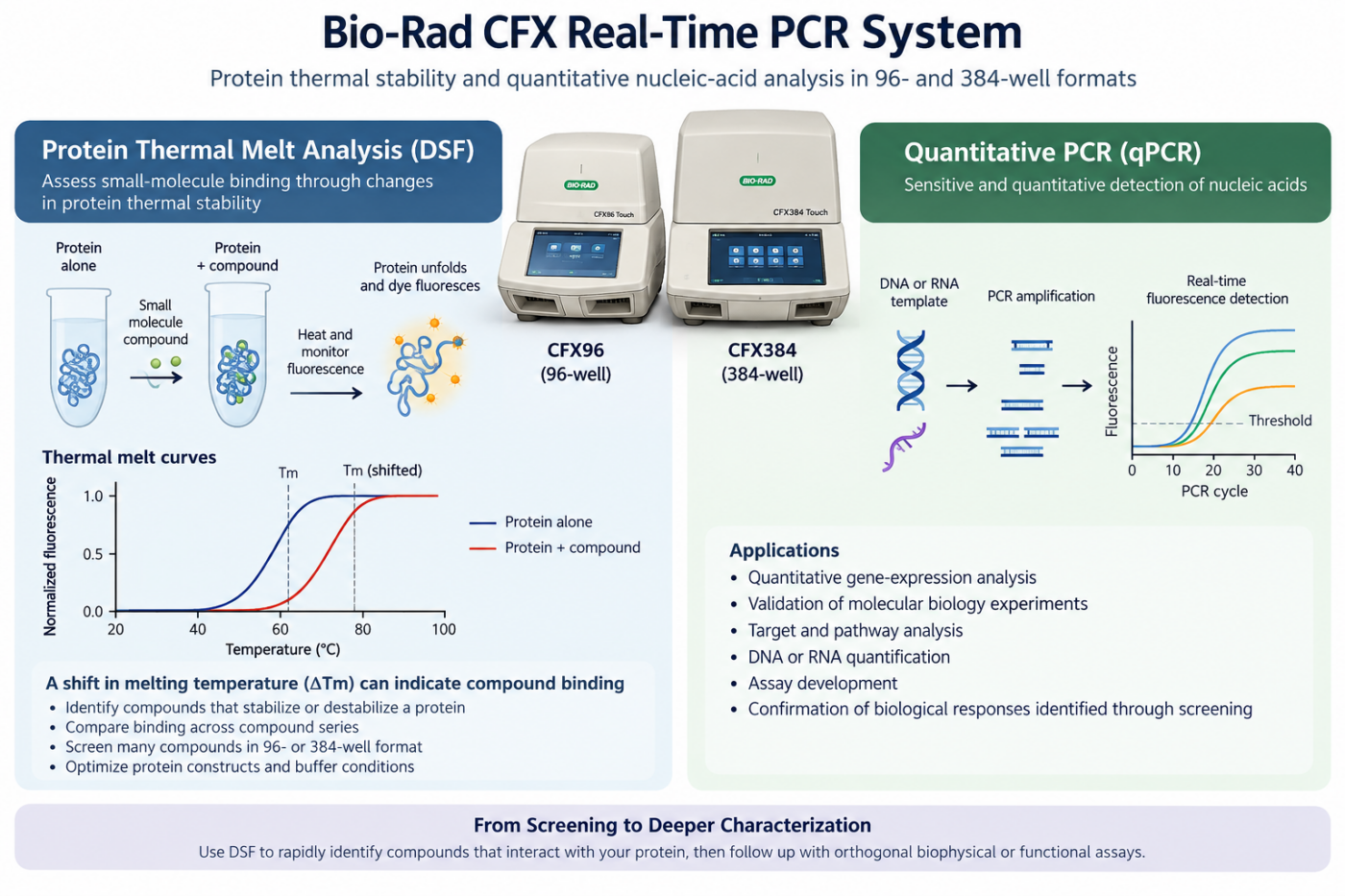
The Bio-Rad CFX platform provides high-throughput differential scanning fluorimetry (DSF), also known as thermal shift analysis (TSA), for assessing changes in protein thermal stability in the presence of small molecules, cofactors, ions, or other experimental conditions.
The DDRC operates both 96-well and 384-well CFX systems, allowing thermal stability experiments to be performed at a range of throughputs. The technology is particularly useful during early-stage drug discovery for rapidly screening compounds for potential interactions with purified proteins.
Scientific Question
Does a small molecule interact with my protein?
When a ligand binds to a protein, it can alter the protein’s thermal stability. In a DSF experiment, the protein is gradually heated while fluorescence is monitored. The temperature at which the protein unfolds—the melting temperature (Tm)—can be determined.
A shift in Tm in the presence of a compound can provide evidence that the compound interacts with or stabilizes the protein.
DSF therefore provides a relatively rapid and economical way to evaluate potential protein–small-molecule interactions without requiring a direct binding assay for every compound.
When Is It Useful?
CFX-based DSF is particularly useful for:
- Screening compounds for potential protein binding
- Identifying compounds that stabilize or destabilize a protein
- Comparing binding across compound series
- Evaluating protein constructs and formulations
- Optimizing protein conditions for downstream biophysical studies
- Investigating the effects of cofactors, substrates, ions, and other ligands
- Prioritizing compounds for more detailed binding characterization
- Supporting fragment screening and hit validation
Because DSF can evaluate many conditions simultaneously, it is especially useful for rapidly exploring a large experimental space before committing to more resource-intensive biophysical or structural studies.
How It Works
Purified protein is combined with a fluorescent dye that responds to changes in the protein’s environment during thermal unfolding. The samples are heated progressively while fluorescence is measured throughout the temperature ramp.
As the protein unfolds, hydrophobic regions become exposed and interact with the fluorescent dye, producing a characteristic change in fluorescence.
The resulting thermal unfolding curve can be used to determine the protein’s melting temperature (Tm). Comparing Tm values in the absence and presence of a compound provides a measure of the thermal shift (ΔTm).
A positive thermal shift can indicate protein stabilization associated with ligand binding, although a thermal shift is not by itself definitive proof of direct binding. Compounds producing promising shifts can therefore be advanced to orthogonal biophysical techniques such as SPR, MST, or ITC.
What Can the CFX Tell You?
A DSF experiment can provide:
- Protein melting temperature (Tm)
- Thermal shift (ΔTm) relative to a control
- Thermal unfolding profiles
- Comparison of protein stability under different conditions
- Concentration-dependent thermal shifts
- Identification of compounds or conditions that alter protein stability
The 384-well format provides particularly high experimental throughput, making it possible to examine many compounds, concentrations, buffer conditions, or protein variants in a single experiment.
Drug Discovery Applications
DSF is often most valuable as an early-stage triage and decision-making tool.
For example:
Compound → DSF → Orthogonal Binding Assay → Functional Assay
A compound library or focused series can first be evaluated for thermal stabilization of a purified target protein. Compounds producing reproducible thermal shifts can then be prioritized for direct binding measurements using technologies such as SPR, MST, or ITC, followed by functional or cellular assays.
This approach can reduce the number of compounds requiring more expensive and time-intensive characterization.
Auxiliary Application: Quantitative PCR
Although the CFX systems at the DDRC are primarily used for protein thermal stability studies, the instruments also support quantitative real-time PCR (qPCR).
qPCR monitors fluorescence during successive cycles of nucleic-acid amplification, allowing the amount of a specific DNA or RNA-derived target to be quantified.
At the DDRC, this capability can support applications such as:
- Quantitative gene-expression analysis
- Validation of molecular biology experiments
- Target and pathway analysis
- DNA or RNA quantification
- Assay development
- Confirmation of biological responses identified through screening
Related Technologies
Surface Plasmon Resonance (SPR)
Provides direct kinetic and affinity measurements of molecular interactions and is a natural follow-up to promising DSF results.
Microscale Thermophoresis (MST)
Measures binding interactions in solution and can complement DSF when compounds produce a thermal shift that requires confirmation.
Isothermal Titration Calorimetry (ITC)
Provides detailed thermodynamic characterization of protein–ligand interactions, including affinity, stoichiometry, enthalpy, and entropy.
Protein Thermal Stability Analysis
DSF can also be used independently of compound screening to optimize protein constructs, buffers, cofactors, and other conditions for downstream structural and biophysical studies.
Why Use the DDRC?
The CFX systems provide a high-throughput entry point into biophysical characterization. Rather than immediately applying lower-throughput binding technologies to every compound, researchers can use DSF to rapidly identify compounds and experimental conditions worthy of deeper investigation.
The DDRC can help design the thermal-shift experiment, establish appropriate controls, analyze thermal unfolding data, and determine the most appropriate orthogonal assay for subsequent confirmation.