Hamamatsu FDSS uCell
Kinetic microplate reader for real-time cellular measurements
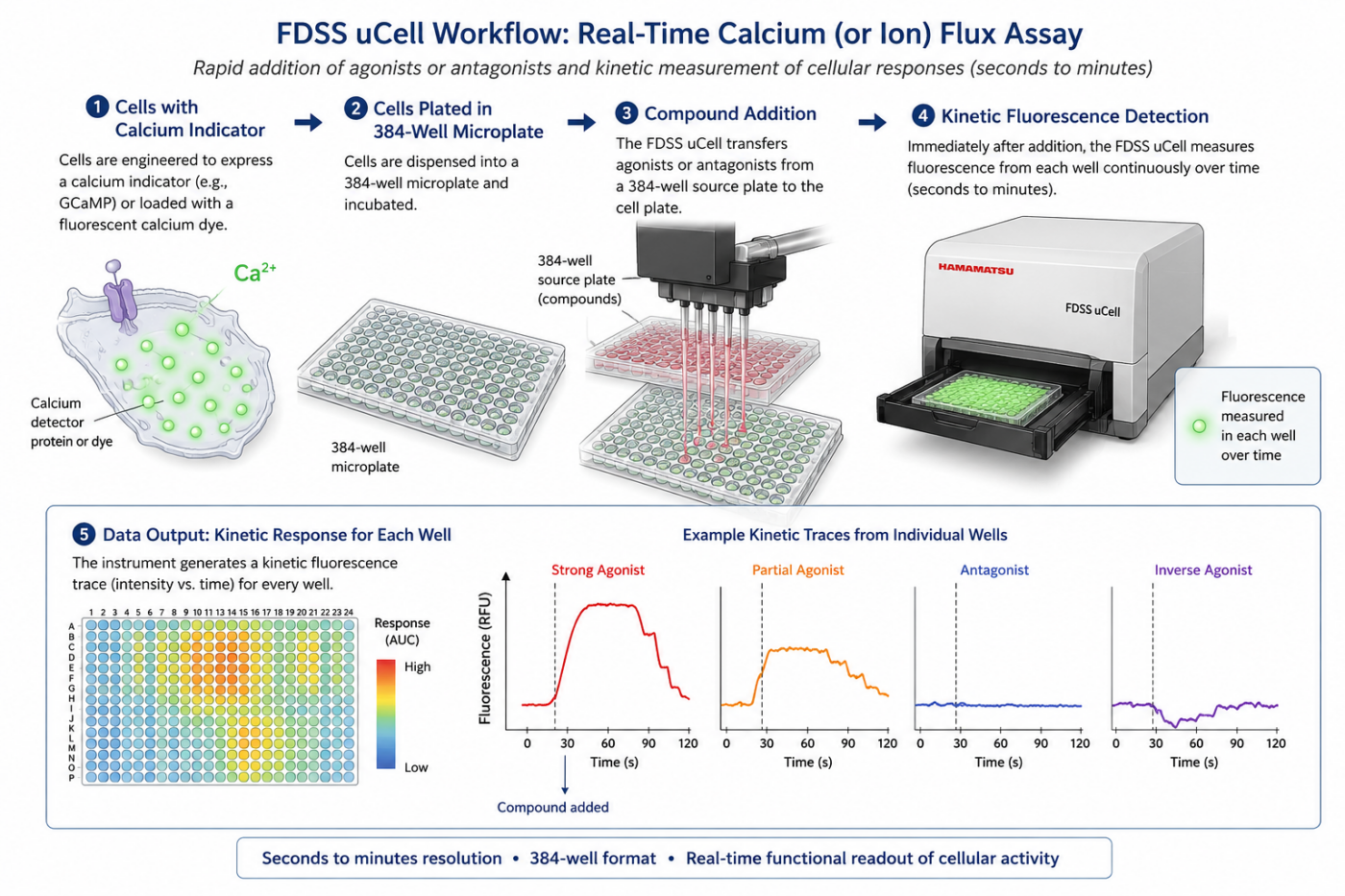
The Hamamatsu FDSS uCell is a kinetic microplate detection system designed to measure rapid changes in cellular fluorescence following the addition of compounds, ligands, agonists, antagonists, or other reagents. At the DDRC, we primarily use the FDSS uCell for calcium-flux and ion-flux assays, providing a rapid functional readout of receptor, ion-channel, and cellular signaling activity.
What scientific questions can it answer?
The FDSS uCell is useful when the important question is how a cell responds to a compound or stimulus in real time. It is particularly well suited to assays in which the response develops over seconds to minutes.
Typical applications include:
- Calcium-flux assays to measure receptor activation and intracellular signaling
- Ion-flux assays for functional characterization of ion channels and transporters
- GPCR functional assays, including agonist and antagonist profiling
- Ion-channel screening and compound characterization
- Measurement of rapid cellular responses following compound or reagent addition
- Concentration-response and pharmacological profiling
Because measurements are collected continuously, the FDSS uCell can capture transient cellular responses that may be missed by endpoint assays.
How does it work?
Cells are loaded with an appropriate fluorescent indicator and distributed into microplates. The FDSS uCell rapidly measures fluorescence while compounds or other reagents are added, allowing changes in the cellular signal to be followed in real time over seconds to minutes.
For example, in a calcium-flux assay, a fluorescent calcium indicator reports changes in intracellular calcium following receptor activation. Addition of an agonist can produce a rapid increase in fluorescence, followed by recovery toward baseline. The resulting kinetic trace can be analyzed for peak response, response amplitude, response kinetics, and concentration-response relationships.
When is it useful?
The FDSS uCell is particularly valuable when the timing of the cellular response matters. Rather than measuring a single endpoint, the instrument records the response as it happens, making it possible to characterize rapid activation, transient responses, sustained responses, and recovery.
This makes it especially useful for functional pharmacology and compound profiling, where the goal is to determine whether a compound changes the activity of a receptor, ion channel, or signaling pathway in living cells.
The system can support screening across microplates, making it useful for evaluating relatively large numbers of compounds. However, plates are manually loaded, which limits practical throughput compared with fully automated high-throughput screening platforms. The FDSS uCell is therefore particularly well suited to focused screening, assay development, concentration-response studies, and follow-up characterization.
From target activity to cellular function
Functional cellular assays provide an important complement to biochemical and biophysical measurements. A compound may bind to a target or inhibit an isolated enzyme without producing the desired effect in a living cell. Calcium- and ion-flux assays provide an opportunity to ask the next question:
Does the compound actually change cellular function?
The FDSS uCell can therefore be used as part of a progression from molecular interaction → biochemical activity → cellular function, helping determine whether activity observed in simpler assay systems translates into a measurable response in cells.
Related technologies
The FDSS uCell can complement other DDRC technologies, including:
High-content imaging — for cellular assays where morphology, localization, or spatial information is important.
SPR, MST, and ITC — for measuring and characterizing direct molecular interactions and binding.
Biochemical fluorescence and luminescence assays — for measuring target activity in purified or cell-free systems.
Together, these approaches provide complementary information about target engagement, biochemical activity, and functional cellular responses.