Why studying how the immune system evolves could teach us much about evolution itself
 COPY LINK
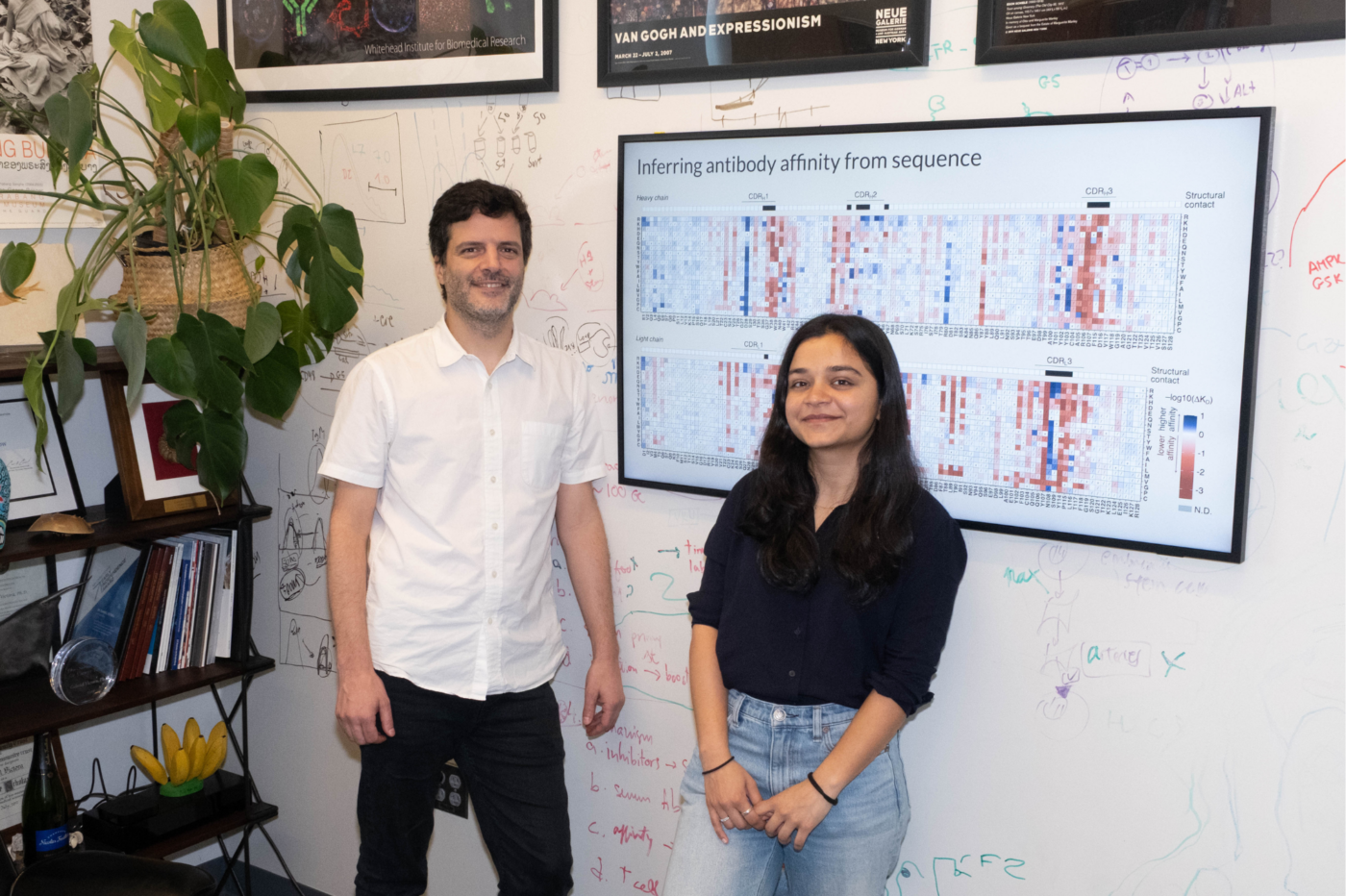
Gabriel D. Victora and Ashni Vora are turning germinal centers into a living laboratory for investigating one of biology’s oldest questions: how much of evolution is shaped by chance? (Credit: Lori Chertoff)
If the history of life on Earth could be rewound, would evolution arrive at the same outcomes again? While that question strikes at the heart of evolutionary biology, good models and assays for testing it experimentally are few and far between—and that reality has relegated evolutionary biology to something of a retrospective science. Without the ability to rerun millions of years of prehistory under controlled conditions, researchers study the organisms and fossils that survived in hopes of determining how much evolution boils down to inevitability versus pure chance in the end.
Gabriel D. Victora, the Laurie and Peter Grauer Professor at Rockefeller, suspects that the immune system can provide a solution. His Laboratory of Lymphocyte Dynamics focuses on how B cells mutate and compete inside lymph nodes during infection or vaccination, producing progressively stronger antibodies within molecular bootcamps known as germinal centers. These B cells face a tightly constrained evolutionary challenge that plays out over days rather than millennia and, because many germinal centers operate simultaneously, the same evolutionary process is replayed again and again. A recent study from Victora’s lab, published in Cell, brought us one step closer to turning germinal centers into an experimentally tractable system for studying evolution in real time, capable of answering the most fundamental questions of evolution—including how much of evolution is predictable, and how much is the product of chance.
We spoke with Victora and Ashni Vora, a graduate fellow in the lab, about how the immune system may offer an unprecedented window into the evolutionary process.
What inspired you to explore germinal centers as models for evolution?
Gabriel Victora: One of my key influences was Stephen Jay Gould’s book “Wonderful Life”, where he imagines this thought experiment: rewind history on Earth back 100 million years and let it play out again. What would you get? Would you get people? Would you get mostly creatures with four legs? What parts of evolution are predictable, and what parts are just due to dumb luck? With germinal centers we can get practical, real-life observations of phenomena that evolutionary biologists had only speculated about.
Scientists have tried to study evolution experimentally for decades, often using bacteria. What makes the immune system uniquely suited for replaying evolution?
GV: There is a famous experiment done by Richard Lenski, an evolutionary biologist at Michigan State University, who took a bunch of E. coli cultures, split the same culture into several parts, and begin observing how the genomes of these cultures change, and what evolutionary strategies the E. coli are adopting to survive.
But Lenski’s E. coli could become overrepresented in their test tubes by doing all manner of things, because bacterial evolution centers around maximizing survival and growth, regardless of strategy. For example, one lineage of E. coli found out how to survive on the waste products that the others secreted; another learned how to live on citrate or some other component of the media that was not consumed by the competitors in the same tube. While that is fascinating, it also means that any sort of phenotype could emerge, making the system difficult to constrain experimentally.
With B cells, it’s much easier to design an experiment because we know what phenotype they are aiming for; we know what they want to do and we know which genes they have to mutate to get there. B cells evolve their immunoglobulin genes to increase their affinity, and all evolutionary pressures converge on a single question: how much antigen can you bind?
Ashni Vora: B cells are also easier to work with because they evolve faster. We know that evolution generally takes eons. Millions of years is what you think of when you think of Darwinian evolution. But germinal centers are very quick, evolving over weeks. And in immunized mice, like the ones we study, this happens many times per mouse—each mouse is going to have 20 or so germinal centers—so you can do many replicates.
It’s as if the immune system seems to have built a miniature evolutionary engine inside our lymph nodes.
GV: It had to. Viruses and bacteria evolve so fast. How does our immune system cope with these different evolutionary timescales? We are so slow and the bugs are quick—recall Covid, which we all watched evolving in real time. The immune system has essentially said to pathogens, okay, we can beat you by evolving even faster inside the B cell system.
What is the ultimate promise of using the immune system as a model for studying evolution?
AV: It allows us to make observations of phenomena that evolutionary biologists had speculated about for a long time, but could never really test experimentally. And while we do see the same mutations pop up many times, the evolutionary trees still look completely different in every germinal center. So there are aspects of the process that are repeatable, and aspects that are different every time you run it. That makes it a very hands-on experience with evolution.
GV: Investigating how germinal centers operate is the core work of our lab. But we had always taken a mechanistic view of them as selection machines or cell sorters that find the best cells and keep them alive. As we formed a better understanding of how the pieces of the germinal center fit together, we found that it behaves much more like evolution than a machine. That has led us to these more naturalistic questions: what does the germinal center do when you simply watch it do its job? How do B cells compete in those settings? Those are the kinds of questions that laid the groundwork for asking much larger ones in the future. Now we can begin asking how reproducible antibody responses really are and, by extension, how reproducible evolution itself may be.