Campus book club examines the intersection of science and imagination
 COPY LINK
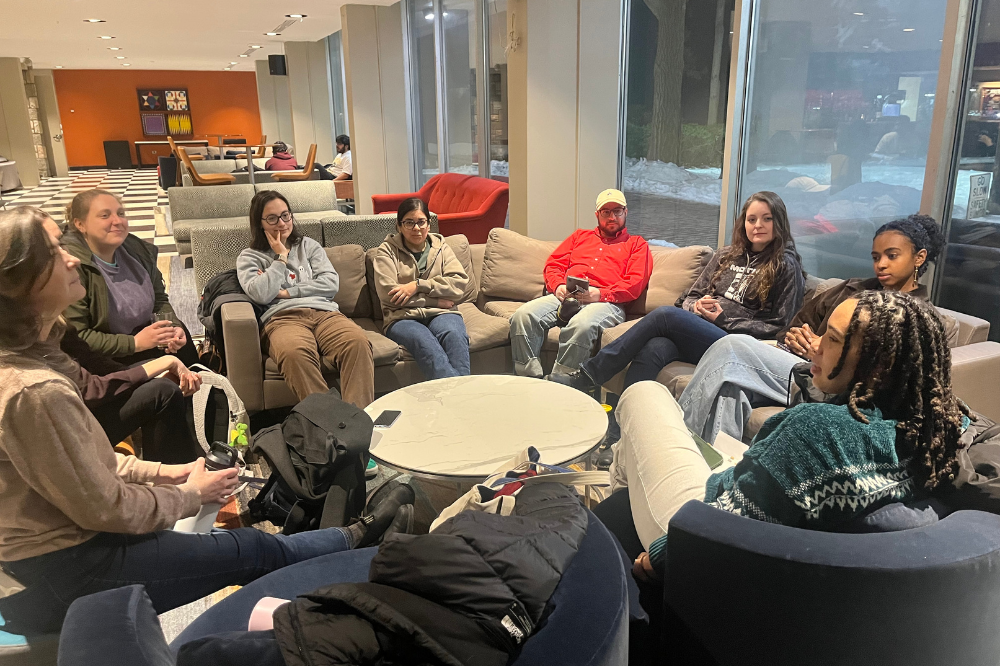
From left to right: Jeanne Garbarino, Anne van Vlimmeren, Jen Bohn, Adela Dujsikova, Raffia Ahmed, Parviz Daniel Hejazi Pastor, Kelly Eckartt, Sara Omer, and Sasha Mills (Credit: Jessi Hersh)
Rockefeller is a place of facts, but it’s also a place of imagination: Every hypothesis, for example, is essentially informed speculation about what might lie on the other end of an experiment. It’s also a place where researchers develop advanced technologies with an eye on the far horizon of future science.
It makes sense then that Rockefeller has a Sci-Fi Book Club, which meets the first Monday of the month in the Faculty and Student Club, to have an in-depth conversation about titles they’ve collectively chosen. Each month features a new book, and new members are welcome to join at any time.
“It’s a nice mix of people, and I think most of us wouldn’t have met otherwise, because it’s easy to get caught up in the circle of people you work with every day,” says club founder Jessi Hersh, program manager of student engagement at RockEDU. “Our discussions are full of thoughtful reflections, and people are really engaged and respectful of each other’s perspectives.”
Hersh was inspired to launch the club in 2024 after going to one of the Office for University Life and Community Engagement’s Coffee Chats and bonding with other attendees over The Three-Body Problem, the first book of a trilogy by author Liu Cixin. She placed an ad in Rockefeller’s Classifieds, and the club was born.
Since then, the club, which generally has 6–12 people in attendance, has completed the entire trilogy, which also includes The Dark Forest and Death’s End. Other recent reads include Yoko Agawa’s The Memory Police and Station 11, by Emily St. John Mandel, who wrote the blockbuster while working in Sohail Tavazoie’s lab as an administrative assistant.
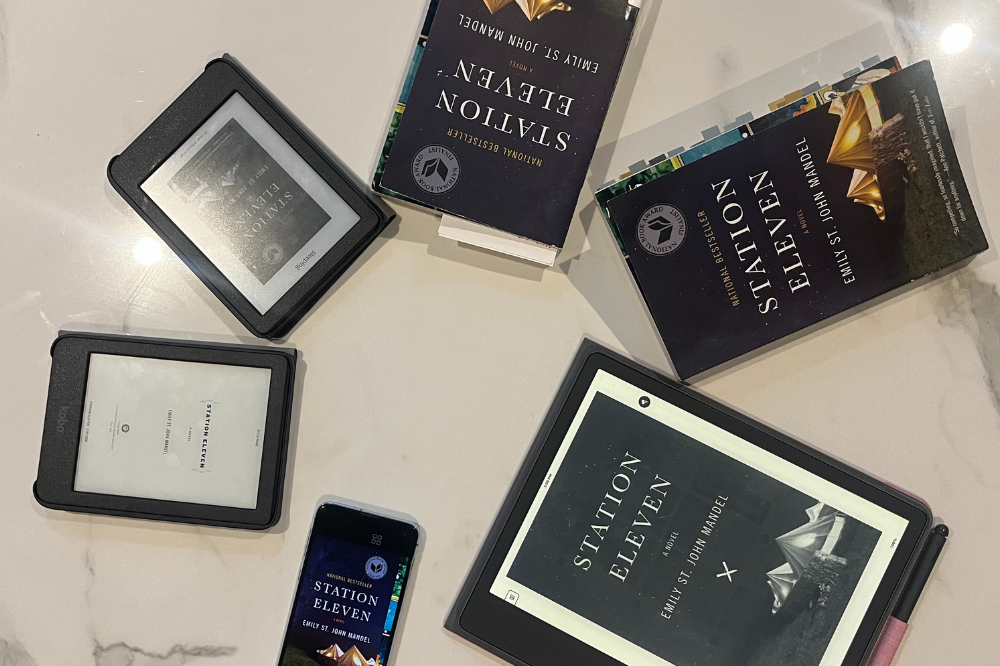
Station 11 was written by Emily St. John Mandel while she was working in Sohail Tavazoie’s lab as an administrative assistant. (Credit: Jessi Hersh)
Not surprisingly, the club members are avid readers. Hersh, who ranks Martha Wells, Terry Pratchett, and Octavia Butler among her top authors, tears through one or two titles a week, while Sasha Mills, a research assistant in Li Zhao’s lab, reviews books on TikTok. And with virtually all the members having a science background, the conversations have a level of insider knowledge that lay book clubs may not have.
“I think we can really easily tell when an author is an actual scientist,” says Mills, who counts N.K. Jemisin as one of her favorite writers. “And if the author isn’t a scientist, it’s also very clear to us whether or not they’ve actually done their research or just googled something.”
The club offers an opportunity to look at broader issues of science and society through the lens of literature. “The Three-Body Problem was physics-heavy at first, but then it veered towards the role of science in the world, such as the disconnection between policymakers and scientists, and the public trust—and distrust—in science,” says Yixuan Zhao, a Ph.D. student in Michael Young’s lab. “As people involved in science, we had a lot of opinions on all of it.”
And the post-pandemic world of Station 11 also made for ripe conversation in the biomed-savvy group. “Since it’s a dystopian novel, it sparked a lot of philosophical and societal discussions about pandemics, technology, end-of-the-world societal confusions, what it means to find purpose or meaning in life, and how people grow and change over time,” says Hersh. “There was a really cool spread of interpretations and points of focus.”
To determine the next read, Hersh creates an online form where club members suggest and vote on potential titles. The most recent selections are The Power, by Naomi Alderman, which they’ll discuss on July 6, and Jemisin’s The Fifth Season, which is on deck for August 3.