Researchers uncover clues to how parenting behavior evolved in ants
 COPY LINK
Key takeaways
- Parental care appears to have evolved in ants by repurposing ancient neural circuits rather than inventing entirely new brain systems.
- Because the same family of neuropeptides regulates caregiving in ants and mammals, evolution may have relied on a common molecular blueprint for social behavior.
- The findings establish ants as a powerful new model for studying how parenting came to be.
- Moreover, because the researchers found that caregiving behaviors change over an ant’s lifetime, their findings also contribute insights into how healthy aging naturally reshapes the brain and behavior.
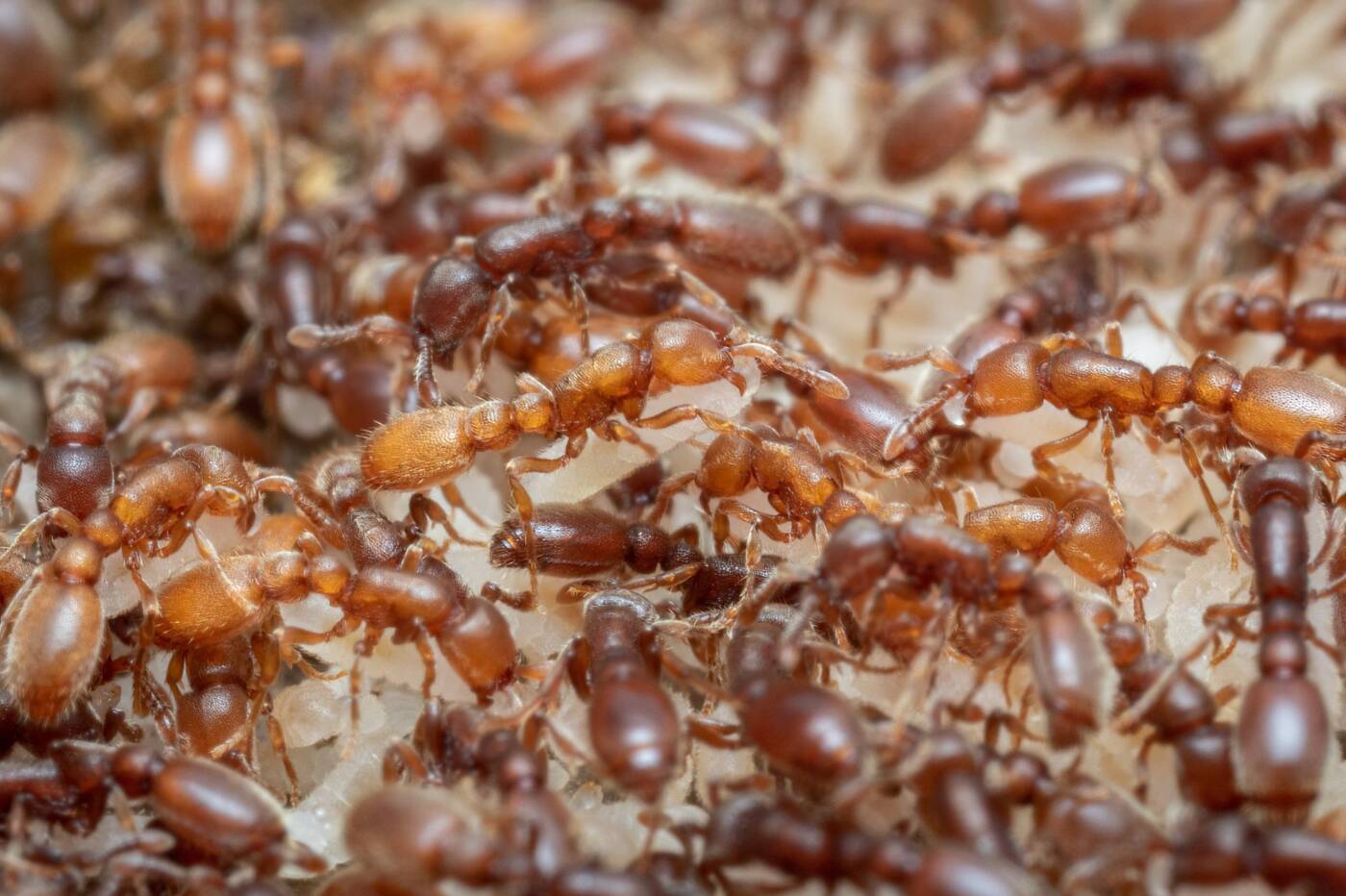
Ants, like these clonal raider ants tending to their larvae, are highly attuned to their young. A new study shows that two neuropeptides in the ant brain modulate how ants respond to larvae, thereby determining the behavioral roles ants assume in the colony. (Credit: Bart Zijlstra, UNIL)
Long before the dawn of modern parenting, animals laid eggs and moved on, leaving their progeny to fend for themselves. Now, a study published in Nature uncovers one of the elegant ways that evolution transformed neglect into nurture. Working in clonal raider ants, a surprisingly parental insect, researchers found that, rather than evolving entirely new brain circuits for caregiving, evolution repurposed ancient neural systems for regulating hunger into triggers for social behaviors.
Because ants and mammals share closely related brain signaling systems involved in caregiving, and because these behaviors naturally change as the ants age, the findings in ants could help scientists better understand how parenting evolved in mammals, and how even the human brain changes as it ages.
“Our work is a prime example of how evolution seldom invents things from scratch,” says Daniel Kronauer, head of the Laboratory of Social Evolution and Behavior at Rockefeller. “Evolution takes what it has and works with that, sometimes in very surprising ways.”
Model parents
Mammals nurse their young, birds maintain nests, and ants nurture larvae. How these diverse caregiving behaviors arose from deadbeat ancestors is a mystery, but scientists suspect that evolution pulled it off by repurposing ancient biological systems, rather than inventing something new. Indeed, previous studies in mammals suggest that some neuropeptides involved in regulating hunger may have been co-opted to motivate parenting.
Testing that idea, however, has proven difficult. The workhorses of modern neuroscience, fruit flies and roundworms, don’t care for their young; mice are doting parents, and scientists have identified some of the neuropeptides involved in their caregiving. Kronauer’s team was able to show in their study that some of the neuromodulatory mechanisms overlap between mice and ants. That means that, going forward, the relative simplicity of the ant brain—60,000 cells vs 100 million—it might offer a quicker path to understanding some of these mechanisms and the underlying circuitry at a finer resolution than what would be possible in mice.
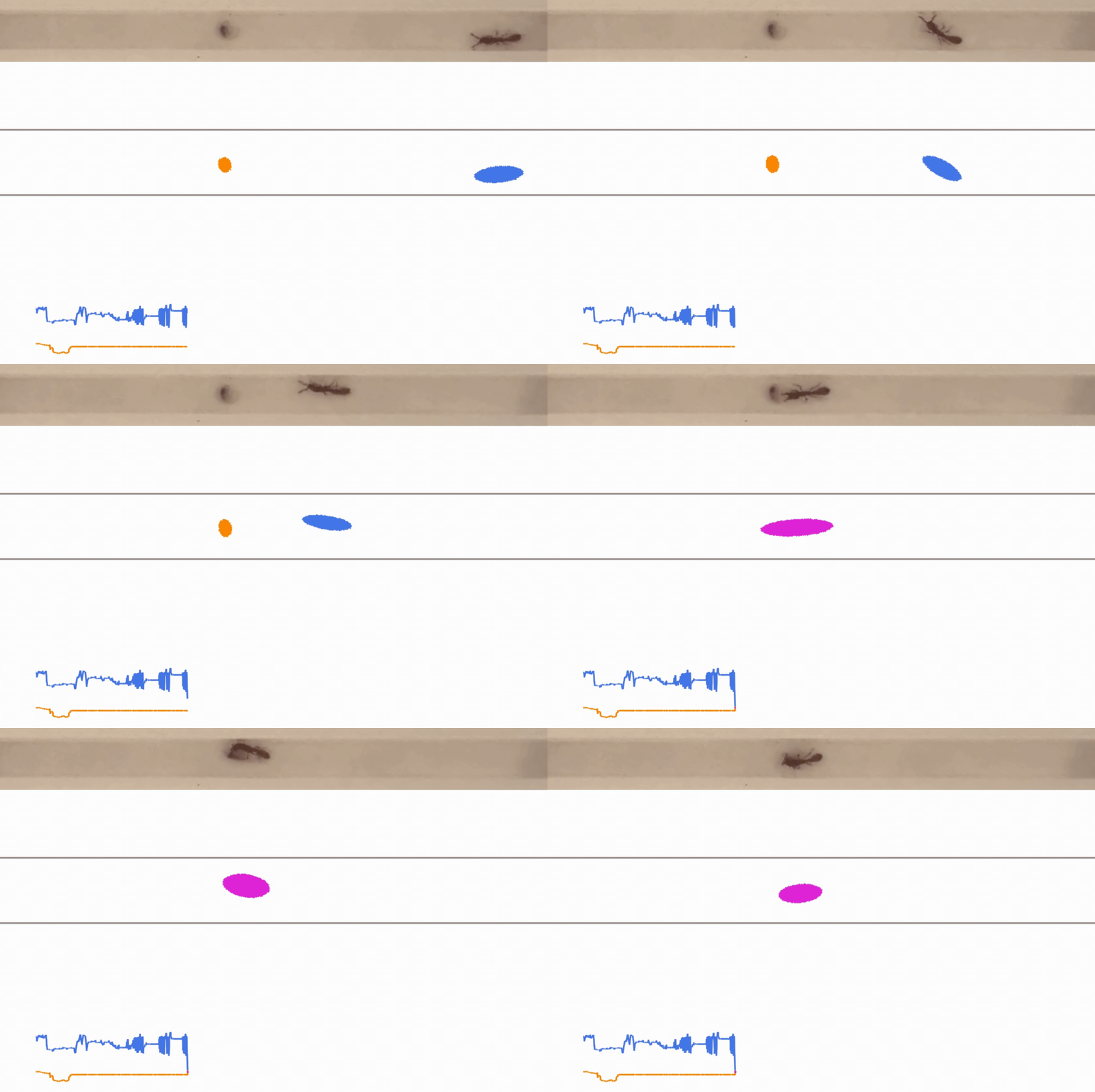
Closeup of the high throughput assay used in the study to quantify the interactions between larvae (orange) and adults (blue), and when they are in contact (magenta). (Credit: Kronauer lab)
The team began by developing a behavioral platform that paired individual ants with individual larvae, allowing them to track hundreds of caregiving interactions automatically. They then identified and synthesized many of the chemical signaling molecules in the ants’ brains and systematically tested each one for its effects on caregiving. Because ant colonies rely on a strict, age-dependent division of labor—where young ants stay inside the nest to nurse larvae and older ants transition to leaving the nest to forage—the researchers wanted to understand how brain chemistry controls this shift. Subsequent experiments examined where the most promising molecules were produced in the brain, how they changed over the ant’s lifetime to drive these changing roles, and how behavior shifted when the researchers increased or decreased molecular activity. The team also compared well-fed and starved ants to determine whether these caregiving signals remained linked to the ancient feeding circuits from which they were thought to have evolved.
“We annotated the neuropeptidome of this ant, the complete set of neuropeptides,” says Tomas Kay, a postdoc in the Kronauer lab. “There were 70 that we could identify. It took a lot of hard work, but now we have a set of molecules that we can investigate in numerous ways.”
A caregiver’s brain
Their findings suggest that the neural systems controlling caregiving in ants remain closely linked to the ancient circuits that regulate hunger, revealing two brain signaling molecules that act as opposing regulators of behavior, depending on the ant’s internal state. Neuropeptide F (NPF) promoted caregiving while Allatostatin A (AstA) encouraged the ants to leave the larvae behind and forage. Young ants naturally had more NPF and less AstA in key brain regions, whereas older ants showed the opposite pattern. This made sense, as ants shift from caregiving to foraging as they age. Manipulating either molecule changed the ants’ behavior, demonstrating the power of these neuropeptides. And, as indicated in mammalian studies, these two neuropeptides that were so closely associated with caregiving also responded to hunger—starving ants showed increased NPF and reduced AstA, causing them to behave like caregivers, while feeding reversed that balance and pushed ants to switch their parental responsibilities to foraging.
“We learned that parental behaviors build on the neural circuitry for feeding, and that makes some sense,” Kronauer says. “Parental behavior is a lot about feeding—not just yourself, but your offspring.”
The next step is to map the neural circuitry that these neuropeptides act on to produce parental behavior. Because mammals appear to rely on some of the same neuropeptides to regulate caregiving, comparing those circuits across species could shed light on the evolution of parenting itself, revealing a common biological strategy that may extend across much of the animal kingdom
“It amazes me that similar parenting behaviors have evolved so many times in so many distinct animal lineages,” says Kay. “Our paper suggests that the evolutionary routes to these sorts of behaviors are far more constrained than we may have naively imagined. That’s very exciting, because it may eventually lead to a blueprint of how these complex social behaviors evolve.”
And because ants naturally transition from caregivers to foragers as they age, they offer researchers a powerful new model for understanding how healthy aging reshapes the brain. The findings may provide a foundation for exploring similar processes in humans. “There’s a lot of research and funding invested in studying late-stage neurodegenerative diseases, but we actually know very little about how the brain changes throughout the normal healthspan of an individual,” says Kronauer. “In ant colonies, these dynamics are central to the organization of the society. Our discovery provides a striking demonstration that neuromodulators can produce age-dependent changes in behavioral proclivities in ants, and I suspect that that’s the case in other animals as well, including in humans.”

Key takeaways
- Parental care appears to have evolved in ants by repurposing ancient neural circuits rather than inventing entirely new brain systems.
- Because the same family of neuropeptides regulates caregiving in ants and mammals, evolution may have relied on a common molecular blueprint for social behavior.
- The findings establish ants as a powerful new model for studying how parenting came to be.
- Moreover, because the researchers found that caregiving behaviors change over an ant’s lifetime, their findings also contribute insights into how healthy aging naturally reshapes the brain and behavior.