Teaching the immune system to control HIV
 COPY LINK
Key takeaways
- Last year, results from an HIV clinical trial showed that some participants maintained viral control for nearly two years without daily antiretroviral therapy.
- Now, a follow-up study shows that long-acting broadly neutralizing antibodies, or bNAbs, working together with antibodies produced by a patient's immune system, may help explain these unprecedented results.
- The new analysis also shows that the treatment accelerated the decline of dormant HIV capable of restarting an infection, reducing its estimated half-life from many years to just 36 weeks.
- The latest findings point to a new strategy: using vaccination to prime the immune system to work with bNAbs, while designing novel antibody combinations that make it harder for HIV to develop resistance.
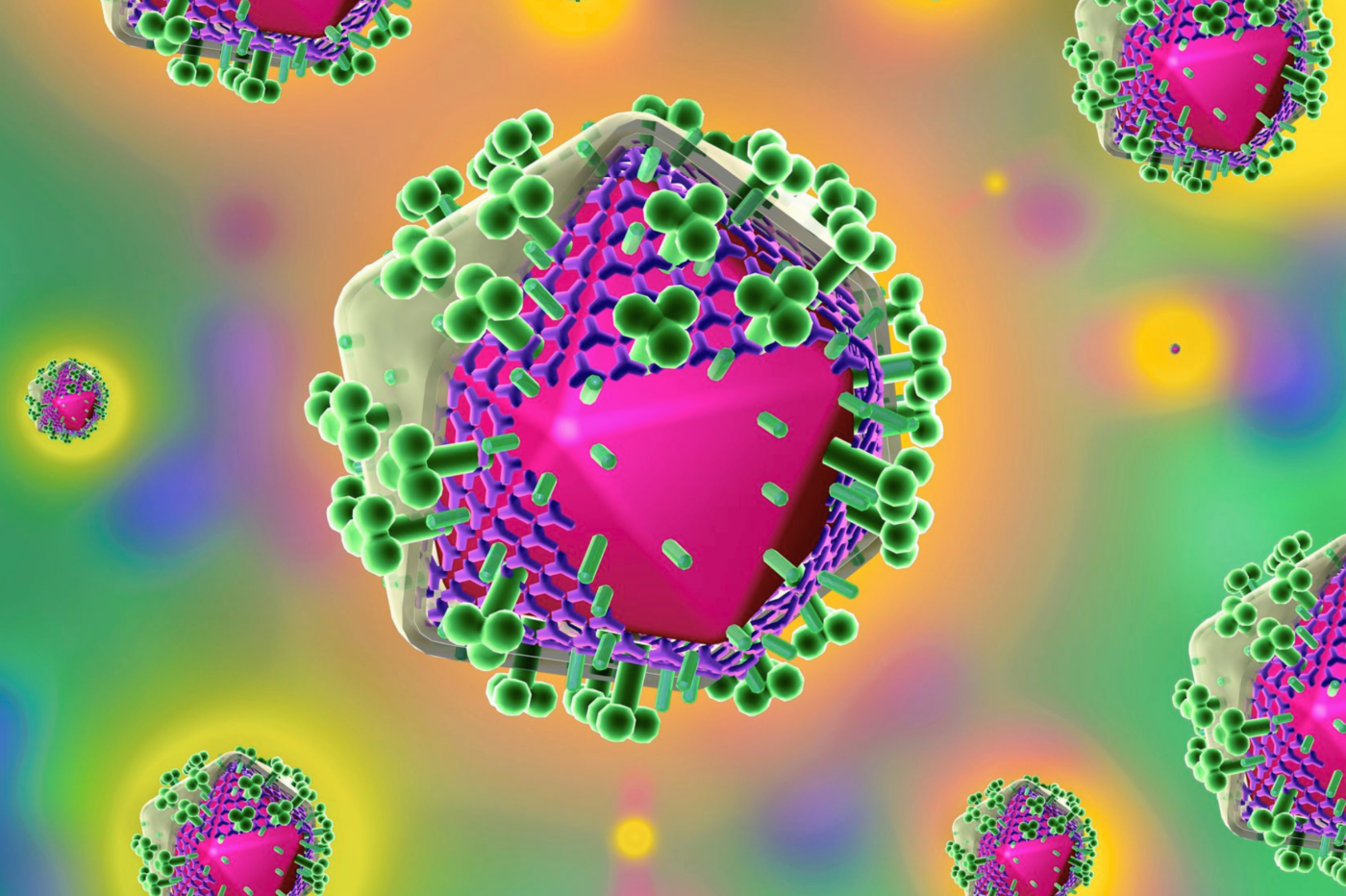
A large clinical trial shows that long-acting antibodies may work with the immune system to control the HIV virus (illustrated above) and help reduce the reservoir that would make lifelong treatment necessary. (Credit: Science Photo Library)
There is no cure for HIV. While scientists have made considerable progress in controlling the infection, patients still must take daily antiretroviral medication for the rest of their lives. Results from a clinical trial led by Rockefeller, Imperial College London, and the University of Oxford (RIO) have offered a new strategy, suggesting that just one or two doses of broadly neutralizing antibodies (bNAbs) can suppress the virus long-term, keeping it at undetectable levels for months and even years.
Now data from the RIO trial reveals how the bNAbs used kept the virus in check, with lessons that may inform HIV therapy. In a paper published in Nature Medicine, researchers found that participants who already had their own neutralizing antibodies against HIV were better able to control the virus, suggesting that a patient’s natural immune response can work alongside bNAbs. The bNAbs also appear to have accelerated the decline of the intact viral reservoir, the pool of dormant HIV that can reignite infection when treatment stops.
“The antibodies appear to be teaching the immune system to control HIV,” says Michel C. Nussenzweig, head of the Laboratory of Molecular Immunology. “It’s almost as if the participants’ own immune activity acts as a second component to the antibodies. Together, the bNAbs and the natural immune response seem to work together to corner the virus.”
Promise in the clinic
Antiretroviral therapy (ART) transformed HIV from a death sentence into a manageable chronic disease. But it is not a cure. ART cannot eliminate the virus that lies dormant in long-lived immune cells, which form a latent viral reservoir that can always spawn new infections. While most remnants of HIV in the reservoir are defective, a small intact fraction remains latent for life—persisting for decades and making lifelong daily treatment necessary.
The discovery and development of broadly neutralizing antibodies presented a new opportunity to attack that reservoir and thereby bring the idea of an HIV cure back to the table. The RIO trial, funded by the Gates Foundation and Rockefeller’s Stavros Niarchos Institute of Infectious Diseases, randomized 68 men living with HIV to receive either two long-acting bNAbs or a placebo before undergoing a closely monitored pause in the ART that they had been taking daily since the start of their infections. Initial results suggested that a single dose allowed most participants to keep HIV at undetectable levels for up to 20 weeks without daily ART. Participants who maintained suppression were given the option to receive a second dose of the bNAbs at 20 weeks. Half of these individuals remained undetectable at 48 weeks and one third at 72 weeks.
But undetectable virus was not the only sign of control. Among the 29 participants who received bNAbs and eventually had detectable virus, 38 percent developed a distinctive pattern of “fluctuating viremia,” in which HIV repeatedly rose and fell at low levels without reaching the trial’s criteria for restarting ART. This pattern persisted for up to 58 weeks.
The results were remarkable, in part because they suggest that the bNAbs—which in some cases had long since left the body—had trained the immune system to control HIV. “We have one participant who is at 160 weeks, more than three years now,” says Marcilio Fumagalli, a postdoctoral associate in the Nussenzweig lab. “After that long, he certainly wouldn’t have bNAbs circulating anymore. They’ve been washed out. And yet, he still does not need ART.”
Clarity in the lab
With these clinical results in hand, Nussenzweig and colleagues returned to the lab to better understand these promising results. What had happened to the latent viral reservoir? And why were some participants able to control HIV so much longer than others?
To answer these questions, the team analyzed blood samples collected throughout the RIO trial, examining both the reservoir and the viruses that in some cases emerged after treatment. Genetic assays allowed them to distinguish intact, potentially infectious HIV from far more numerous defective copies, while sequencing revealed how rebounding viruses responded to the bNAbs and participants’ own antibodies. They found that rebounding viruses rarely matched the dominant intact proviruses in the blood, suggesting they may have emerged from unsampled tissues or deeply dormant viruses. And while the reservoir’s initial size did not predict how long participants remained off ART, they found that intact proviruses declined with an estimated half-life of just 36 weeks after bNAb therapy, compared with four to seven years during ART.
The most surprising and potentially impactful finding, however, was that participants who maintained long-term control were more likely to have neutralizing antibodies of their own against HIV—natural antibodies generally thought to offer little protection because the virus readily escapes them. Participants with these autologous antibodies went an average of 108 weeks before restarting ART, compared with just 27.5 weeks among those without them.
Further analyses revealed that, when HIV eventually rebounded in participants who received bNAbs, it generally became resistant to one of the two therapeutic antibodies, 10-1074-LS, while remaining vulnerable to the other, 3BNC117-LS. In other words, rebound appears to begin when levels of 3BNC117-LS fall too low and effectively leave 10-1074-LS fighting alone.
Nussenzweig likens the system to a tricycle: the two infused bNAbs provide two wheels, while the patient’s autologous antibodies provide a stabilizing third. Most participants lacked that third wheel, leaving them vulnerable as one of the therapeutic antibodies faded.
“That was surprising, to find that a patient’s own immune system was what kept things in balance, because it’s been clear for a long time that, by themselves, autologous responses just aren’t enough to control anything,” Nussenzweig explains.
Taken together, the findings suggest that bNAbs may do more than temporarily suppress HIV. By working with a patient’s own immune response, they may prolong viral control while accelerating the decline of the intact viral reservoir. “Next, we want to see what these cells are producing before and after therapy, and whether they are actually becoming better at fighting the virus during our antibody treatments,” Fumagalli says.
The results also point toward ways to improve bNAb therapy. Vaccination could first train patients to produce their own antibodies, supplying the “third wheel” before therapeutic bNAbs are administered. “One of the problems with this form of therapy is that not everybody responds. Not everybody does well,” Nussenzweig says. “What we are now looking for are ways to make good outcomes more general. The present work provides clues—ones that we can now test.”


Key takeaways
- Last year, results from an HIV clinical trial showed that some participants maintained viral control for nearly two years without daily antiretroviral therapy.
- Now, a follow-up study shows that long-acting broadly neutralizing antibodies, or bNAbs, working together with antibodies produced by a patient's immune system, may help explain these unprecedented results.
- The new analysis also shows that the treatment accelerated the decline of dormant HIV capable of restarting an infection, reducing its estimated half-life from many years to just 36 weeks.
- The latest findings point to a new strategy: using vaccination to prime the immune system to work with bNAbs, while designing novel antibody combinations that make it harder for HIV to develop resistance.