"I have always had so many questions about the world."
 COPY LINK
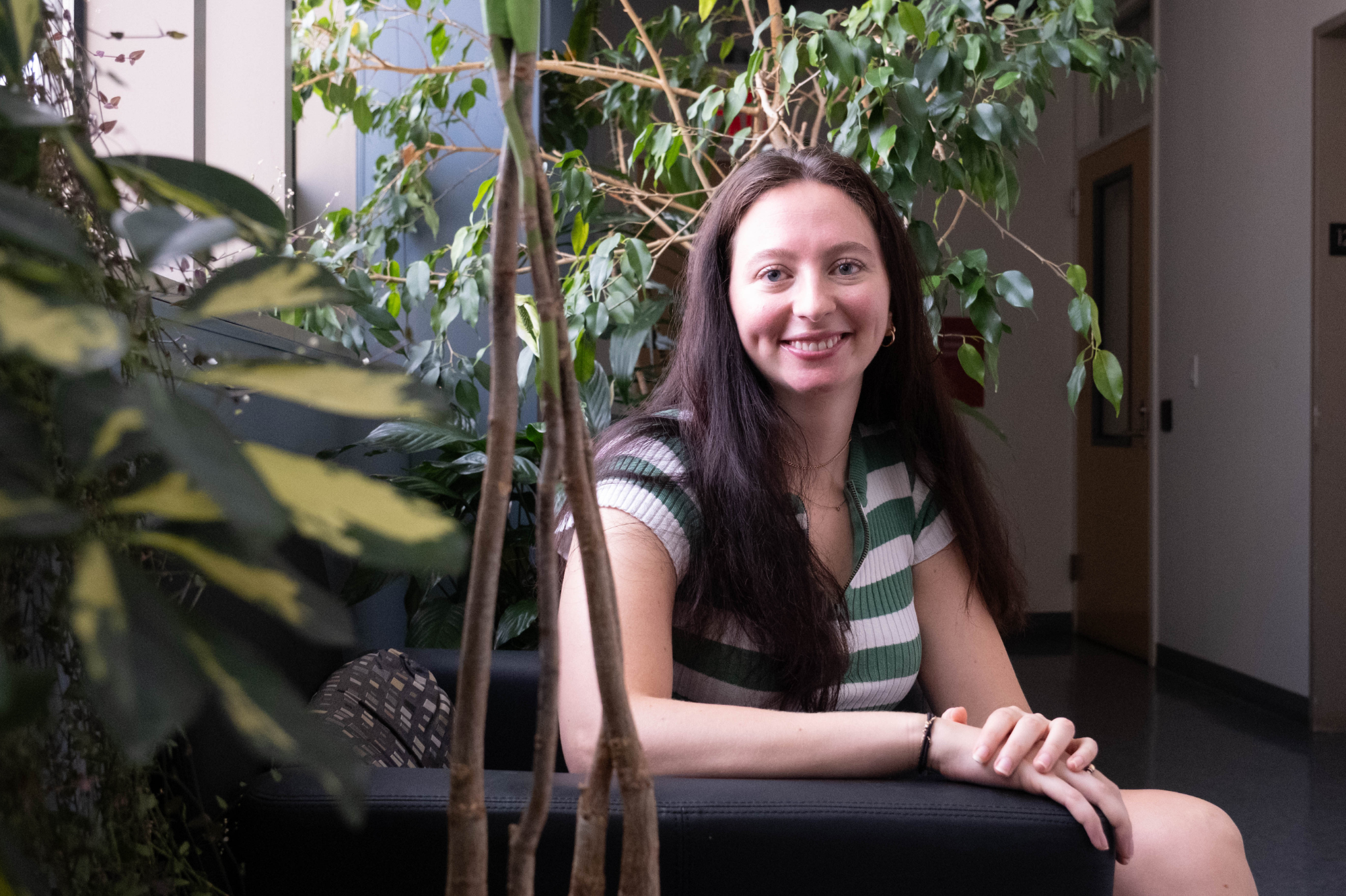
Natalie Alexander wants to understand why obesity triggers higher rates of inflammatory skin diseases. (Credit: Lori Chertoff)
Rockefeller University is known as a place where inquisitive minds and independent spirits thrive. That made it a natural draw for Natalie Alexander, NSF Graduate Research Fellow in the Fuchs lab, who studies the connection between obesity and inflammation in skin—a focus she crafted by following her curiosity through different labs and scientific disciplines.
Now in her sixth year, Alexander is making fresh insights into the mechanisms that may underlie the higher rates of skin diseases seen in people with obesity, including epigenetic inflammatory memory and sex differences.
“I have always had so many questions about the world, and science is a really practical way to answer those questions,” she says. “I also have a variety of interests, so the interdisciplinary nature of research at Rockefeller lets me not have to choose just one lane.”
Choosing basic science
Alexander was in high school in Austin, Texas, when she was introduced to molecular experiments in AP biology. She was enthralled. “The first time I did a gel electrophoresis experiment and could see the DNA bands moving, I thought it was so cool. I even told my mom, ‘Just lock me in a lab for the rest of my life—I’ll be happy doing this all day long.'”
But her curiosity was wide ranging, so at Boston College, she majored in both biology and history. She alternated between running her own experiments in Thomas Seyfried’s cancer lab and writing her thesis on how the 19th-century American steel industry contributed to the development of the U.S. Navy with historian Heather Cox Richardson.
“I know biology and history seem very different, but writing my history thesis was a lot like the experiments I was doing in the lab,” she says. “For both of them I was reading primary sources and technical treatises, and collecting data and piecing it together.”
After graduation, conflicted about which path to pursue, she threw herself into her job as a research technician at Massachusetts General Hospital in the patient-centered infectious disease lab of Michael Mansour, where she was part of a clinical team profiling neutrophils from patients with multiple recurrent infections. When the Covid pandemic hit, the lab immediately shifted its focus from fungus to virus and became the epicenter of a city-wide clinical trial of tocilizumab, an anti-inflammatory being tested for its potential to calm the cytokine storm some Covid patients experienced. It was not effective, so they eliminated it as a treatment possibility.
For Alexander, it was not only a lesson in the importance of negative data but a clarifying moment for her career. “We were working directly with patients, and seeing the manifestation of our research in real time put this passion in me and convinced me to pursue science in graduate school,” she says.
That led her to Rockefeller, a uniquely structured university where there are no departments, where high-risk, high-return research is the norm, and where heads of lab offer students tailored guidance and free rein in equal measure.
“I really liked that I wouldn’t be pigeonholed into one field and that I could design my own curriculum and research project,” she says.
Obesity and inflammation
While rotating through labs in her first year, Alexander became fascinated with the research in Paul Cohen’s lab. “I was really intrigued by the idea of obesity as a disease and how having this condition can manifest in a whole lot of outcomes unrelated to metabolic dysfunction, such as inflammation,” she says.
Soon after, a lecture by Fuchs on inflammatory memory—by which the skin’s stem cells can retain “memories” of past experiences, for better (faster healing) or worse (inflammation)—set Alexander on her current path.
“Within the first couple weeks of my rotation in Elaine’s lab, I knew I was where I was meant to be. I liked the questions they were asking, and it was almost like a microcosm of the university in that there are a wide range of researchers—developmental biologists, immunologists, cancer biologists, bioinformaticians—and a lot of collaboration,” she says. “And Elaine was so open to all of my ideas. She let me design my own rotation project, which eventually became my thesis project, and encouraged me to investigate all my curiosities to my heart’s content.”
Sex differences
For the past several years, Alexander has been researching connections between obesity and inflammation in the skin. “Pro-inflammatory skin diseases such as eczema, psoriasis, and hidradenitis suppurativa are very common in people with obesity, but we don’t really know why,” she says.
Her research is beginning to offer clues. For instance, she’s found that in obese mice, a commensal bacterium called Staphylococcus xylosus (its equivalent on human skin is S. epidermidis), which normally lives on the skin without issue, becomes the target of a high inflammatory response by the skin’s epidermal stem cells and immune cells. Moreover, sex differences play a role in that response, with female mice having more immune cells in the skin than male mice, and the females’ stem cells and immune cells being more reactive to the bacteria.
“This tracks with what we know about the incidence of autoimmune diseases preferentially affecting females,” Alexander notes.
She’s also discovered that females have many more upregulated hyperinflammatory genes within their epidermal stem cells than males do, and is actively investigating whether GLP-1s may be able to reverse the hyperinflammatory response linked to obesity.
“We’re wondering if GLP-1s can reset the environment,” Alexander says.
For this work, she’s gotten guidance and input from Rockefeller’s Svetlana Mojsov, who discovered the active form and function of that peptide hormone.
Women in science
Another sex difference Alexander is keenly aware of is the historical and structural biases impacting women in science. As the former president and now VP of WISeR (Women in Science at Rockefeller), she develops resources and works to build community on campus. Recent group events include a series of Chalk Talks with guests including heads of lab Leslie Vosshall and Lamia Wahba. After hearing from mothers on campus that events held at the end of the workday often conflicted with childcare pickup, Alexander scheduled the series for the afternoon.
“I want to make conversations about what it’s like to be a woman in academia out in the open,” she says. “I hope we’ll be able to help each other, especially in moments of doubt or imposter syndrome.”
Upcoming events this fall include a lecture on November 2 by Cohen lab alum and science policy expert Sarah Ackerman and the launch of a new book club, which will take a deep dive into one book for the entire academic year: A Lab of One’s Own: One Woman’s Personal Journey Through Sexism in Science, by Rita Colwell the first female director of the National Science Foundation. The plan is to read and discuss two chapters at a time at monthly meetings, so as to encourage deep conversations. WISeR will provide a free copy of the book to all interested participants at its first general meeting on September 24.
For the past three years, Alexander has also mentored high school students from across the city through the SSRP program run by RockEDU, and along with two other postdocs in the Fuchs lab, designed the original eight-week curriculum, which includes a lot of hands-on lab experience. She’s already seen some of her mentees go on to schools like Harvard and Stanford.
“I loved science from a young age, and I had a lot of support, but even so, it was really hard for me to see myself working in science because a lot of the scientists we learned about in school looked nothing like me and came from backgrounds that were nothing like mine,” she says. “I feel driven to give girls and young women what younger me didn’t get, and to be able to follow their curiosities as much as I have.”