The fine art of managing science
 COPY LINK
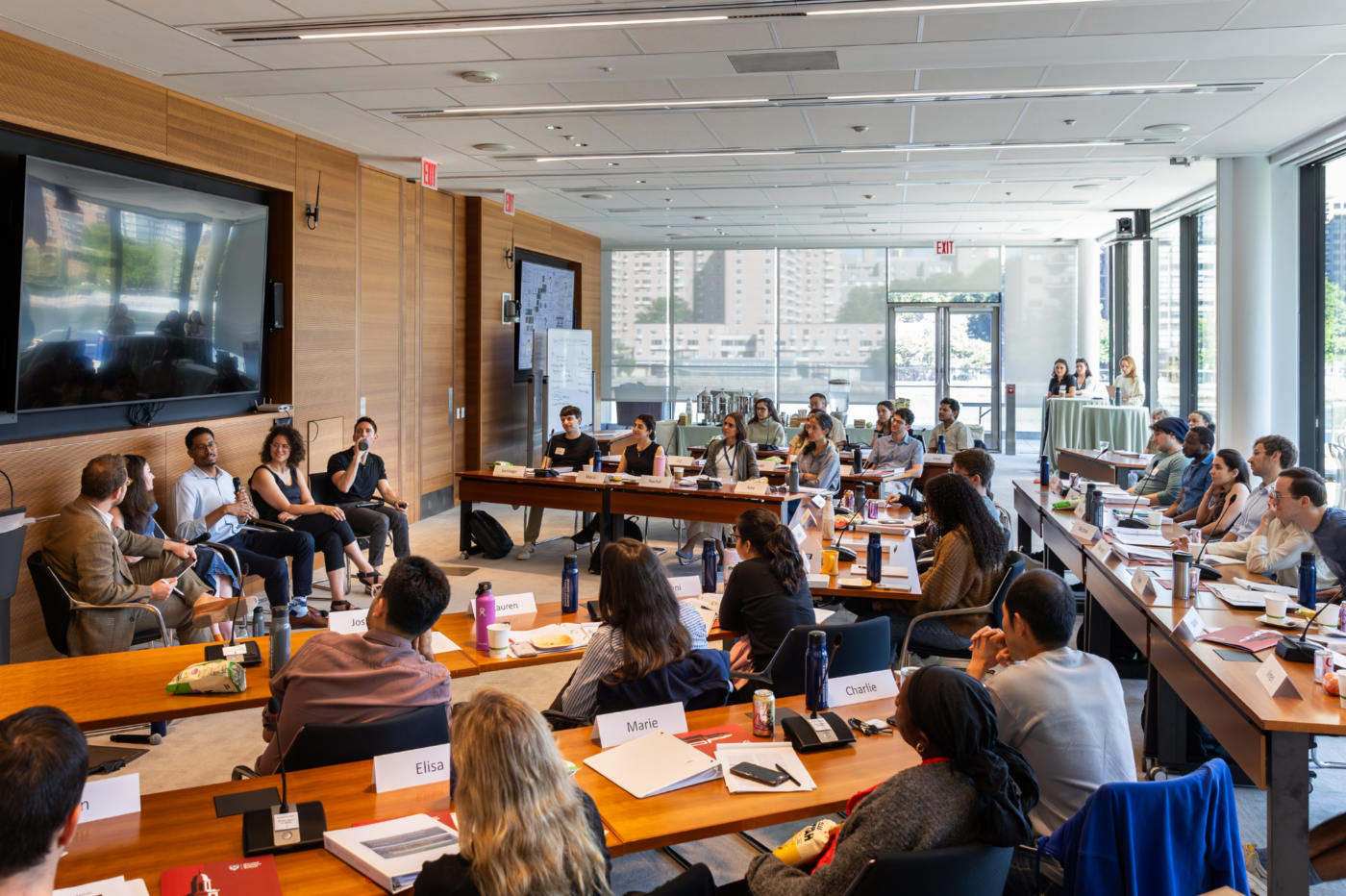
A three-day workshop equipped early-career Rockefeller researchers with skills rarely taught in graduate school, from managing laboratory operations to financial literacy and well-being. (Credit: Scott Rudd)
Early-career scientists quickly learn how to design rigorous experiments and interpret data. They’re seldom taught how to juggle projects, manage laboratories, or negotiate salaries.
These essential skills were the focus of Managing Science & Scientists, a three-day workshop held this July at Rockefeller, sponsored by the Dean’s Office and the Kellen Women’s Entrepreneurship Fund.
The workshop was developed specifically for the university and led by faculty from Harvard Business School and UC Berkeley Haas School of Business, with the goal of introducing a cohort of early-career researchers to evidence-based approaches for addressing the professional realities of research.
More than 90 Rockefeller graduate students, postdoctoral fellows, clinical scholars, and research associates have completed the workshop since its launch four years ago. This summer’s class of 33 was its largest yet. “We were delighted to be able to expand this exceptional program,” says Tim Stearns, the university’s dean of graduate and postgraduate studies and vice president for educational affairs. “Rockefeller scientists often go on to head up teams in industry or launch labs of their own, and this is part of how we can equip them for their future leadership roles.”
The workshop combines lectures, interactive exercises, discussions of real-life examples, and conversations with Rockefeller alumni. A main theme of this year’s installment was the increasingly collaborative nature of science. With the average number of authors on a scientific paper more than doubling from about 2.5 in 1990 to nearly 6, today researchers are expected to lead larger, more complex teams despite having few opportunities for formal management training.
Better management by design
Established and fully funded with support from donors, the program provides scientists at Rockefeller with training, resources, funding, and mentorship to help translate their discoveries into clinical applications and explore entrepreneurial opportunities.
The application is strictly limited to Rockefeller’s later-stage graduate students, postdoctoral fellows, clinical scholars, and research associates. Because the workshop curriculum is highly interactive and builds upon itself over three days, those selected must commit to attendance across all three days; upon completion, they are awarded a professional certificate from the university.
During the course, participants explored negotiations, laboratory operations, mentorship, psychological safety, wellness, and career development, while building practical strategies that they could immediately apply in their own research groups. The workshop also emphasized learning to navigate the uncertainty inherent in scientific research while building the leadership skills needed to help teams thrive.
For instance, some sessions challenged participants to rethink how they manage the research process itself. Drawing on principles from operations research, Harvard professor Kyle Myers argued that scientific progress may slow not because researchers lack talent or effort, but because they fail to identify bottlenecks—the steps limiting the pace of an entire project—and focus instead on attainable wins.
Myers illustrated this point by borrowing a thought exercise actively used by Google’s research and development arm: imagine trying to teach a monkey to recite Shakespeare on a pedestal. Most people, Myers explained, instinctively gravitate towards building the pedestal first because it’s straightforward and almost guaranteed to succeed. But the bottleneck holding up progress was never the pedestal—it was the monkey.
“You have the temptation to do the thing you know will succeed, but it’s the wrong thing to prioritize,” Myers says. “The only learning can occur with the monkey. It’s a recurring theme: bottleneck, bottleneck, bottleneck.”
This idea resonated strongly with participants. When asked to write down a one-phrase takeaway from the workshop, “confront the bottleneck” was an obvious choice for Ashni Vora, a graduate student in the Victora Lab. “That’s an idea that I wish I had understood better earlier,” she says. “Since the workshop, identifying and confronting the bottleneck has become central to how I approach tasks.”
Other sessions revolved around financial literacy. Through case studies and role-playing exercises, UC Berkeley faculty Solène Delecourt encouraged participants to think beyond salaries and approach job offers as complete packages that include laboratory space, equipment, start-up funds, teaching responsibilities, childcare, and other forms of institutional support. To illustrate this point, Delecourt asked participants to imagine accepting a faculty position based on verbal promises of a state-of-the-art microscope. Before accepting, she urged them to ask pointed questions: Does the microscope actually work? Who else uses it? Who maintains it? Will I have to pay for repairs? The broader lesson, she explained, was that the value of an offer depends not on what is promised, but on what the promise actually means.
For Rachel Zicherman, a clinical scholar in the Simon Lab, that information was worth its weight in gold. “One of the most valuable takeaways was the toolkit for handling challenging conversations,” she says. “It was refreshing to get concrete, actionable frameworks rather than just abstract advice. I wish I had encountered the structured approaches to negotiation earlier.”
The program also emphasized community and well-being. Guest speaker Julie Wilcox led two sessions on personal wellness and leadership, while Rockefeller alumni Naama Aviram, Daniel Gilmer, Dylan Kwart, and Laura Duvall discussed managing laboratories and careers after leaving the university. An evening reception and workshop dinner, professional headshots overlooking the East River, and a barbecue at the Faculty Club were also included.
The program concluded with each participant developing a six-month improvement plan, identifying management challenges in their own research environments and outlining steps to address them. Like experimental design or statistical analysis, the organizers explained, management is a skill that can be learned—and one that can make better science possible.
In just the short time since the workshop, that’s been the experience of Ana Badimon, research associate in the Strickland Lab. “The discussions surrounding efficiency, automation, optimization, avoiding bottlenecks, and negotiation really impacted me and have led me to adjust some of my methods,” she says. “I’ve already incorporated many of the skills and techniques discussed into my daily life, both in the lab and at home.”