New Parkinson’s drug candidate has roots in a Rockefeller lab
 COPY LINK
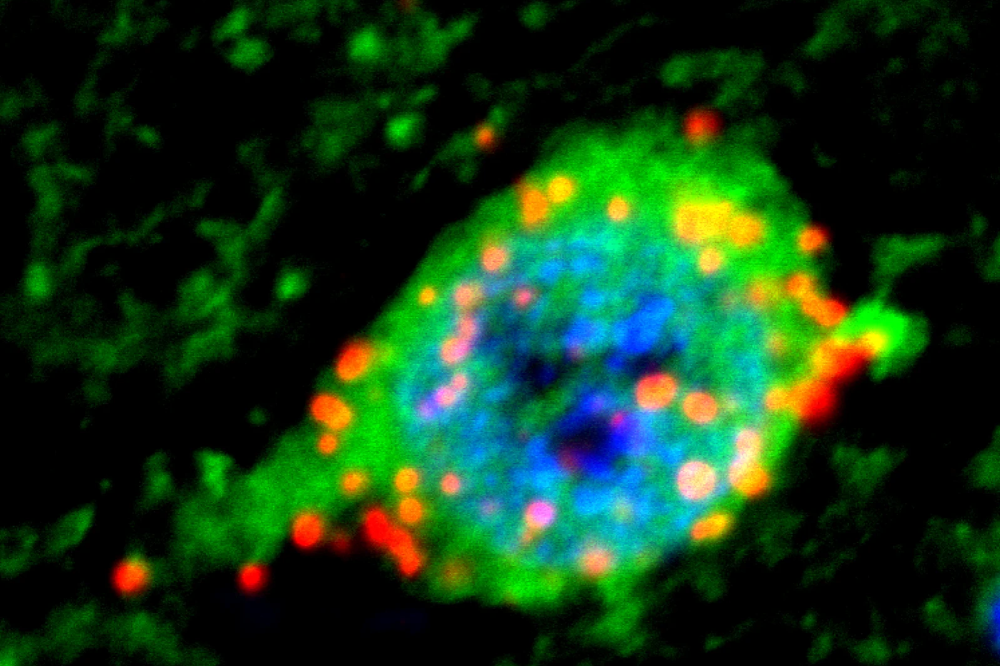
A medium spiny neuron, with GPR6, the target of the new drug Solengpras, fluorescing in red. (Credit: Heintz lab)
Earlier this month, the biotech company Cerevance announced that its experimental Parkinson’s drug, solengepras, had succeeded in a large phase 3 clinical trial. Adding a once-daily solengepras pill to their usual medication regimen gave people with Parkinson’s more time each day with their symptoms under control, improved their ability to manage everyday activities, and eased their daytime sleepiness.
“For some patients, this drug completely changed their life,” says Nathaniel Heintz, head of the Laboratory of Molecular Biology at Rockefeller. “It’s not just they move better; they feel better.”
For Heintz—who identified the drug target behind solengepras nearly two decades ago—the new results are a success story because of how much they help patients. But they also offer some of the first real validation that drugs aimed at a single, precisely defined circuit in the brain can work to treat disease in people, an idea that Heintz has built his career around.
Most neurological drugs that make it through late-stage trials act on a target that other medicines already hit. Solengepras works on a molecule that almost no one had studied until Heintz’s lab flagged it in 2008 while studying precise differences between different brain cell types in the lab.
“This is a brand-new target, a brand-new drug,” says Brad Margus, the current chair of Cerevance’s board who co-founded the company with Heintz and served as its CEO until 2022.
And solengepras may be just the beginning. The same tools Heintz developed to uncover its target have already revealed several other molecules unique to specific brain cells. Some of them are already being pursued as potential treatments for Alzheimer’s disease, addiction, and other conditions.
“I think this opens up a lot of potential for new targets,” says Heintz, who also directs Rockefeller’s Fisher Center for Alzheimer’s Disease Research.
The missing data on different brain cells
In the late 1990s, Heintz was a molecular biologist studying cancer biology and specifically how cells divide, with no formal training in neuroscience. But he became captivated by a basic question about the brain, which contains hundreds of types of neurons and supporting cells.
“What was unknown at the time was how the different neurons and glia in the nervous system differed from one another at a molecular level, and I thought we could approach that,” he says. “What is so great about working at Rockefeller is that I got full support to completely shift the focus of my research. That’s rare in academia. I don’t think I would have been able to accomplish what I have anywhere else.”
Indeed, Heintz’s entire lab pivoted to work on the problem of how to define all the cell types in the brain. First, they developed a new way to genetically engineer mice so that certain of these cell types glowed under a microscope. That let them sort out the different types and—using another new technology devised by the lab—determine exactly which genes each was actively using.
By comparing these profiles—not only between cell types but between healthy and diseased brains—Heintz suspected he would be able to find new, highly precise drug targets. A drug that acts on a molecule found in only one cell type, he reasoned, would avoid many of the side effects common in existing neurological drugs, which often impact multiple cell types and brain regions at once.
How new data led to a new drug target
In 2008, Heintz and the late Rockefeller neuroscientist Paul Greengard used TRAP, a technology invented by Heintz, to compare two types of neurons in the brain’s striatum, a region that helps control movement. The two cell types look nearly identical, but they work like a car’s gas pedal and brake. In Parkinson’s, the loss of dopamine throws them out of balance, and the brake becomes overactive. But developing a drug to target those brake cells—called D2 medium spiny neurons—would require identifying the tiny differences between them and the opposing cell type, D1 medium spiny neurons.
That’s exactly what Heintz and Greengard used TRAP to do. Among the handful of genes that differed between the two cell types, one stood out: GPR6, which appeared almost exclusively on the brake neurons.
That year, Heintz, Greengard, Rockefeller’s Jeffrey Friedman, and Margus founded Envoy Therapeutics to develop drugs against GPR6 and other targets that TRAP had revealed. Within a few years, the pharmaceutical company Takeda acquired Envoy. But the GPR6 program proved difficult to pursue at the time; the results were entirely from mice, which don’t naturally develop age-related brain disorders. The team needed to see proof that GPR6 mattered in Parkinson’s in humans.
“I didn’t think I could make a contribution to understanding late onset human disease without studying human cell types directly,” Heintz says.
So, his lab developed a second technology, called FANSseq, which is sometimes also referred to as NETSseq. It uses fluorescent probes that bind only to certain proteins or RNA molecules. A sorting machine then separates out any glowing cells for further analysis. Since it doesn’t require genetically engineering the cells, it can be used to sift out precise cell types in postmortem human brain tissue.
In 2016, Heintz and Margus co-founded Cerevance to put the new method to work finding drug targets in human brain tissue. One of the first things the Cerevance team did was check whether GPR6 showed up in human brain cells the way it had in mice. It did—appearing only in the D2 medium spiny neurons known to play a role in Parkinson’s.
That result, Margus says, “gave us and our investors the confidence to go forward with the program.”
Parkinson’s and beyond
The new clinical trial, which comes after earlier phase safety testing and trials, included 341 people with Parkinson’s disease across the United States, Europe, and Australia. After 12 weeks, people taking solengepras had gained more than half an hour a day of “on” time (when certain symptoms are controlled) compared with people taking a placebo. They also improved on a standard measure of everyday activities, such as dressing, eating, and walking.
Many Parkinson’s medications make patients drowsy, and they can also cause nausea, hallucinations, and other side effects. Solengepras caused few side effects and appeared to make people more alert, not less.
Margus and Heintz hypothesize that the lower number of side effects is due to the incredibly specific action of the drug: Heintz’s team discovered GPR6 is only found in one single type of neuron. Heintz compares these latest developments to the shift in cancer treatment over recent decades, from harsh chemotherapies that had side effects throughout the body, to targeted therapies that only eliminate cancer cells.
“The more precise the treatment, the more likely it is that it’s going to be able to generate a benefit without side effects,” he says.
For solengepras, the next step is applying for FDA approval for clinical use. But for Cerevance and Heintz’s lab, the drug’s success points to other future directions.
Cerevance has already used NETSseq to profile more than 18,000 brain tissue samples from 26 brain banks around the world. That analysis turned up a molecule found only on the brain’s immune cells, and they subsequently developed a potential Alzheimer’s treatment that targets the molecule.
Back at Rockefeller, Heintz is also using the technique to keep uncovering new drug targets from the approximately 11,000 FANSseq human datasets collected in the lab—including molecules that may be important in Alzheimer’s disease, Huntington’s disease, addiction, and memory. Each new target could open the door to another entirely new class of drugs.
“There are other very specific targets like this that we are pursuing in the lab,” Heintz says. “Taking that together with the solengepras results and other compelling targets moving forward in the company gives us confidence that this approach will lead to additional new therapies for neurodegenerative disease.”