Mapping how metabolism rewires protein function in cancer
 COPY LINK
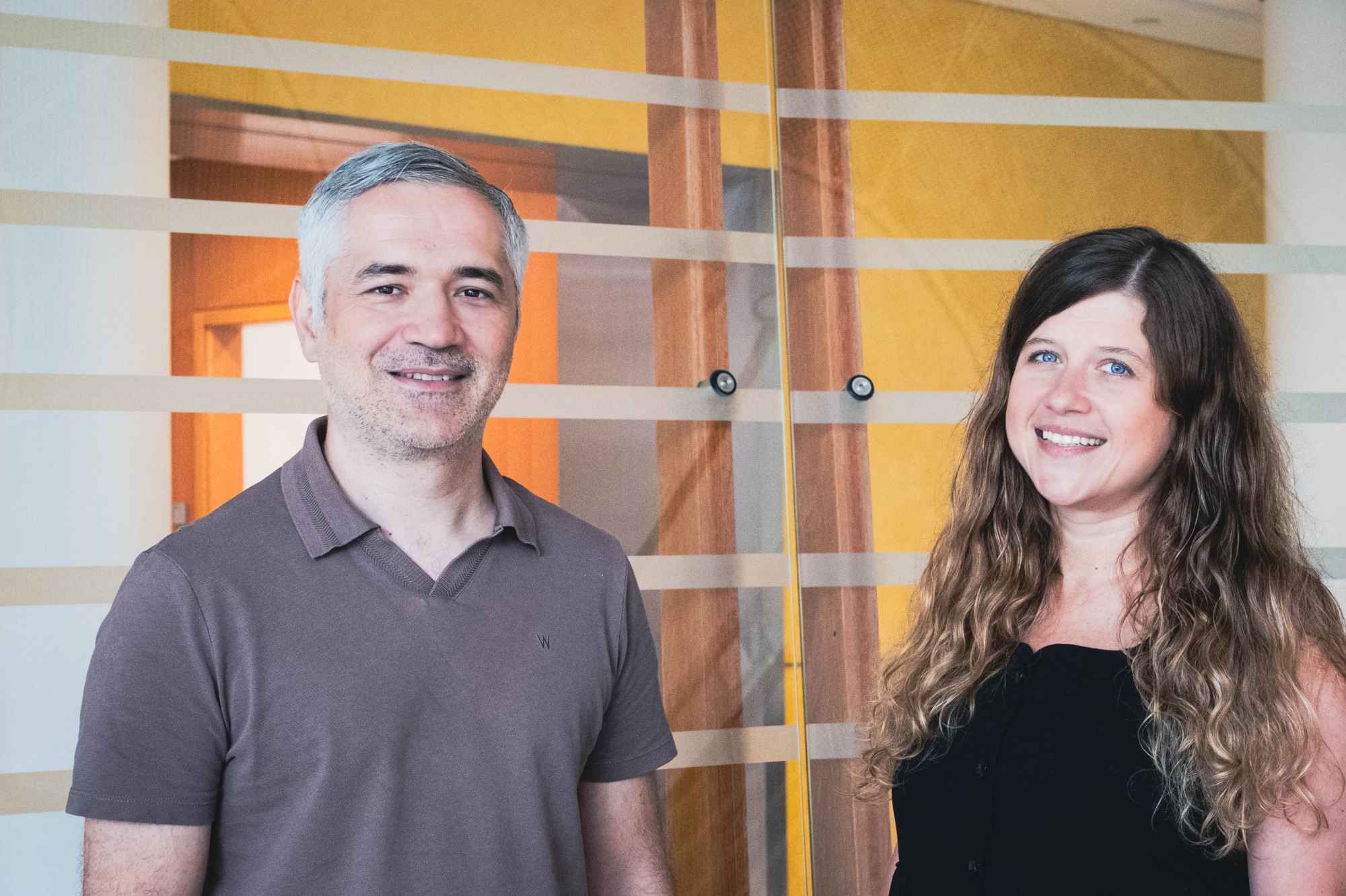
Rockefeller’s Birsoy and Vinogradova labs teamed up to study how cancer cells rewire their metabolism, and how these changes could be targeted therapeutically.
All cells metabolize nutrients to generate the energy and molecular building blocks required for survival. Cancer cells, however, do it differently.
To sustain rapid growth and adapt to hostile environments, they extensively rewire their metabolic machinery. Recent studies suggest that metabolism plays a much broader role than simply meeting the bioenergetic and biosynthetic demands of the cell, with metabolites increasingly recognized as regulators of protein function and cellular signaling. Yet, we still have only a limited understanding of how these metabolic changes directly alter protein function and ultimately control cell behavior.
Rockefeller’s Ekaterina V. Vinogradova, head of the Laboratory of Chemical Immunology and Proteomics, and Kivanç Birsoy, Joseph L. Goldstein Professor and head of the Laboratory of Metabolic Regulation and Genetics, have joined forces to bridge this gap. By combining expertise in cancer metabolism, organelle biology, chemical proteomics, and mass spectrometry, the two laboratories are developing new approaches to uncover how metabolic rewiring remodels the functional proteome of cancer cells and how these changes might be therapeutically targeted.
“We are interested in understanding how metabolism regulates protein function during tumor growth and metastasis,” says Birsoy. “If we can identify proteins that respond to specific metabolic changes, we can begin to understand their biological importance and determine whether they represent new therapeutic opportunities.”
Fueling the work is the inaugural Herbert Singer Award for Collaborative Innovation, which was established at Rockefeller with a gift from The Herbert & Nell Singer Foundation. In 2025, Birsoy and Vinogradova received the two-year award that supports high-risk, high-reward, high-impact collaborations among Rockefeller investigators. Each lab received $250,000 per year. The team spent the first year of the funding period developing and optimizing experimental platforms and now in their second year are applying these tools to the study of pancreatic cancer models.
The right tools for the job
Collaborating was a no-brainer for Birsoy and Vinogradova, as their separate research programs on cancer metabolism and chemical proteomics tools had begun to converge in particularly intriguing ways.
Birsoy studies how metabolic pathways enable tumor growth and metastasis. His team has developed innovative approaches to identify metabolic dependencies in cancer cells and characterize metabolism within distinct subcellular compartments, including mitochondria, lysosomes, and the Golgi apparatus.
Vinogradova develops novel mass spectrometry-enabled chemical proteomic approaches to measure functional changes across thousands of proteins simultaneously. Rather than simply looking at changes in protein expression, these platforms report on the reactivity of chemically sensitive amino acids, providing a direct readout on changes caused by protein oxidation, conformational rearrangements, and altered protein interactomes with diverse biomolecules.
The collaboration initially focused on understanding how oxidative stress alters cysteine reactivity in cancer. However, recent work from Vinogradova lab has shown that the same platforms can report much more than redox biology. Indeed, the researchers realized that these platforms can also provide an entirely new way to study protein-metabolite interactions at proteome scale.
These insights have fundamentally expanded the scope of the collaboration. The teams are now building a comprehensive atlas describing how individual metabolites influence cysteine reactivity throughout the proteome. These metabolite-specific signatures will provide a reference dataset for interpreting cysteine reactivity changes observed in complex biological systems, including cancer cells, helping distinguish whether a change is driven by oxidation, metabolite binding, or other functional mechanisms.
Getting answers
Organelles finetune protein function by maintaining unique biochemical environments, including redox regulation and changing metabolite pools. Understanding this regulation represents another key area of studies enabled by this collaboration. In the first paper resulting from the Singer award, Birsoy and Vinogradova’s labs refined their integrated approach to study the endoplasmic reticulum (ER), a metabolic hub where fats and proteins are made and folded. The researchers discovered that a protein called SLC33A1 maintains the appropriate redox conditions in the ER by exporting oxidized glutathione (GSSG) when its levels are too high. In cancers with mutations that cause redox metabolites to build up, boosting SLC33A1 activity could restore balance.
The team is now expanding their studies to map protein-metabolite interactions and redox regulation in other organelles and whole cells to generate the first large-scale map of these functional changes. Ultimately, the researchers hope to detect signatures unique to cancer that will show how metabolites alter protein function in the disease.
Existing cancer drugs, such as Sotorasib and Adagrasib, have successfully targeted KRAS_G12C in metastatic non-small cell lung cancer cells; the researchers expect their work could also uncover brand-new protein cancer targets that were previously overlooked. “Our current knowledge of how metabolites regulate protein function in immune and cancer cells is limited, and this would be a transformative approach for expanding our understanding,” says Vinogradova. For example, metabolite binding can lead to structural remodeling in proteins, revealing new druggable pockets as in the case of KRAS_G12C.
To start, the team is focusing on pancreatic cancer in mouse models of the disease. “There’s a lot of interest in a recent drug called daraxonrasib for pancreatic cancer that extends the lifespan of patients by maybe 6 months,” says Birsoy. “It seems small, but this is a cancer type where nothing works. That illustrates how much new treatment strategies are still urgently needed.” The initial ER work has offered a promising lead on that front: Because pancreatic cancer cells have high amounts of antioxidants such as glutathione, SLC33A1 could be a good drug target, he says.
Armed with preliminary insights on metabolite and protein changes in cancer, Birsoy and Vinogradova have shown that the Singer award is doing exactly what it was designed to do—launch promising ideas and foster interdisciplinary approaches. “With this support, we’ve built the tools, generated exciting preliminary data, and are now in a position to make discoveries that simply wouldn’t have been possible otherwise,” Vinogradova says. “Traditional funding mechanisms often won’t take a chance on a fundamentally new idea until it’s already been tested, and that can mean that a lot of great projects never get off the ground.”