Fighting pathogens by watching how they read their own DNA
 COPY LINK

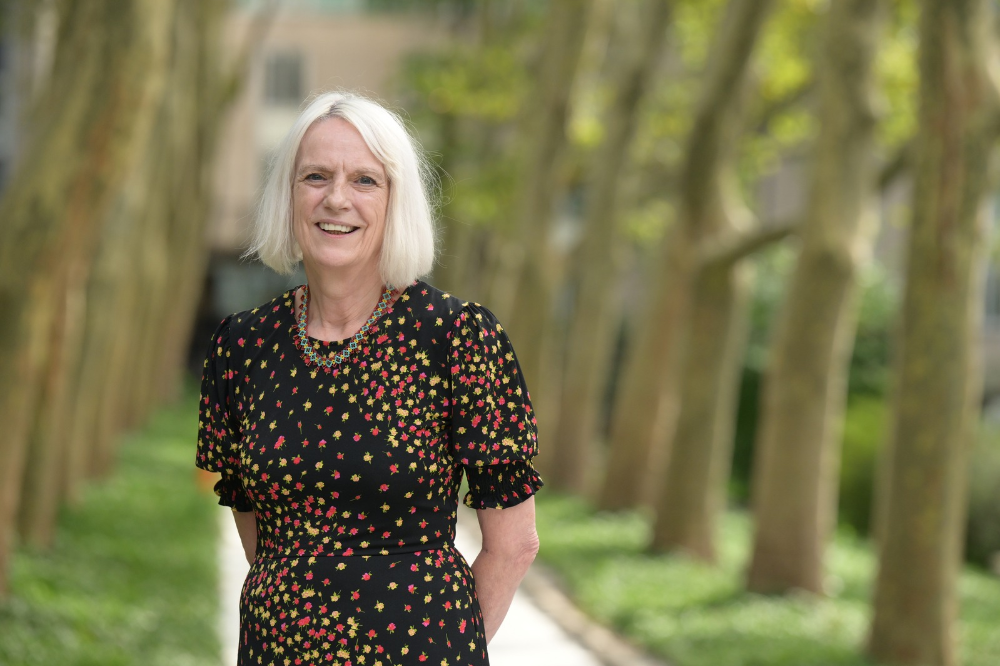
Elizabeth Campbell studies the molecular machinery that all living cells use to read and transcribe their genetic instructions. Her lab is finding new ways to block this critical machinery in bacteria and viruses. (Credit: Lori Chertoff)
Every living cell, from the simplest bacterium to a human neuron, relies on the same basic machinery to read, interpret, and use its DNA. This molecular machinery is so fundamental that life as we know it cannot exist without it. And because it is so essential, it has long been a target for drugs; shut down a bacterium’s ability to access its own genes and it quickly dies.
But designing drugs that do exactly that—without harming the human cells that run on the same machinery—requires a precise understanding of exactly how each system works and their miniscule differences. That’s where structural biologists like Elizabeth Campbell, head of the Laboratory of Molecular Pathogenesis, come in. Campbell uses high-resolution microscopy to see how proteins come together to regulate the gene-reading process in pathogens. By watching how individual molecules bind and bend, she and her colleagues can gain an understanding of how existing drugs target the process and how future compounds could do it even better.
An atomic level of detail, she says, is needed to find vulnerabilities in RNA polymerase—the central protein to the process. That work is producing clinically relevant results; recently, her lab revealed precisely how tuberculosis bacteria become resistant to the most common treatment for it, and a new way to exploit that resistance. And her approach can extend to any bacteria or virus—all of which contain their own unique variants of the molecules that read genes.
We spoke to Campbell about what it means to watch a pathogen read its own DNA, and what her research suggests for the future of treating infectious disease.
What is RNA polymerase, and why is it such a compelling protein to study?
RNA polymerase is the protein that copies stretches of genetic code from DNA into an intermediate molecule, RNA, which can later be translated into proteins. This transcription is incredibly important; it’s basically the only way a cell can make any proteins and sustain life. Even when bacteria like Mycobacterium tuberculosis lie dormant for long periods of time—a strategy that lets them stop dividing in your lungs, where they can evade the immune system and resist drugs—a background level of transcription is needed to survive.
My background is in infectious diseases, and I was originally drawn to RNA polymerase because it’s the target for rifampicin. This drug had been the mainstay of TB treatment for many decades, but scientists didn’t know exactly how it worked. I really wanted to know, at the smallest scale, what happens when rifampicin binds to TB’s polymerase and how the pathogen can sometimes become resistant to the drug.
RNAP is such a crucial protein—why is there so much we still don’t know about it and how do you study it?
The challenge with RNA polymerase is that it’s incredibly complex; it doesn’t just copy DNA mechanically like a train moving along tracks at one speed. It pauses, it backtracks, it slows down and speeds up. Other proteins are constantly interacting with it to make these changes.
In addition to structural biology, where we want to see the exact three-dimensional shape of RNA polymerase in different scenarios, we really want to know how all these different proteins interact. That’s where biochemistry comes in. We purify the individual proteins involved in transcription, add them together in test tubes with DNA and RNA molecules, and watch what happens when we add or remove specific components, introduce a drug, or mimic a resistance mutation.
The structures tell you what everything looks like; the biochemistry tells you what each piece does. Together they give us a full picture of how these pathogens read their genetic material and how we can disrupt that process, either by targeting specific spots on the polymerase or on other proteins that interact with it.
What have those approaches led you to discover about tuberculosis?
Our work has let us see not just that a drug works or doesn’t, but why at the atomic level. Seeing these molecules in action is really satisfying, but it also really tells you what’s happening. You can see exactly where a drug is binding, what other proteins are involved, and how a resistance mutation changes the shape of RNA polymerase. For instance, we collaborated with our Rockefeller colleague Jeremy Rock to look at RNA polymerase in rifampicin-resistant TB strains. When we looked closely at the polymerase, we discovered that the resistance mutation co-exists with other mutations that affect and distort a region of the protein needed to help it move smoothly along a strand of DNA. The first mutation, causing rifampicin resistance, slows down the RNA polymerase; the second mutation rescues that slowness. This study revealed that slow transcription is a vulnerability, setting us up for the next collaboration. That work was a perfect combination of clinical genetics with structural biology and biochemistry.
Building on our previous discovery, I recently teamed up again with Jeremy to ask if we could develop a way to exploit this sluggishness. We treated drug-resistant TB with a second compound that binds to a different spot on RNA polymerase and causes the already struggling enzyme to stop completely. That prevents the protein from being able to transcribe DNA at all. Combining two drugs resulted in powerful synergy that worked especially well against the dormant bacteria hiding in granulomas—those clusters of immune cells in the lung that contain latent TB infections. Being able to treat them and to observe synergy was a significant advance.
We never would have guessed to combine those two particular drugs if we hadn’t discovered exactly what happened to the polymerase when it first developed resistance.
What else in the transcription process could be vulnerable to new drugs?
Transcription is not a single event; it’s a multi-step process, and each step is its own potential drug target. There’s initiation, where RNA polymerase finds the right place on the DNA to start. There’s elongation, where it moves along and produces RNA. There’s termination, where it stops and releases the finished RNA molecule. And involved in all of those steps are dozens of regulatory proteins that help, hinder, or pause transcription; many of those could also be drug targets.
Rifampicin hits one very specific step: it blocks RNA polymerase very early in the process of transcription. That’s enormously effective, which is why it’s been the backbone of TB treatment for decades. But it also means that there are a huge number of steps left that we could target.
How do you figure out what drugs will work well together?
We start with the same approach we took with rifampicin mentioned above, which is to look at what parts of transcription existing antibiotics target. Once we know that, we can rationally pick pairs of antibiotics—that each work on a different step—to use together. My lab has been having a lot of fun testing these kinds of combinations.
We were able to show in a lung model that two particular antibiotics achieve what we call synergy, which is kind of a holy grail for antibiotic therapy. It means the combination is more powerful than the sum of its part. When you hit two different steps of transcription simultaneously, the bacteria can’t compensate for one problem while dealing with the other. That makes it much harder for resistance to emerge; the bacteria actually evolve much differently than they would with either antibiotic alone.
Does this approach extend beyond TB?
Absolutely. When COVID hit, my lab was able to move quickly into studying the coronavirus version of RNA polymerase. We mapped its full structure, which is incredibly important for drug design and basic biology. Just as with TB, if you can figure out how to jam that machinery, you can stop the infection.
RNA polymerase and the transcription machinery exist in some form in every pathogen. But each pathogen has a completely different polymerase. That means that we have to recreate the whole transcription machinery in each organism, and that’s one big reason why this kind of work takes time. In the process of working on TB, however, we developed new tools and uncovered new principles that are more broadly applicable; going forward that helps us research other pathogens more effectively.
For instance, we’ve also done work on Clostridium difficile, or C. diff, one of the most common healthcare-associated infections. We showed how an antibiotic blocks the polymerase in C. diff, but not other bacteria at the same time. That can help us design new targeted drugs that impact one bacteria, but not others.
Every time we understand a new pathogen’s transcription machinery in detail, we get a new map of its vulnerabilities. In that way, I think of our lab’s work as building a general program for fighting infectious disease, one pathogen at a time, while at the same time discovering basic scientific principles in bacteria and viruses.