Programming the immune system to manufacture its own therapeutic proteins
 COPY LINK
Key takeaways
- New work demonstrates that editing just a handful of blood stem cells can permanently program the immune system to manufacture therapeutic proteins, which can be boosted through vaccination.
- This proof of concept, demonstrated in mice, shows that this strategy could one day enable durable treatments in humans for HIV, influenza, cancer, and metabolic disease.
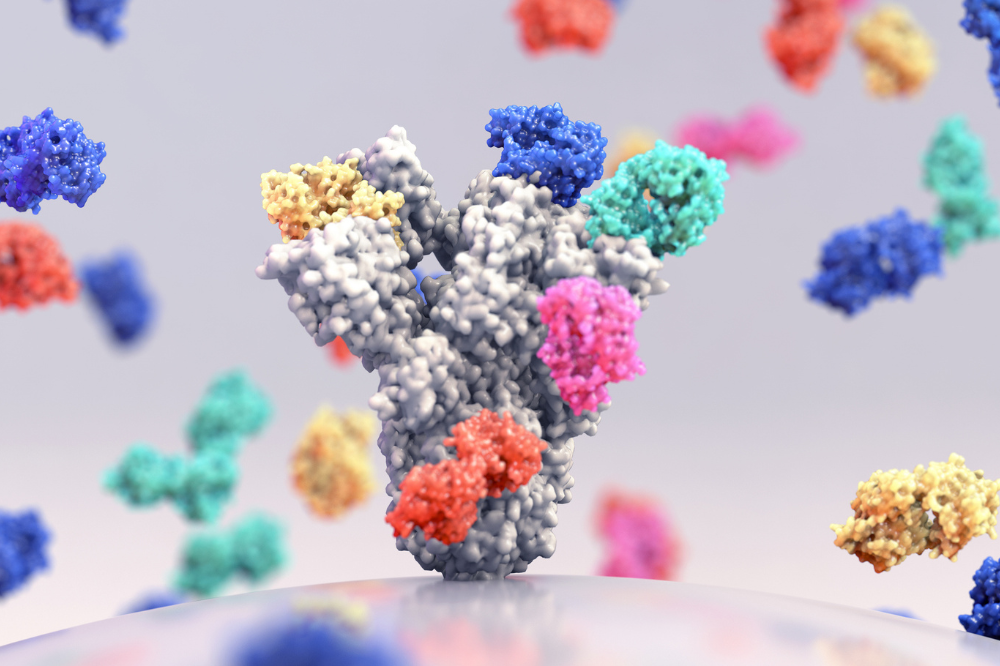
Broadly neutralizing antibodies, illustrated here, arise from rare precursor cells only after a long and complex process of mutation. (iStock/Credit: Design Cells)
An innovative gene-editing strategy could establish a new way for the body to manufacture therapeutic proteins—including certain kinds of highly potent antibodies the are naturally difficult to produce—by reprogramming the immune system itself.
The study, published in Science with a companion perspective, shows that editing a small number of stem cells can lead to long-term, boostable antibody production capable of protecting mice from deadly influenza infections. Funded in part by Rockefeller’s Stavros Niarchos Foundation (SNF) Institute for Global Infectious Disease Research, the work serves as a proof of concept that the immune system can be repurposed as a protein-manufacturing platform—one that could ultimately support treatments not only for infectious disease, but also for genetic protein deficiencies, metabolic disorders, autoimmunity and cancer.
“Our goal is to permanently impact the genome with a single injection, so that the body can make proteins of interest,” says Harald Hartweger, a research assistant professor in Michel Nussenzweig‘s Laboratory of Molecular Immunology. “That protein could be an antibody that’s universally protective against HIV or influenza, but it could also be any therapeutic protein.”
A new approach
While vaccination is effective against many infectious diseases, pathogens such as HIV present a unique challenge. Traditional vaccines expose the immune system to an antigen, prompting B cells to evolve antibodies that recognize a threat. This approach succeeds when viruses display stable and accessible targets. HIV, however, is adept at evasion, shielding its most vulnerable regions behind sugar molecules that resemble the body’s own tissues and are largely ignored by the immune system. Broadly neutralizing antibodies, capable of seeing through the ruse and circumventing these shields, are few and far between. Such antibodies arise from rare precursor cells only after a long and complex process of mutation. Most people will never produce such antibodies, even if they are exposed to the antigens through careful vaccination regimens.
Researchers tried various strategies for overcoming these limitations. Some administered a series of vaccines that trained B cells to produce rare antibodies, with limited success. Others thought to bypass immune training altogether, by genetically editing mature B cells to produce broadly neutralizing antibodies. It worked, but the response proved fleeting. Even edited B cell responses eventually die out.
In search of an effective, long-lasting approach, Nussenzweig, Hartweger, and colleagues turned their attention further upstream. Instead of editing mature immune cells, they wondered whether they could permanently install instructions for broadly neutralizing antibodies in the hematopoietic stem cells that give rise to B cells. If those stem cells were programmed correctly, every B cell they later produced would carry the same blueprint for producing broadly neutralizing antibodies, ready to be activated by vaccination. And because the immune system is built to amplify rare cells, the approach would not need to be perfect. Even a very small number of successfully edited stem cells could give rise to a robust, durable immune response.
“The immune system is inefficient, in that it produces a vast quantity of cells to protect itself,” Hartweger says. “We wanted to take advantage of the immune system’s ability to amplify useful, rare cells.”
Antibodies and beyond
As a proof of concept, the team used CRISPR gene-editing tools to insert the genetic blueprint for producing rare, protective antibodies directly into hematopoietic stem and progenitor cells of mice. Once transplanted back into mice, the edited stem cells gave rise to B cells programmed to produce the engineered antibody. A conventional vaccination would then serve as the trigger.
It worked. Even when only a few dozen stem cells were edited, vaccination triggered rare cells to expand, mature into plasma cells, and produce large amounts of antibodies that persisted long-term and could be boosted if necessary. The engineered B cells behaved just like normal immune cells, and even provided protection from disease. Mice engineered to produce a broadly neutralizing influenza antibody were spared from an otherwise lethal influenza infection.
The team went on to demonstrate their novel platform’s versatility. Engineered B cells were able to secrete non-antibody proteins, pointing to potential applications in treating genetic diseases caused by missing enzymes or other essential proteins. The researchers also showed that stem cells carrying different antibody instructions could be combined, enabling a single immune system to produce multiple antibodies at once—an approach that could limit viral escape and ultimately lead to functional cures for rapidly mutating pathogens such as HIV. And the team showed that human stem cells edited using the same approach gave rise to functional immune cells, providing a key proof of feasibility that the platform could one day work in humans, as well.
From proof of concept to the clinic
Taken together, the findings point to a fundamentally new way of harnessing the immune system, one that programs long-term therapeutic protein production at its source rather than relying on the uncertain process of immune training. “We’ve been working on difficult antibody problems for some time now—HIV, hepatitis—and generally trying to understand how the immune system makes antibodies,” Nussenzweig says. “The present study proposes a workaround for the antibody problem, a way of getting around the possibility that we may never get to a universal HIV vaccine, while still providing a promising, long-lasting solution.”
Next, the team plans to move from proof of concept toward the clinic. Future work will test the approach in non-human primates to assess protection against HIV, and explore whether the strategy that appears to work so well in B cells could be applied to T cells, too.
But the implications extend well beyond infectious disease, pointing toward a generalizable platform for long-term treatment of any number of diseases. “We want to find a way of making any protein,” Hartweger says. “HIV antibodies, of course, but also solutions that address protein deficiencies and metabolic disease, as well as an antibody to treat inflammatory disease or the flu, or one for cancer. This is a step in that direction—showing the feasibility of making life-saving proteins.”

Key takeaways
- New work demonstrates that editing just a handful of blood stem cells can permanently program the immune system to manufacture therapeutic proteins, which can be boosted through vaccination.
- This proof of concept, demonstrated in mice, shows that this strategy could one day enable durable treatments in humans for HIV, influenza, cancer, and metabolic disease.