Symposium highlights SNFiRU's transition from incubator to engine
 COPY LINK
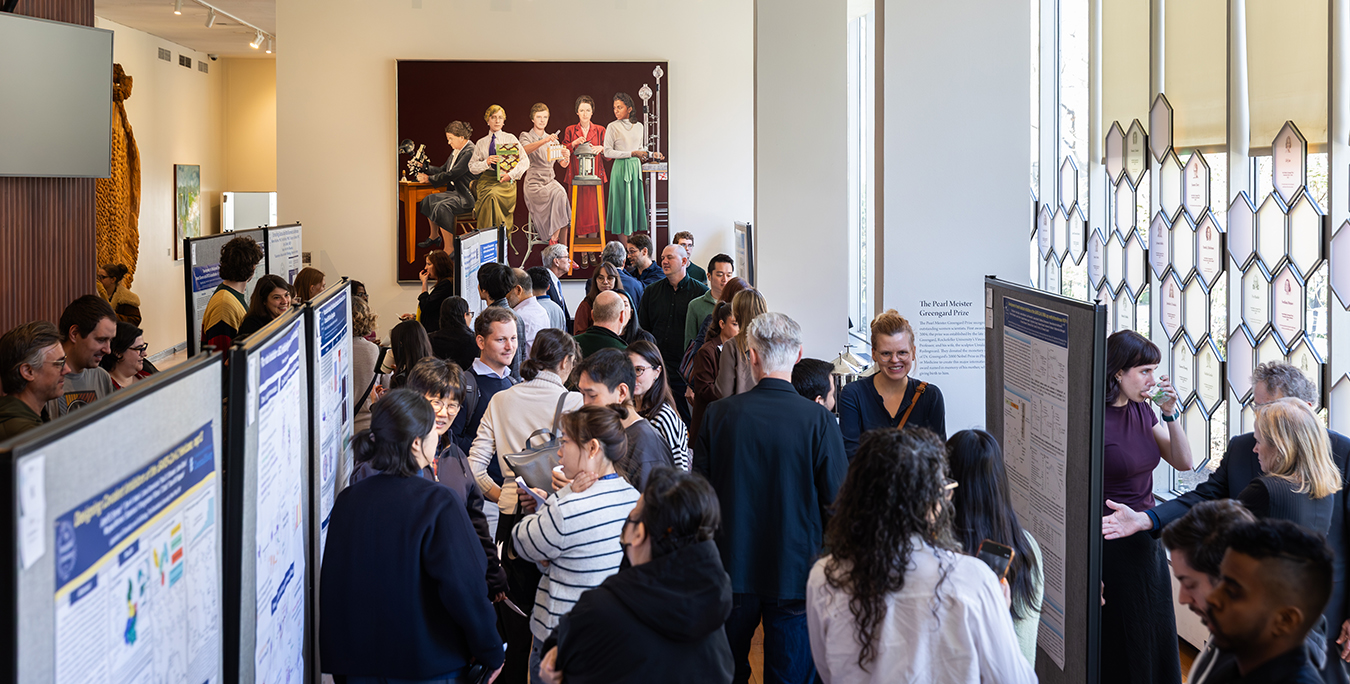
With more than half of Rockefeller’s labs participating, the SNFiRU annual symposium was a vibrant event showcasing the significant progress the institute has made since its 2023 launch. (Credit: Scott Rudd/RU)
At the fourth annual symposium of the Stavros Niarchos Foundation Institute for Global Infectious Disease Research (SNFiRU), the growing strengths of this unique infectious disease community came into focus. Thirty speakers delivered rapid-fire presentations in a single-day showcase of research and innovation at Rockefeller, demonstrating how SNFiRU collaborations—which yielded nearly 50 publications last year alone—are delivering new technologies, diagnostics, and projects on global infectious diseases ranging from HIV and coronaviruses to tuberculosis and Chagas disease.
SNFiRU-supported work now spans emerging antiviral strategies, new methods for sensing hard-to-detect infections, and therapeutic candidates nearing clinical trials.
“We’ve entered a new phase,” said Charles Rice, SNFiRU’s director. “We’re now building on the scientific and organizational foundations we established early on in order to advance research from discovery toward clinical and global impact.”
New tools are expanding what researchers can see. An approach developed in Sean Brady’s lab, for instance, uses environmental data to mine soil for new antibiotics, a method that recently identified two particularly promising drug candidates. At the same time, new diagnostics are moving closer to real-time detection. Peggy McDonald’s group is developing direct-pathogen tests for Lyme disease and Powassan virus using llama-derived nanobodies.
Other efforts are beginning to explain how infections lead to long-term disease and dangerous secondary responses. Daniel Mucida’s lab is tracking how T cells expand and distribute across the body during infection, showing how local antigen signals shape where and when specific immune populations emerge. Li Zhao’s lab is tracking the evolution of Sporothrix brasiliensis, a highly pathogenic fungus spread from cats to humans, revealing how rapid genetic adaptation and environmental pressures are driving its increasing virulence. Sidney Strickland‘s lab is tackling severe, life-threatening acute responses to infection, investigating new ways to treat polymicrobial sepsis by inhibiting the plasma contact system.
Work presented at the symposium also pointed toward new therapeutic strategies for pressing threats to human health. Jeffrey Ravetch’s lab has shown that subtle changes in antibody structure can determine whether an immune response protects or harms the patient, helping explain severe disease in dengue and COVID-19 and suggesting ways to mitigate it. In parallel, the lab showed that antibody treatment in HIV can prompt a long-lasting immune response.
Several approaches pursued by SNFiRU researchers are now moving toward the clinic. Work from Michel Nussenzweig‘s lab has generated monoclonal antibodies for Zika virus and hepatitis D that have advanced toward Phase I trials through a partnership with Brazil’s Butantan Institute, with SNFiRU support. This expands upon the lab’s pioneering translational work in HIV, where their broadly neutralizing antibodies are currently being evaluated in clinical studies for combination immunotherapy and long-term control of the virus. Sharon Lewin, an internationally renowned HIV expert and inaugural director of the Doherty Institute at the University of Melbourne, put this work into context during her featured talk on efforts to devise a cure through novel approaches to reduce and control the viral reservoir. “The eradication of HIV is possible, but it’s not yet scalable,” Lewin said.
Meanwhile, the team from Thomas Tuschl’s lab demonstrated animal model efficacy of small-molecule inhibitors of the mRNA cap methyltransferases of SARS-CoV-2 and MPXV, further illustrating both the breadth of discovery and its translational potential.
“Our emphasis on enabling high-risk, high-reward science has allowed us to assemble an extraordinarily promising translational portfolio,” said Rice.
The Institute’s influence is also beginning to extend outward. Jeremy Rock’s work on genetic interactions in Mycobacterium tuberculosis (Mtb) is helping shape how global efforts, including the TB Drug Accelerator (backed by the Gates Foundation), approach the design of combination therapies. Elizabeth Campbell presented exploratory studies on how targeting metal poisoning survival mechanisms in Mtb disease might provide new avenues for treating TB in the context of infection. This critical fight against tuberculosis is further strengthened by Dom Olinares from Brian Chait’s lab, who, working with Campbell, developed a high-resolution mass spectrometry platform to screen for novel inhibitors that block the bacteria’s essential transcription machinery. Their synergistic efforts showcase the power of the Institute’s collaborative model.
At the same time, SNFiRU has expanded the scope of infectious disease research by bringing in investigators from outside the field. Among them, Avi Flamholz is developing microbial platforms for the sustainable production of foods, fuels, and, crucially, pharmaceuticals—work that addresses a broader effort to understand environmental drivers of disease.
This progress comes at a moment of unusual urgency, as global preparedness for infectious disease faces growing strain. With a pipeline now in place, the Institute is increasingly focused on how to carry its discoveries through the final stages of development and into real-world use. Future plans involve pioneering public-health manufacturing partnerships and exploring new funding models to bridge the gap between academic discovery and commercialization.
These efforts are being shaped in part by work on global access and bioethics, including initiatives led by Barry Coller to develop practical frameworks for ensuring that therapies reach the populations most affected. In parallel, SNFiRU is addressing the social dimensions of infectious disease, including efforts to build trust and improve communication around conditions such as hepatitis B through direct engagement with affected communities in New York.
Throughout the day, attendees learned even more about the featured initiatives by engaging with young scientists presenting 28 posters on the symposium’s various topics.
“Integrating our robust research and education programs is the key to our success,” said Rice. “SNFiRU has become a vibrant central hub, generating bold and original research spanning virology, bacteriology, immunology, genetics, biochemistry and structural biology, and grounded in an ethos of equitable global access.”
SNFiRU is supported by the Stavros Niarchos Foundation (SNF) as part of its Global Health Initiative (GHI).