Even during one of the city's coldest winters, our science never takes a snow day
 COPY LINK
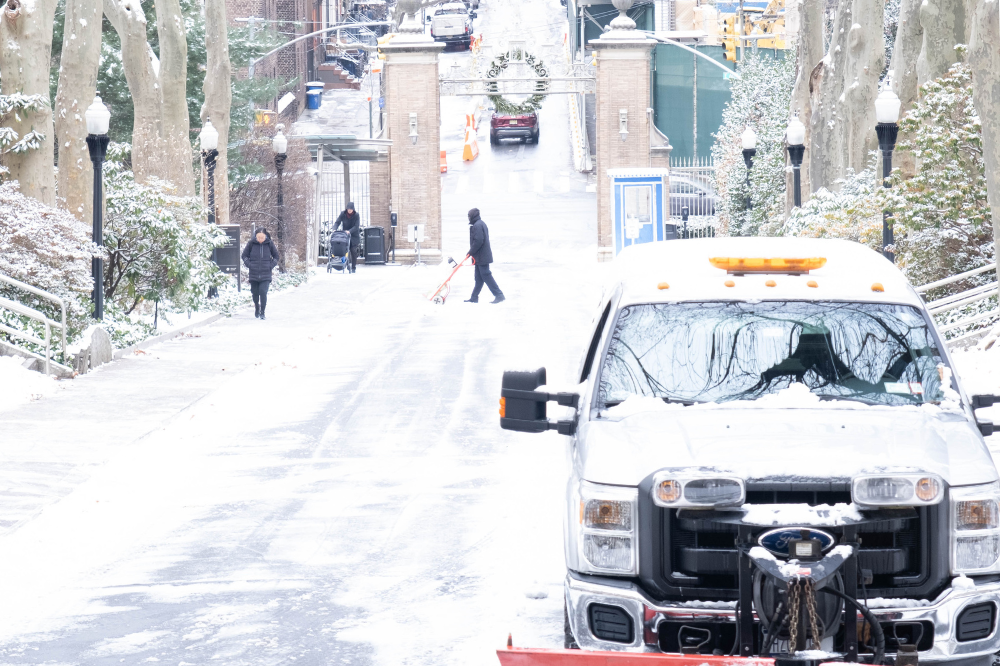
As New York endured severe snowstorms and its coldest winter in decades, the Plant Operations team kept science moving at Rockefeller’s historic campus. (Credit: Lori Chertoff)
On Rockefeller’s innovative campus, our laboratories can’t hit pause because of some bad weather.
That means when winter arrives—especially this one, which featured prolonged temperatures below 20°F and at least a foot of snow—the challenge of keeping all systems on go goes far beyond basic snow removal. The Plant Operations team is charged with protecting a technologically complex infrastructure, built to support science. It’s a task that requires careful planning, deep knowledge, and lots of teamwork.
“We always prepare for the worst and hope for the best,” says Alex Kogan, associate vice president of Plant Operations & Housing. “This year, it took an army to get the job done.”
A campus cleared
Snow removal is a regimented process, Kogan explains, based on a tiered priority plan to ensure essential personnel all retain constant access. As a first step, about 40 custodial staff and housing employees use plows, blowers, and shovels to clear major corridors. The team prioritizes the entrances and exits for each building, trudging through a predetermined route. “Our priority is to first ensure egress in an emergency,” Kogan says.
This winter, as a foot or more of snow blanketed the campus, it was all hands on deck. Some custodial staff typically continue cleaning laboratories while others handle snow, but as the storm raged on, all divisions dissolved. “Everyone grabbed a shovel,” Kogan says.
Keeping that workforce online took as much planning as the clearing plan itself. Rockefeller houses essential personnel on campus during major storms, lest severe weather prevent staff from returning for a shift, providing guest rooms and meals for custodial, housing, security, and plant staff. For custodial manager Maureen Walters, the priority was staying closer to her team.
“If her team were here in the middle of the storm, she wanted to be right there, in it, with them,” Kogan says. “This was her first major snowstorm, and she did a phenomenal job.”
The deep freeze
Even when it doesn’t snow, the cold itself requires careful preparation.
At the heart of Rockefeller is the power house, which produces approximately 350 million pounds of steam annually, powering heating, cooling, and autoclaves across 2.2 million square feet of campus. Because the university operates under an interruptible gas contract, when temperatures fall to roughly below 20°F it must switch the plant from natural gas to oil. That transition depends on plant engineerseing physically present to manage fuel switching and heating systems in real time.
This winter, that call came again and again.
Although the procedure of manually changing nozzles to oil on the plant’s six boilers is routine, it shifts the entire operating rhythm of the campus. While running on oil, Rockefeller consumes fuel faster, requiring daily truck deliveries through the 64th Street gate. Keeping that entrance clear even during a snowstorm is essential. “If that truck can’t get in, it’s turning around and going to the next customer,” Kogan says.
Preparing for the oil-to-gas switches requires more than requisitioning plows. Each year, the team locks in fuel rates well in advance, hedging against volatile winter pricing and consulting experts while tracking heating demand to anticipate oil usage, salt needs, and equipment strain.
“We’re looking at a lot of data,” Kogan says. “It’s not guesswork.”
Hidden stress points
Although snow removal and managing power are the most predictable and essential winter responsibilities, the real test comes when sustained cold and inclement weather place the campus’s layers of tunnels, pipes, and other infrastructure under strain.
The most common cold-weather incident on campus is frozen pipes. Sprinkler heads near exterior doors and unheated vestibules are especially vulnerable. “These stress points tend to show themselves in extreme weather,” Kogan says.
It falls to Plant Operations not only to address the pipes the that burst each winter, but also to prevent incidents by monitoring vacant spaces and maintaining minimum heat levels when necessary.
Redundancy is a key part of that preparation. Upwards of 80 percent of campus buildings are backed by diesel generators, tested monthly. The university maintains enough diesel fuel to operate for days without replenishment, while strategically prioritizing power use.
“Testing our generators is extremely important, in the winter and year-round,” Kogan says. “Once in a while we’ll find that something isn’t working and, although it is inconvenient to run these tests, it’s ultimately a minor annoyance that pays for itself in an emergency.”
Whether testing generators or shoveling walkways, keeping Rockefeller online is not simply an operational task. On a campus built in layers over more than a century, resilience is deliberate. And at Rockefeller, where experiments cannot simply be restarted and years of work can hinge on a stable environment, the stakes are high. For Kogan, the goal is straightforward: to ensure that weather never becomes the reason that scientific discovery slows or stops.
“When scientists here make a discovery, we feel part of it,” Kogan says. “We take great pride in what we do, and that’s the special ingredient that makes it all work. We know that we’re not just here to shovel snow. We’re here to support science. Everyone on campus plays a role in that mission.”