This tiny cellular portal could open vast possibilities for medicine
 COPY LINK
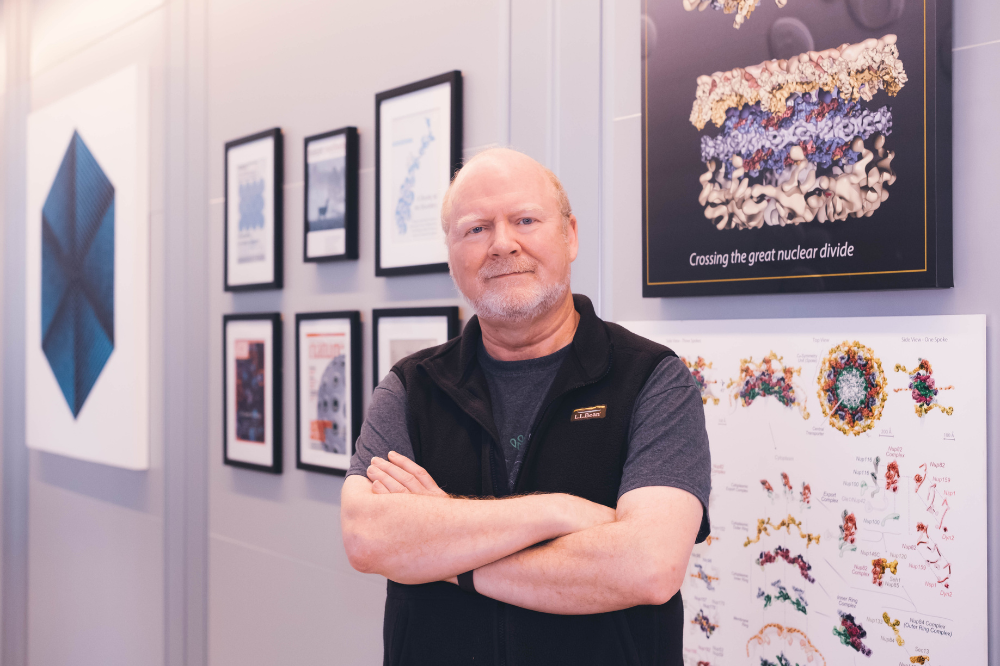
Michael P. Rout (Credit: Lori Chertoff)
Inside each of your cells, there lies the nucleus, its master command center. Protected inside each nucleus are your chromosomes, containing all the genetic instructions for making proteins. To keep the body operating smoothly, proteins, RNA molecules, and molecular signals must constantly flow in and out of this cellular HQ, mediating which genetic instructions are used when.
Nearly all of that two-way traffic passes through the same gateway: the nuclear pore complex.
The nuclear pore complex, or NPC, is far more complex than a simple doorway. Hundreds of individual proteins come together to form the NPC, which acts as an active player in controlling how genetic information is used. When it doesn’t function right, some cellular messages don’t make it to their final destinations. The consequences can range from cancer to neurodegeneration to life-threatening viral infections.
Michael Rout, the George and Ruby deStevens Professor and head of the Laboratory of Cellular and Structural Biology at Rockefeller University, has spent his career parsing the inner workings of the NPC. We spoke with him about what makes this molecular machine so remarkable and how this work could open a new frontier in medicine.
You’ve been studying the nuclear pore complex for several decades. How has the field’s thinking about the importance of the NPC changed in that time?
When I started, the prevailing view was that the NPC was like a Swiss watch—an enormously complex, precisely tuned machine where if you damaged any part of it, the whole thing would simply shut down. But when we actually started taking it apart, we found the opposite was true. You could delete the genes for many of its components and cells kept growing. It turned out to be tremendously redundant and resilient. That changed our thinking completely. We now know that the NPC can tolerate partial disruption and keep functioning.
The downside of that resiliency is that diseases can exploit it. Hundreds of diseases—cancers, neurological disorders, viral infections—are now known to be associated with defects in nuclear transport or the NPC itself.
At the same time, it has emerged that the NPC is really a nexus for a lot of crucial processes. It doesn’t just passively sit there and allow nuclear transport, but rather acts as an organizer for this whole assembly line that’s in place to keep our cells alive. This infinitesimal portal is what maintains communication between the genetic material in the nucleus and the entire rest of an organism.
How do you study something this small and complex?
It requires the ability to make sense of a staggering amount of data. The approach we’ve taken is to gather and combine as much information as possible about the NPC, using many different complementary methods, and integrating all of that into a single, comprehensive picture. Early on, that meant isolating the NPC and using mass spectrometry to identify every protein it’s made of. From there, we could start asking where each piece sits within the structure.
Over the years the technology available to do this work has become extraordinary. With cryo-electron microscopy, we can now flash-freeze the NPC and visualize it at near-atomic resolution, which was simply unthinkable when I started. More recently, we’ve been able to watch the NPC in action in real time, at millisecond resolution. When we get all this data, we put it together into computational models that let us simulate how the whole system behaves.
Your lab proposed a model called the “virtual gate” to explain how the NPC controls what passes through. What does that mean in plain terms?
For a long time, people assumed the NPC must work like a physical gate, either dilating and contracting like an iris, or using motor proteins to actively pull cargo through. When we identified all the NPC’s components and found no motor proteins, we had to fundamentally reevaluate the science—nature was making it made clear that our previous ideas were wrong. What we found instead was that the central channel is packed with flexible, constantly moving protein chains—so dense and so mobile that they create a barrier without being a physical wall.
We called it a virtual gate because whether it’s open or closed depends entirely on whether you can bind to those protein chains. If you’re carrying the right molecular signal, you get through. If not, you’re excluded. It’s like a crowded dance floor where only those with the right partner can move.
What we’ve discovered more recently is that transport factors don’t just pass through. They continuously reshape those protein chains, making the barrier even more dynamic than we first thought.
How is the NPC linked to disease?
Many diseases gain a foothold by disrupting the flow of molecular messages in and out of the nucleus. What’s really interesting is that different cancers and viruses keep targeting the same small subset of NPC components to do it.
Pretty much every virus that’s been sufficiently studied seems to have evolved to target the NPC of human cells very early in infection. The viruses hijack the transport machinery so that the cell’s innate immune response can’t kick into action and produce new proteins to fight the viruses.
With cancer, the picture is similar. Normally, cells produce proteins that can trigger the cells to self-destruct if they begin growing too quickly and aggressively. Often, cancer cells subvert this by ramping up nuclear export, hustling those protective proteins out of the nucleus before they can act. Selinexor, an FDA-approved drug for certain blood cancers, works by blocking that excess export through the NPC, keeping those protective proteins inside the nucleus where they can do their job. Because we now know that the NPC can be targeted therapeutically, this could represent a major untapped area for future medicine in multiple diseases.
You’ve been building increasingly detailed computational models of how the NPC works. For a while now, scientists have dreamed of creating a virtual model of an entire cell, which could dramatically accelerate all kinds of discoveries. Do you see your work contributing to that larger quest?
Because the NPC sits at the crossroads of so many cellular systems, a complete enough model of it could let us begin to simulate how all those systems work together. That’s the dream of the virtual cell: a computational model of a living cell detailed enough that you could test, for example, how a disease mutation changes the flow of molecules in and out of the nucleus, or screen potential drugs without ever stepping into a wet lab. We’re not there yet, but the NPC is a remarkable place to start because so much has to pass through it. Understanding this one machine in full detail gets you surprisingly far toward understanding the whole cell.
What’s the biggest open question you’re still trying to answer?
We still don’t fully understand the details of how the virtual gate actually works at the molecular level. The protein chains that fill the channel aren’t the same all over; there appear to be different zones with different behaviors, possibly even separate lanes for different types of cargo. Figuring out that internal organization is where a lot of our energy is focused right now. I think getting that worked out could be the key to being able to control the flow of traffic through the NPC for therapeutic purposes.
I think this field is a perfect example of how studying the fundamental machinery that keeps our cells running yields discoveries that can offer powerful new insights into human disease.