How cells move and change shape—and why it matters for our health
 COPY LINK
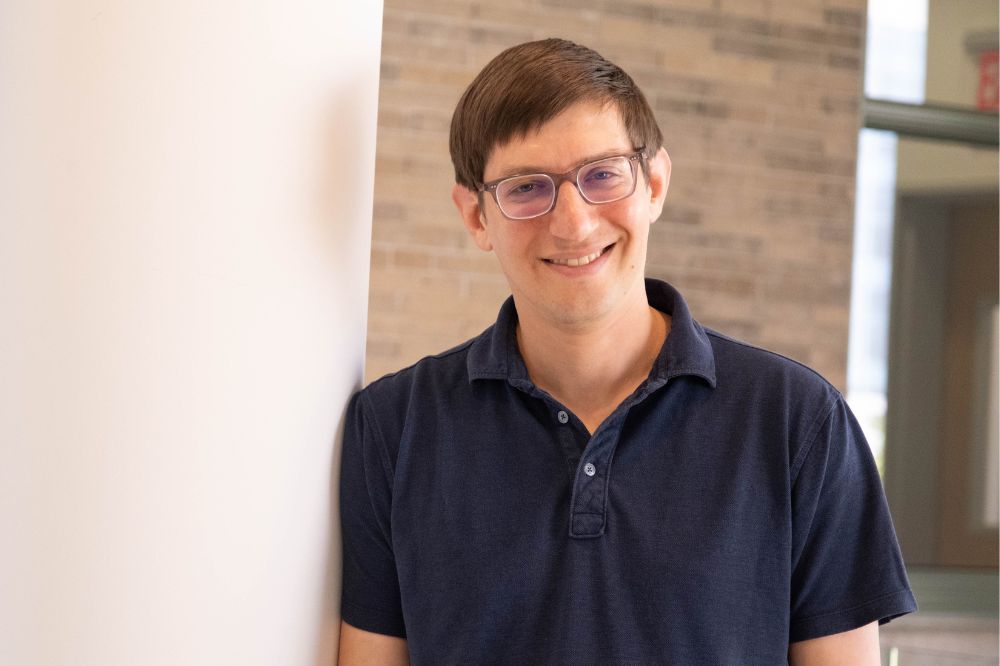
Gregory M. Alushin (Credit: Lori Chertoff)
Inside each of your cells, there’s a microscopic scaffolding that helps determine what the cell looks like, how it moves, and how it responds to its surroundings. This internal structure, called the cytoskeleton, is constantly shifting and adjusting. It braces, flexes, and even senses physical forces, allowing cells to move, divide, and interact with the world around them—processes that go awry in developmental disorders and in diseases like cancer.
Gregory M. Alushin, head of the Laboratory of Structural Biophysics and Mechanobiology at Rockefeller University, wants to uncover how the cytoskeleton works at the most fundamental level—crucial information that’s currently poorly understood. So his lab studies how cells use mechanical force—pushing, pulling, stretching—to shape their behavior, and how proteins deep inside the cell respond to those forces.
It’s the kind of basic science that could make a big impact on medicine. By learning how cells physically sense and respond to their environment, Alushin hopes to lay the foundation for new therapies that address cancer, developmental disorders, tissue engineering, and more.
We spoke to Alushin about what he most wants to know about the cytoskeleton and where his research could lead us.
Let’s start with the basics. What is the cytoskeleton, and why should people care about it?
Cells in our bodies have very elaborate shapes that are important for what they do; a nerve cell must have long extensions to send and receive messages throughout our body, for instance, and a blood cell must be flexible enough to squeeze through tiny blood vessels. Cells need to be able to move, change shape, divide, and respond to physical cues to function. All of that is executed by the cytoskeleton, a network of molecules that create structures within the cell. Without it, a cell would be an immobile blob.
Most people think of a skeleton as something relatively rigid and fixed. But the cytoskeleton is incredibly dynamic. It is made of this big network of proteins that form long filaments. They’re sort of like the girders in a building, but the cool thing about these cellular girders is that they can grow, shrink, and be rearranged over the life of the cell.
How do problems with the cytoskeleton lead to disease?
There are a lot of birth defects and developmental disorders where your cells don’t go to the right place in the body or don’t turn into the right kind of cell. There is increasing evidence that the ability of the cell’s cytoskeleton to sense or generate force is important for that; cytoskeleton defects might make it so that cells either cannot interpret where in the body they are, or might not be able to move correctly. Rearrangements of the cytoskeleton are also vital to how cancer cells form tumors and migrate through the body.
Right now, scientists know very little about how the cytoskeleton senses and generates force. So we can’t even begin to target these problems with drugs yet. That’s why my lab is focused on figuring out how a healthy cytoskeleton works—so that we get a sense of how these molecules can misbehave in developmental diseases or cancer, and what kind of therapies might correct them.
So what does your lab most want to figure out?
We’re trying to understand two big, foundational things. The first is how mechanical forces, like pushing, pulling, or stretching, change the behavior of individual proteins in the cytoskeleton. These proteins aren’t just passive scaffolding; they actually sense and respond to force. But right now, we don’t know how that sensing works. If you apply force to a particular protein, how does it change? Does it mechanically shift shape? Chemically trigger a signal? We want to get molecular-level answers to those questions.
The second big area we’re exploring is how groups of cytoskeletal proteins come together to form functioning networks inside cells. A cell doesn’t just have one or two of these proteins; it has thousands, and they’re constantly assembling and reassembling into complex, dynamic structures. We want to understand how those networks organize themselves to carry out specific tasks like movement or shape change. There’s no central controller telling proteins where to go, so how do they coordinate their behavior to build something useful rather than assemble a pile of molecular junk?
These basic science questions are crucial for figuring out how the cytoskeleton works in both health and disease.
In working at the molecular scale, how do you study the intersection of these tiny proteins with physical force?
We use a technique called cryo-electron microscopy (cryo-EM), which is an imaging tool widely used in many scientific fields. But our lab needed to find a way to use cryo-EM to see something that no one had ever been seen before: detailed snapshots of cytoskeletal proteins that have been flash-frozen in action.
To do that, we developed a new method for delicately applying force to these miniscule proteins. We do that by taking advantage of molecules that we already know cause the cytoskeleton to change; they are called natural motor proteins and they use cellular energy to tug, twist, or push on the cytoskeleton. We mix these motor proteins with cytoskeleton proteins, giving them fuel, and then freeze everything to capture the protein shapes under force. This gives us a much more interesting—and unprecedentedly complex—picture of how they operate, than we would get if we just looked at the passive structure of these proteins sitting around on their own.
What has your lab discovered?
One of our big findings is that when a molecular motor called myosin pulls on filaments of actin—a main building block of the cytoskeleton—it can actually contort the actin into spiral shapes, which we did not expect. That shape change affects how other proteins interact with actin, which helps explain how cells might sense and respond to mechanical force.
For instance, in one recent paper, we showed the importance of myosin and actin’s interactions to how hair cells correctly develop the ability to sense sound. When mice or humans have a mutation in a particular myosin protein, it doesn’t interact with actin correctly and the mice end up deaf. That’s just one example of the kind of problem that can result when the cytoskeleton doesn’t form properly in a particular cell type.
Earlier this year, we also studied a protein called fascin, which helps cells build thin, finger-like projections that are important for sensing the environment and moving. Fascin’s job is to bundle actin filaments together tightly. We know that cancer cells have high levels of fascin, and it helps them spread throughout the body. We also know that mutations in fascin can cause some rare genetic diseases. When we used our technique to look at fascin bundles, what surprised us is how flexible fascin is. It was much more complex than we expected, and helps explain why fascin is so critical to dynamic cell movement. Drugs targeting fascin’s behaviors are already in clinical trials to treat some cancers. Our work could help make even better drugs that are more effective and work in more kinds of cancer.
What comes next for your research?
The next step is crucial. We’re working on moving these techniques from simplified systems into living cells, where things are a lot more complex—and much more relevant for health and disease. Inside a real cell, cytoskeletal proteins don’t act alone; they’re part of huge networks of molecules responding to all kinds of signals and stresses. We want to understand how those proteins behave under force in this context. That’s a major technical challenge, but it’s essential if we want to connect what we’re seeing at the molecular level to actual biology.
At the same time, we’re focusing more on proteins that are directly linked to human disease, especially ones like fascin that are involved in cancer or developmental disorders. A big goal here is to figure out how we might intervene when things start going wrong.