What could an ant’s sense of smell teach us about social organization?
 COPY LINK
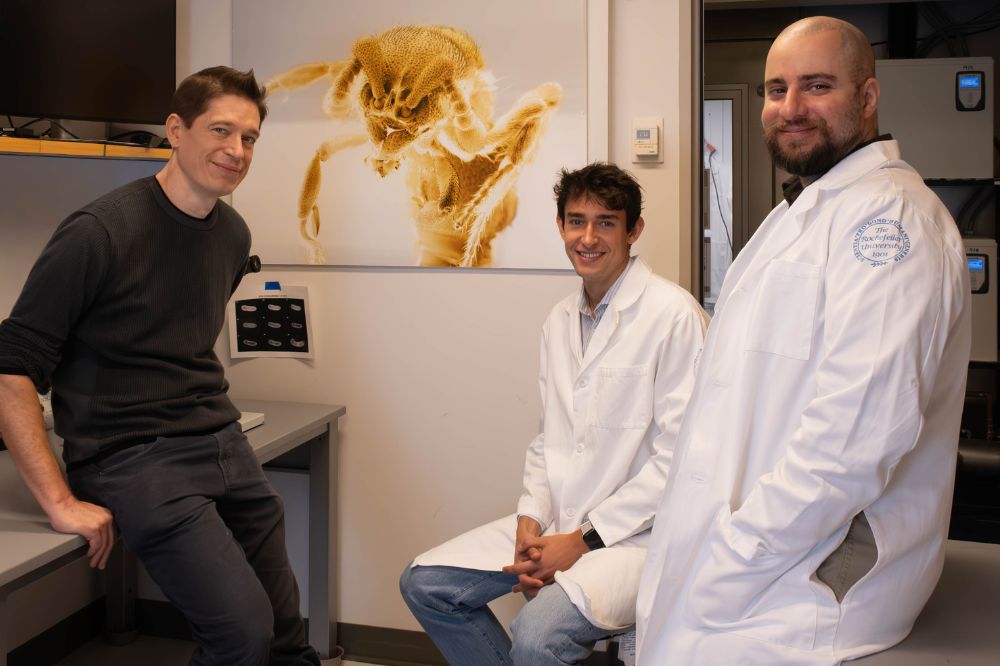
Daniel Kronauer, Giacomo Glotzer, and P. Daniel H. Pastor, pictured above, have uncovered a unique mechanism of olfactory neuron expression. (credit: Lori Chertoff)
Ants rely on smell to navigate nearly every aspect of their complex social lives. Thus, investigating their olfactory system, scientists believe, will reveal clues about the organization of ant society.
But olfaction is one of the least understood senses across species. In ants alone, there are hundreds of lookalike odorant receptor genes that, in theory, should lead to a mish mash of mixed signals. So any attempt to understand the system has to first answer a key question: how do these insects ensure orderly processing of their most crucial sensory system?
Daniel Kronauer’s lab recently uncovered the molecular safeguard that prevents olfactory chaos—a form of gene regulation that ensures each neuron activates just one receptor. The work reveals a previously unknown strategy for controlling large clusters of related genes.
We asked Kronauer, head of the Laboratory of Social Evolution and Behavior, and graduate students Giacomo Glotzer and Daniel Pastor about how this finding reshapes our understanding of gene regulation in insect olfaction—and where it may ultimately lead us in the quest to understand how genes connect to behavior.
Why is your lab interested in studying ants’ sense of smell?
Daniel Kronauer: Animal societies are built on communication. Humans communicate via facial expressions, as well as spoken and written language. We have dedicated areas of our brains that are particularly responsive when we see faces, and others that process and produce spoken language. Social insects, on the other hand, communicate primarily via pheromones. They have a chemical language; that’s why, for instance, ants have a massive olfactory center in their brains.
In our new study, we discovered a new form of gene regulation at the center of ant olfaction, which is a step toward understanding how the ant brain processes chemical cues and, therefore, how ants communicate
Why was it important to study these phenomena in ants, specifically?
DK: Researchers have been working on fruit flies for decades, and there is now a vast amount of information about their genetics and neurobiology. However, as our study illustrates, if you shift focus and look at less conventional study species, like ants, you can not only discover new things about their biology, but also fundamental molecular phenomena that are new and that don’t exist in the conventional model systems. After observing a different form of gene regulation in ants, we now suspect that the ant mechanism is actually used more broadly across insects. We don’t know yet, but fruit flies could turn out to be the odd ones out!
What’s the next step in mapping out the relationship between odor receptors and neurons?
Giacomo Glotzer: While our paper helps explain how ants lock in the expression of a single odorant receptor, we still don’t understand how each cell chooses which receptor to express in the first place. Solving this next bit of the puzzle is one of our top priorities. To start, we want to see whether cells in each compartment of the antenna always express the same receptor(s) across individuals. Next, we hope to probe the molecular constraints on receptor choice. Finally, we aim to test how the mapping of neurons to receptors reacts when a new receptor evolves.
These approaches may shed light on why the ant is such an olfactory specialist.
How can studies like these help us better understand the relationship between genes and behavior?
Daniel Pastor: To me, the peripheral nervous system is a fascinating and rich place to start thinking about behavior. The olfactory sensory neurons provide the inputs that allow the ant to understand its world and to then behave in response to it. Therefore, by understanding the development, receptor identity, tuning, and innervation into the brain, we begin to understand the chemical picture that the ants see.
Similar to how in medicine we are bridging our understanding of the mind and brain, we hope to someday connect the dots between how these signals picked up by olfactory neurons translate to the social behaviors that are vital to ant colonies.