Inside the Cycle of Scientific Glassware
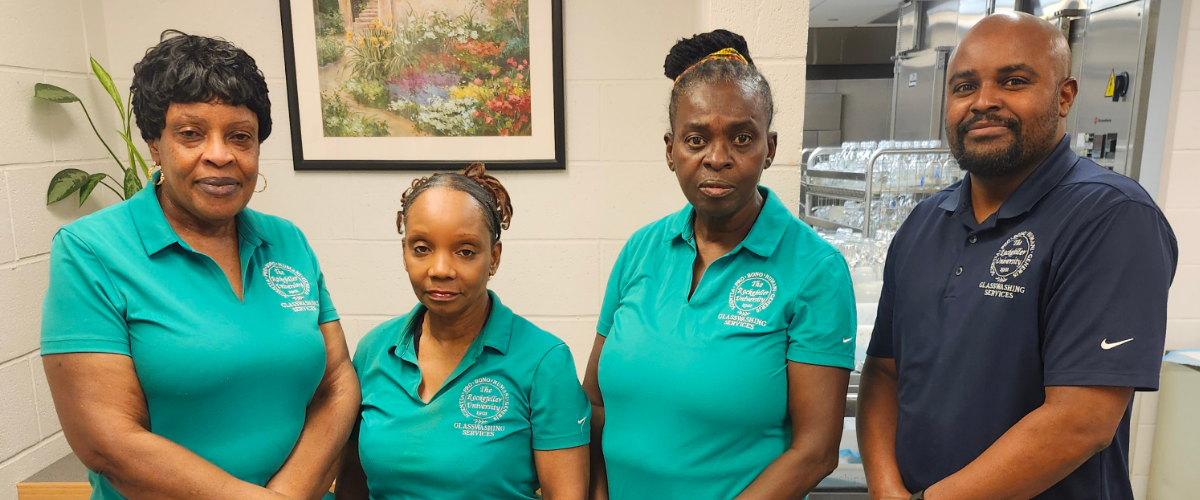
The Glasswashing team
From contamination control to rapid turnaround, Rockefeller’s Glasswashing operation supports the day-to-day demands of laboratory research.
Across the Rockefeller University, thousands of pieces of scientific glassware move continuously between laboratories and the university’s Glasswashing operation. Flasks, bottles, pipettes, and beakers collected from research labs are cleaned, sterilized, inspected, and returned to researchers, often within hours, to support ongoing experiments across campus.
Each item must be carefully tracked, inspected for residue or contamination, sterilized when necessary, and returned to the correct laboratory. Inside the facility, the workflow combines logistics, quality control, safety procedures, and coordination with laboratories across campus.
The Glasswashing team processes approximately 600 pieces of glassware per day, or nearly 3,000 pieces each week, while maintaining rapid turnaround times for researchers.
“Without Glasswashing many labs lack the ability to properly clean and sterilize their glassware,” says Khalil Koiner, who has worked in the facility for about 14 years. “So, reliance on the Glasswashing facility is essential for many.”
A typical day begins with collecting used glassware from laboratories across campus. Once transported back to the facility, materials are logged before entering the washing process. Detailed notes help ensure that glassware from different laboratories remains separated throughout washing, drying, and delivery.
Quality control plays a central role throughout the operation. After washing, each piece is inspected individually, often by holding the glassware up to the light to detect any remaining residue or contamination. If needed, items may be rinsed again with distilled water, soaked overnight, or rewashed before sterilization.
“We check all glassware to make sure there is no residue in it,” explains Lourdes Matthew, who has been part of the Glasswashing team for 29 years.
The facility also handles autoclaving services for laboratory media and other materials requiring sterilization. Safety procedures are integrated into every step of the workflow. Protective equipment is used while handling glassware, liquids, detergents, and sterilization equipment. Broken or cracked glassware presents an additional hazard and must be managed carefully to avoid injuries.
“Labs should be reminded not to place broken or cracked glassware in bins for pickup because this is dangerous,” Koiner notes. “And to rinse glassware before placing them in the dirty bins. Residue that goes unnoticed can spread throughout the washer and into other glassware.”
The operation also requires constant communication with laboratories when materials are ready for pickup, when delays occur, or when improperly prepared items require attention. The work depends not only on technical consistency, but also on careful organization across campus.
For Beverley Guthrie-Turenne, who has worked in Glasswashing for more than 12 years, teamwork remains one of the most important aspects of the job. “We work as a team,” she says. “I love my job.”
Researchers occasionally stop to thank the team or acknowledge the importance of their work, small interactions that reflect the close relationship between the facility and the laboratories it serves.
From contamination control and sterilization to rapid turnaround and coordination with laboratories, Rockefeller’s Glasswashing operation supports a critical part of the university’s day-to-day research activity.
To learn more about the Glasswashing Services, visit https://www.rockefeller.edu/glasswashing/.
To read more news about the Scientific Resource Centers, visit https://www.rockefeller.edu/researchsupport/news-and-announcements.