With Hatten’s election, the Rockefeller faculty now has 39 members or foreign associates of the National Academy of Sciences.

Scientists have discovered a common mutation that might explain why some people have trouble going to sleep at night and getting up early. The gene alteration slows the internal biological clock that regulates our sleeping patterns.

In some people whose cognitive functions are weakened due to Alzheimer’s, the disease can be traced back to changes in the brain’s blood vasculature. Scientists have found that a protein involved in blood clotting and inflammation might offer a potential path to new drugs.

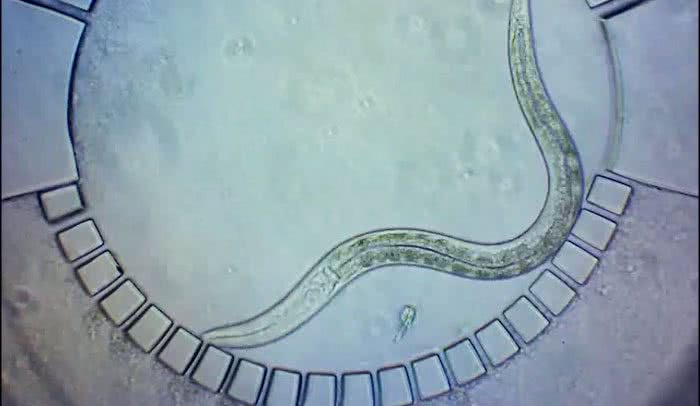
Two new technologies are helping scientists understand new aspects of organ and nervous system development in C. elegans. One allows them to image worms developing in a natural environment, while the other makes it possible to track single neurons as the worms grow.

Since the first case was documented in the United States in 1938, the causes of autism have remained elusive. Hundreds of genes, as well as environmental exposures, have been implicated in these brain disorders. Sex also seems to have something to do with it: About 80 percent of children diagnose...

Late last year, guests at the President’s House raised a glass in celebration of one of Rockefeller’s most beloved colleagues. In his nearly 35 years at Rockefeller, Paul Greengard has led pioneering studies that have transformed our understanding of how the nervous system works, and have paved ...

As much as we try to avoid it, ­we are constantly sharing germs with those around us. But even when two people have the same infection, the resulting illnesses can be dramatically different—mild for one person, severe or even life-threatening for the other. Now, new research from The Rockefell...

As he opened this year’s Talking Science lecture, geneticist Jean-Laurent Casanova made a stark observation to his teenage audience: “If we had been here 150 years ago, about half of you would already have died.” The primary reason, he told the 350 high school students and 60 teachers present,...

You can anticipate a color before you see it, based solely on the length of light waves. Music can be interpreted from notes on a page without being heard. Not so with odor.

 Cocaine is one of the most addictive substances known to man, and for good reason: By acting on levels of the “feel-good” chemical dopamine, it produces a tremendous sensation of euphoria. Now the laboratory of Rockefeller University Professor and Nobel Laureate Paul Greengard has shown...