Hess Center for Research on Women's Health and Biomedicine explores recent advances in its second annual symposium
 COPY LINK
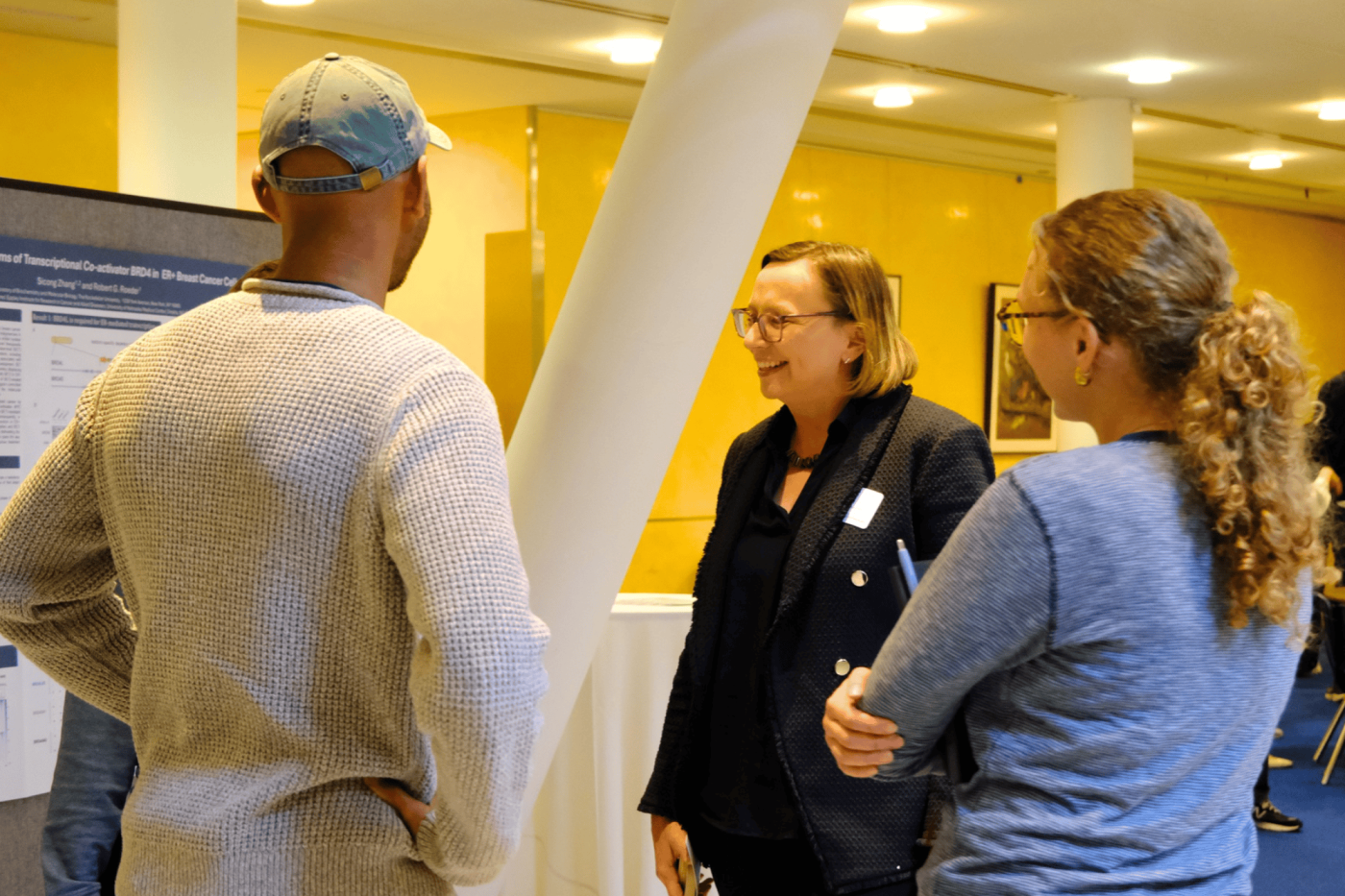
Hess Center head Agata Smogorzewska with two researchers from the center. (Credit: Athena Lackides)
Researchers, postdocs, graduate trainees, and heads of lab from across campus recently gathered for the Marlene Hess Center for Research on Women’s Health and Biomedicine‘s second annual academic symposium. The event showcased a maturing research ecosystem, where initial hypotheses—many of which were put forth by junior scientists—are developing into insights that could transform our understanding of biological sex differences.
The findings presented at the symposium reflect the center’s goal of filling a critical gap in the biomedical sciences. “Clinically oriented women’s health centers are all around us,” says Agata Smogorzewska, who leads the center, as well as Rockefeller’s Laboratory of Genome Maintenance. “However, few of them are positioned to draw on world-class basic science to illuminate what underlies those differences between sexes. This center exists to leverage Rockefeller’s unique scientific strengths to ask fundamental biological questions.”
Advancing into the third year
Since its launch two years ago, the Hess Center has awarded 17 two-year grants to investigators across biological disciplines, with a particular emphasis on supporting junior scientists as they pursue independent research.
Several presentations focused on why diseases affect men and women differently. Charlotte Wayne of Ekaterina Vinogradova’s Laboratory of Chemical Immunology and Proteomics explored sex differences in multiple sclerosis, identifying significant differences in the behavior of brain immune cells in male and female mice early in disease. Mariana Nogueira Batista of Charles M. Rice’s Laboratory of Virology and Infectious Disease tackled a related question in liver disease, finding that female mice develop organized immune cell structures that may help protect against the liver damage associated with chronic viral hepatitis. And Dana Orange of Robert Darnell’s Laboratory of Molecular Neuro-oncology examined how inflammation in the joints of women with knee osteoarthritis may interfere with cartilage repair and undermine the cells responsible for maintaining healthy tissue.
Other researchers examined how sex differences shape fundamental biological processes. Lishu Yue of Paul Cohen’s Weslie R. and William H. Janeway Laboratory of Molecular Metabolism identified a gene that plays a critical role in maintaining healthy brown fat, which helps the body generate heat. Female mice lacking the gene struggled to maintain their body temperature in the cold, while males appeared to be able to compensate. Keiichi Ito of Robert Roeder’s Laboratory of Biochemistry and Molecular Biology explored how different genetic programs help maintain skeletal muscle health in males and females, identifying mechanisms that may be particularly important for preserving muscle function and energy metabolism in women. And Lily Yu of Tarun Kapoor’s Selma and Lawrence Ruben Laboratory of Chemistry and Cell Biology examined molecular safeguards that ensure chromosomes are properly separated during egg development.
A third category of presentations explored the molecular and genetic mechanisms underlying sex differences. Shixin Liu, head of the Laboratory of Nanoscale Biophysics and Biochemistry, demonstrated how a protein complex called BAF moves proteins along DNA, a finding with implications for X-chromosome inactivation. Li Zhao, head of the Laboratory of Evolutionary Genetics and Genomics, presented findings suggesting that differences in the variability of gene expression between males and females, particularly among immune-related genes, may help explain why autoimmune diseases are more common in women than men. And William Snyder of Charles Gilbert’s Laboratory of Neurobiology explored differences in sensory processing associated with autism, examining how the condition may manifest differently in females and potentially contribute to underdiagnosis in women and girls.
The symposium also featured a poster session showcasing work on metabolism, gene regulation, and immune function, which further underscored both the breadth of sex-based biology research at Rockefeller and potential opportunities for collaboration across disciplines.
Reflecting on the progress made in the center’s first two years, and her hopes for a productive third year that is already underway, Smogorzewska expressed gratitude. “This center exists thanks to the generosity of Marlene Hess,” Smogorzewska said. “She is keenly interested in the center’s mission and has been a steadfast supporter of our university. I’m really grateful for her support of the center and of the many scientists who are here today doing great work.”