Marie Skłodowska-Curie honored with street naming outside Rockefeller
 COPY LINK
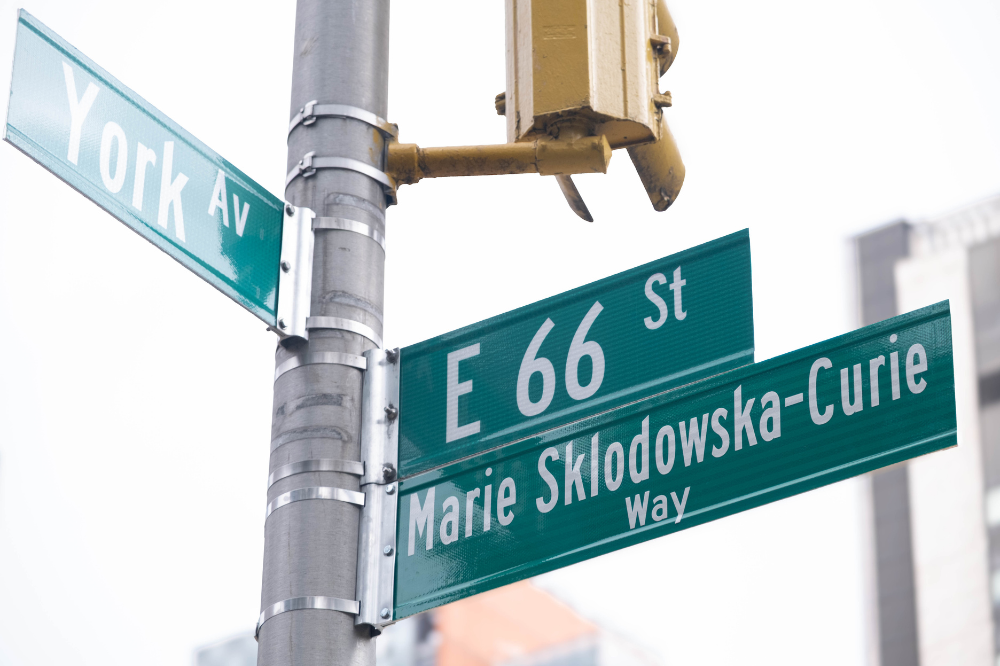
View of the new sign from the south eastern corner of 66th street. (Credit: Lori Chertoff)
Civic leaders, diplomats, scientists, and other proud New Yorkers gathered outside The Rockefeller University at the corner of York Avenue and East 66th Street on November 10 to unveil a street sign honoring the life and legacy of Marie Skłodowska-Curie. The designation, initiated by the Consulate General of the Republic of Poland in New York and held on the eve of Poland’s National Independence Day, recognizes Skłodowska-Curie for work that transformed our understanding of radioactivity and laid the groundwork for advances in cancer treatment.
The new sign is situated between Rockefeller and Memorial Sloan Kettering Cancer Center (MSKCC), and just down the street from Weill Cornell Medicine—standing, quite literally, at the intersection of basic scientific discovery and clinical application. “It is especially fitting that this sign honoring Maria Skłodowska-Curie stands just outside Rockefeller, the birthplace of so many discoveries that have shaped human health,” noted Agata Smogorzewska, head of Rockefeller’s Laboratory of Genome Maintenance, who delivered remarks on behalf of the university.
The street designation also restores a distinction lost to New York’s changing geography. In 1921, Skłodowska-Curie made her first visit to the United States, where she toured Memorial Hospital, the predecessor of MSKCC, and observed early applications of radium therapy in cancer treatment. Her visit followed a fundraising campaign organized by American women, who raised enough money to purchase a gram of radium for her laboratory. Later, in 1935, Mayor Fiorello LaGuardia named a thoroughfare Marie Curie Avenue, but that street subsequently disappeared during construction of what now is the Franklin D. Roosevelt Drive. The new sign restores her name to Manhattan’s street grid, this time including her Polish last name, Skłodowska.
For Smogorzewska, who grew up in Warsaw, Poland before pursuing a scientific career in the United States, the dedication carried particular personal significance. “As a Polish scientist, I have always found Maria Skłodowska-Curie a source of inspiration, especially because both of my grandparents were chemists,” she said. Her grandfather, in particular, was involved in the Polish Radiation Research Society, wrote about Skłodowska-Curie’s legacy, and was a colleague of Alicja Dorabialska, a radiation chemist who studied under Skłodowska-Curie and broke down barriers herself, by being the first woman in Poland to hold a professorship at the Lwów Polytechnic.
“At a time when women faced significant barriers to careers in science, Skłodowska-Curie was an inspiration not only as a scientist making groundbreaking discoveries, but as a person who changed what women could aspire to achieve,” Smogorzewska said.
Born in Warsaw, Sklodowska-Curie studied at the Flying University—a clandestine education movement which operated in Poland during times of partition between Russia, Prussia, and Austria—before moving to Paris in 1891. Working alongside her husband, Pierre, she pioneered the study of radioactivity and discovered two elements, polonium and radium. She became the first woman to win a Nobel Prize (Physics, 1903), the first woman professor at the University of Paris (1906), and the first person to win a second Nobel Prize (Chemistry, 1911). During World War I, she developed mobile X-ray units for battlefield hospitals and later established research institutes in Paris and Warsaw. Her discoveries transformed atomic physics and laid the foundation for radiation-based cancer treatments and modern medical imaging. Her attachment to her homeland was apparent. In his remarks, Consul General Mateusz Sakowicz pointed out that Skłodowska-Curie named the element that she discovered polonium in honor of Poland.
“The world knows her as Marie Curie,” Sakowicz said. “We have to explain to the world that her maiden name was Polish. We have permanently inscribed her into the fabric of New York City, and in doing so, we have inscribed Poland into it.”
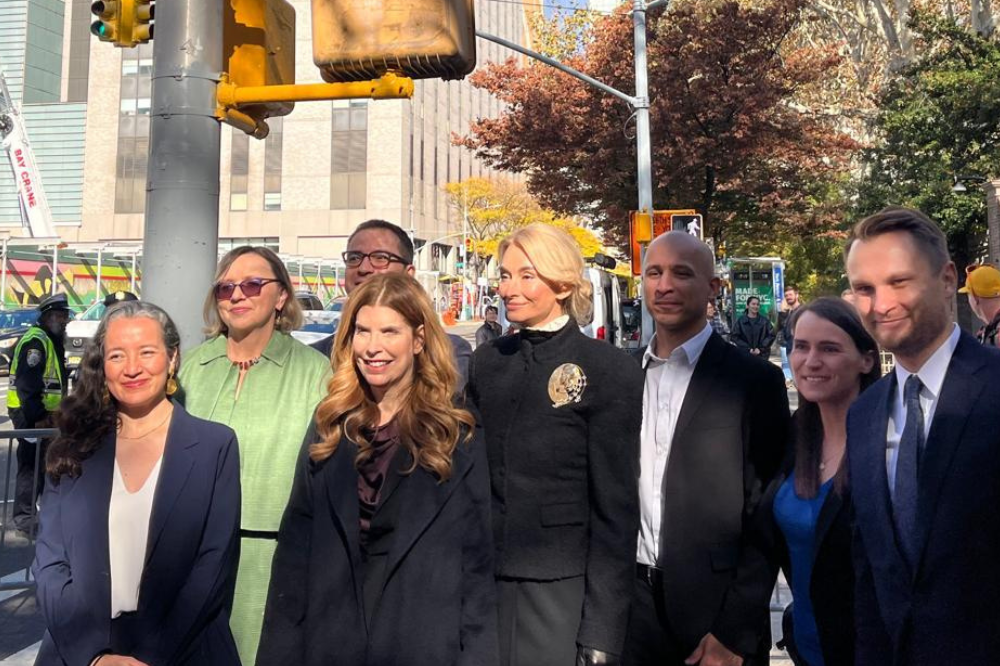
Smogorzewska in green, pictured behind Ana Maria Archila and Julie Menin. Martyna Wojciechowska, Agnieszka Blaska, and Krzysztof Wyscholaski were also in attendance.
The ceremony also featured remarks from New York City Council Speaker Julie Menin, who sponsored the street co-naming legislation; Ana Maria Archila, commissioner of the Mayor’s Office for International Affairs; and Polish journalist and explorer Martyna Wojciechowska, who led the countdown to the unveiling. Polish parliamentarians Agnieszka Blaska and Krzysztof Wyscholaski were also in attendance. In a technological tribute, Polish AI company ElevenLabs recreated Skłodowska-Curie’s voice using archival transcripts of her speeches, allowing the crowd to hear the scientist’s words shortly before the street sign was unveiled.
Smogorzewska concluded her remarks by emphasizing that the new sign is as much about inspiring the future as honoring the past. “I hope this sign will remind the next generation of scientists at Rockefeller and beyond of what is possible: that discoveries beginning with a desire to understand the most basic mechanisms of nature can ultimately transform medicine and human health in ways we could never have anticipated. And of the importance of investing in and supporting the brilliant minds who will make tomorrow’s discoveries.”