Summer Seminars help postdocs polish presentations—and make new connections
 COPY LINK
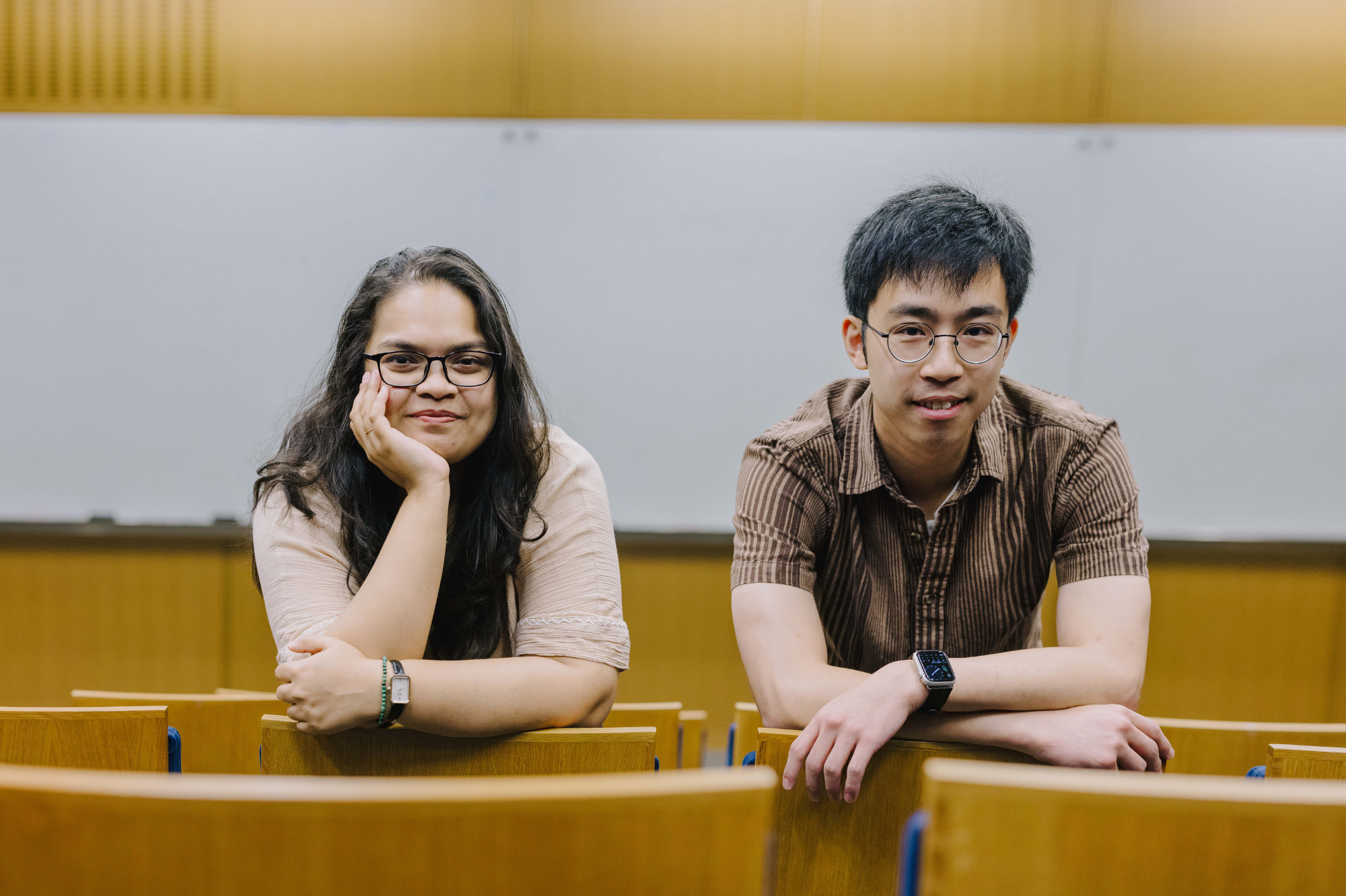
Postdocs Jayeesha Ghosh and Teri Cheng (above), as well as Paloma Bravo (not pictured), organized the 2026 summer seminar series. (Credit: Roshni Khatri)
For more than a decade, the Rockefeller Postdoctoral Association (PDA) has invited trainees to present their current research—and fine-tune their lecture skills—through the annual Summer Seminar Series.
Held every Friday from 3:30 p.m. to 4:30 p.m. in Carson Family Auditorium, each seminar is led by a different head of lab and features presentations by two postdocs. This year’s series began on July 10, hosted by Seth Darst, and runs through August 28, hosted by Elizabeth Campbell. The series is supported by the Office of the President and the Dean’s Office.
“It’s a fantastic opportunity for trainees to practice presenting their work to a diverse scientific audience,” says co-organizer Teri Cheng, who researches how cell cycle–dependent regulation of chromatin affects cell division in the Funabiki lab. “This is especially relevant for people preparing for academic job searches.”
Cheng and his fellow postdocs Paloma Bravo and Jayeesha Ghosh organized the 2026 summer’s series with support from Mercedes Harris, graduate and postdoctoral program coordinator in the Dean’s Office. With an eye on keeping the schedule consistent with the Friday Lecture Series held during the academic year, the trio shifted the event to 3:30 p.m. They also added an ice cream social, which is held directly after outside Carson.
“We hope this creates a more relaxed environment where faculty hosts, postdocs, and graduate students can continue their scientific discussions,” says Ghosh, who researches the molecular mechanisms of DNA replication in the O’Donnell lab. “The seminar series helps participants expand their professional networks and exchange ideas.”
Among the topics covered so far have been the molecular mechanisms of a leukemia-linked complex, the evolutionary mechanisms of behavior, and type III CRISPR-Cas activation. Still ahead are the innervation of fat cells, genetic specialization in the mammalian motor cortex, and the characterization of RNA-protein interactions. The full schedule of talks can be found here.
Much of this research will be new to attendees, notes Bravo, a F. M. Kirby postdoctoral fellow in the Hudspeth lab, where she researches sexual dimorphism and developmental neurobiology. “Many researchers on campus don’t know what people in neighboring labs are working on, and by attending these seminars, they can learn about techniques, research, and questions being asked at RU. Sometimes that triggers collaborations, troubleshooting conversations, or just curiosity about other people’s work.”
That was Albana Kodra’s experience. A member of the Mucida lab, she presented her work on neuronal regulation in food allergies on July 24. “As a speaker, it gave me a great opportunity to present my work to colleagues outside my immediate field, receive valuable feedback, and practice for job talks,” says Kodra, who was also a series organizer in 2024 and 2025. “I think the series does a great job of building community and connecting researchers from different labs, especially during the summer, when campus can feel a bit quieter.”