Peggy Rockefeller concert series kicks off new season
 COPY LINK
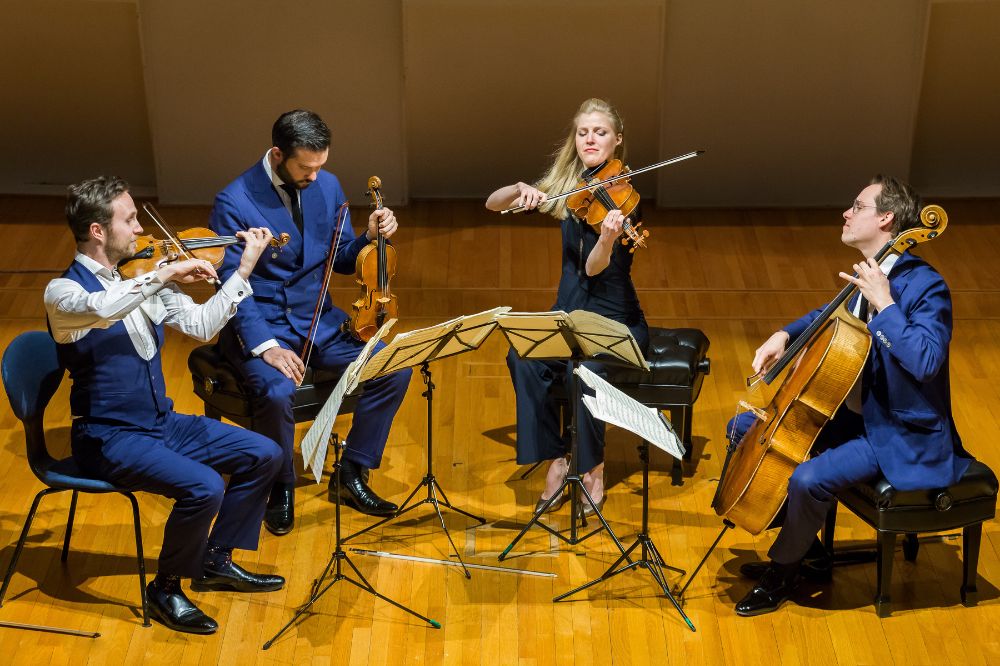
The Doric String Quartet, performing in a Peggy Rockefeller Concert in 2018. (credit: Scott Rudd)
When the first notes of the Beo String Quartet ring out in Caspary Auditorium on September 30, they will launch the 68th season of the Peggy Rockefeller Concerts. This enduring Rockefeller tradition brings world-class musicians to one of New York City’s most intimate and acoustically remarkable performance spaces.
The 2025–26 series presents seven evenings of music between September and May, featuring internationally acclaimed ensembles and soloists. Whether you prefer the resonance of a live performance in Caspary’s fan-shaped, 430-seat hall or the convenience of watching from home via livestream, the series offers different options to experience each concert. Season subscriptions and single-concert tickets are available, with significant discounts for students and postdocs.
From idea to tradition
The concerts began in 1958 when noted chemist and Rockefeller professor Theodore Shedlovsky invited musician friends to perform in the new auditorium. What started as informal gatherings soon became a subscription series of chamber music featuring renowned artists. Nobel Prize–winning neuroscientist Gerald Edelman later took over, continuing the faculty-led effort with minimal administrative involvement.
George N. Reeke Jr., who joined Rockefeller in 1970 to work in Edelman’s lab, began helping with the concerts in 1990. Two years later, when Edelman left for the Scripps Research Institute, then-president Torsten Wiesel asked Reeke to take charge. His first booking was renowned lyric tenor John Aler, a memorable start to his curating role.
Although Reeke officially retired from Rockefeller in 2019, he continues to run the series, spending significant time each year on programming and logistics.
“In the early days, I typed the programs, distributed brochures, and managed the mailing list,” Reeke says. “Now the university handles the administrative work, while I continue to select the artists—my favorite part.”
In 1996, after the death of Peggy Rockefeller, a passionate supporter of the arts, President Wiesel renamed the series in her honor. Her husband, David Rockefeller, a major benefactor and longtime Rockefeller trustee, also supported the concerts financially, helping keep ticket prices accessible while attracting top-tier talent.
Where science and music meet
Selecting the performers is a months-long process. Artist managers send proposals, and Reeke listens to recordings, often on YouTube, weighing repertoire, performance style, and how the music will sound in Caspary Auditorium, celebrated for its distinctive design and superb acoustics. Some musicians will be familiar to Rockefeller audiences, while others are emerging talents.
“I might listen to half a dozen string quartets or pianists before making a decision,” Reeke says. “Sometimes I seek input from my wife, Gail, who plays violin, or other musician friends.”
A lifelong music enthusiast, Reeke sees an intrinsic connection between science and art, he says. “Perhaps so many scientists are drawn to music, because both require similar cognitive skills—keeping track of sequences, attention to detail, and a structured way of looking at the world.”
He notes that Einstein, a violinist and pianist, considered music an integral part of his creative process. And Rockefeller has long reflected this overlap, with both faculty and students who are accomplished musicians as well as pioneering scientists. Members of the tri-institutional community often perform with the Music and Medicine Orchestra, and other ad hoc campus groups.
This season’s programs showcase a range of chamber music experiences, from intimate piano recitals to dynamic group performances. Highlights include Ukrainian pianist Vadym Kholodenko, whose artistry has been praised on the world’s leading stages, and the Dalí Quartet with clarinetist Ricardo Morales, known for blending the Classical and Romantic canon with vibrant Latin American repertoire. The Beo String Quartet shares Rockefeller’s commitment to learning and discovery, bringing chamber music to students of all ages through school programs and residencies. While the concerts have deep traditions, they have adapted to changing times. In-person attendance typically draws a few hundred guests, with others joining via livestream. The virtual option, introduced in recent years, allows audiences to experience performances in real time for the same ticket price. Due to artists’ recording rights, replays are not available.
“These concerts are a gift to the Rockefeller community—faculty, staff, students, and postdocs—as well as to the wider public,” Reeke says. “Music has a unique power to connect people, and I’m glad we can share that here.”