Gruss Lipper Precision Instrumentation Technologies: Building Custom Tools for Rockefeller University Science
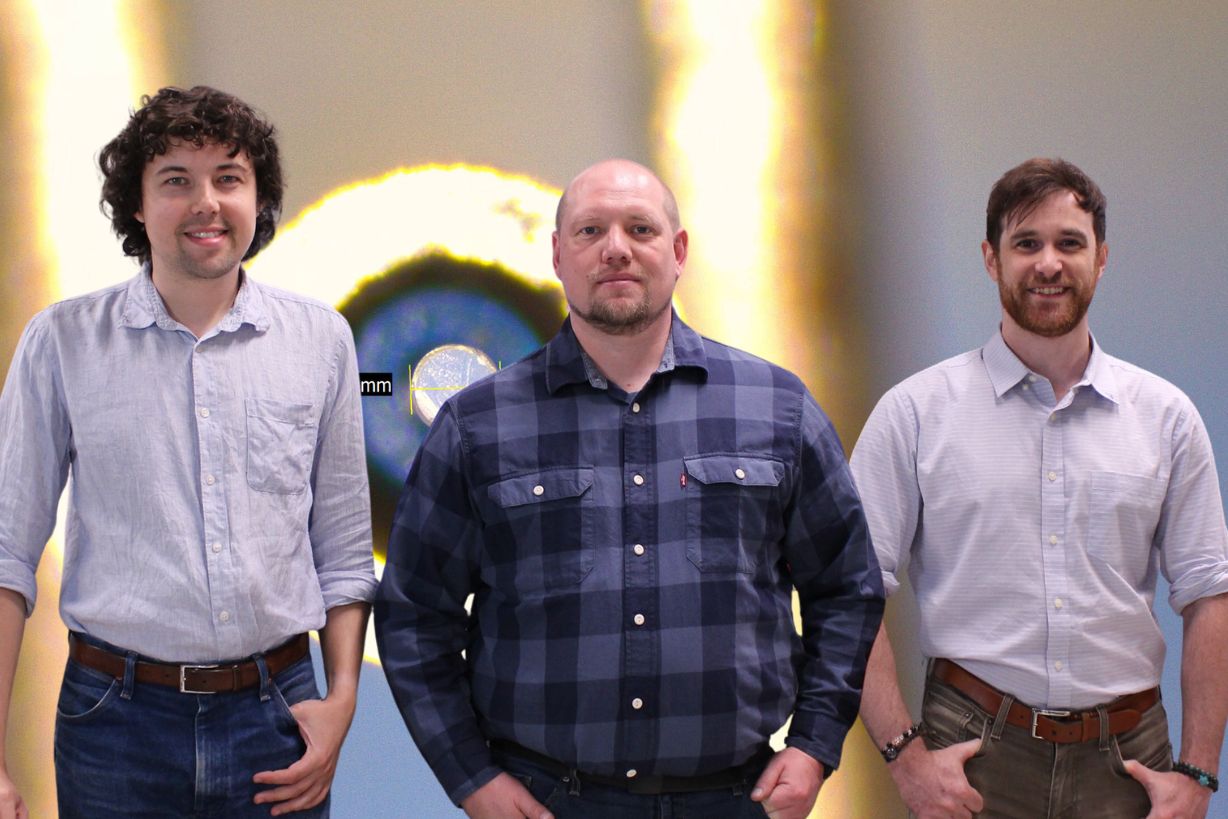
The PIT Resource Center team
The Gruss Lipper Precision Instrumentation Technologies (PIT) center, led by Director Peer Strogies, is the Rockefeller University’s in-house engineering and prototyping resource. The team of engineers at the PIT help to turn scientific ideas into working devices. From electronics to mechanical assemblies, the PIT offers a collaborative problem-solving environment that helps labs design, build, and refine the custom tools that their experiments demand.
A recent project with the Heintz Laboratory is a perfect example of the PIT’s role on campus: the development of an open-source photobleacher for advanced fluorescence imaging of large, pigment-rich human tissues.
Solving the Problem of Autofluorescence
Fluorescence microscopy relies on specific dyes or probes to label cells and molecules. Many tissues, especially human brain samples, are autofluorescent – emitting their own background glow that can obscure the signals from the dyes and probes. Traditional chemical treatments can reduce the autofluorescence but often damage or alter the tissue in the process.
Photobleaching offers an alternative: using intense light to permanently suppress unwanted autofluorescence while preserving the labeled targets. Unfortunately, commercial photobleachers have limited availability and are expensive. While some labs have built their own photobleaching solutions, the published designs often omit key details needed to replicate them.
That’s where the PIT came in.
“We were approached by Tatz Murakami from the Heintz Lab to help develop a photobleacher that could treat whole 3D tissue samples at once,” explained Nick Belenko, instrumentation engineer at the PIT. “He had found only minimal design information in the papers he was reading—basically a couple of blurry photos. We had to do a lot of research and iterative testing to figure it out.”
Engineering Challenges and Solutions
One major challenge was thermal management. Powerful LEDs produce heat, which can damage delicate biological samples.
“If we design the light sources to have as much power as possible without any other considerations you end up with a poorly performing Easy-Bake oven,” said Griffin Dennis, instrumentation engineer at the PIT. “Our job was to ensure the exposure chamber stayed cool while delivering enough light for effective bleaching.”
To address this, the team combined computer simulations of light patterns with empirical thermal testing. They built early mockups out of laser-cut acrylic to quickly validate the design before investing in metal fabrication. Careful airflow design with multiple fans ensured the chamber stayed at safe temperatures, even during long bleaching cycles.
Another innovation was modularity. Instead of one giant LED board that would be expensive to replace if damaged, the PIT team designed tiled 100mm x 100mm circuit boards that connect side by side. Each module is fused independently, allowing easy replacement of individual sections. This approach also makes the device scalable. Labs can adjust the size and power to fit their needs.
“We wanted it to be serviceable and adaptable,” Dennis said. “This isn’t just one device but a platform that can be improved and built upon.”
Collaborative Design with the Heintz Lab
The partnership wasn’t just about fabrication—it was a truly collaborative engineering effort. The Heintz Lab, with Murakami taking the lead on the project, defined the critical optical requirements.
“Tatz determined the wavelengths and color temperature of the LEDs needed to remove the autofluorescence,” Belenko explained. “He also calculated how bright they needed to be and how far away the sample should sit. That gave us our starting dimensions for the enclosure and guided the overall layout.”
Throughout development, the PIT team worked closely with the Heintz Lab to refine the design, adding features like door interlocks to prevent accidental exposure and spill protection on the sample stage—using 3D-printed barriers sealed with epoxy to contain any liquid accidents.
“Working with the PIT turned our concept into a reliable, lab-ready tool. They promptly incorporated feedback from biological experiments and elegantly elevated a rough sketch into a refined device through iterative prototyping. That made all the difference,” said Murakami.
Open-Source and Ready to Share
The final photobleacher design is fully open source, with detailed assembly instructions, wiring diagrams, and parts lists available on GitHub. This commitment reflects the PIT’s mission to lower barriers for research everywhere.
“When we started, there was very little information about how to actually build one of these,” Belenko noted. “We thought any researcher should have an easy, documented path to make one themselves.”
“I’d love to see this become a platform that others can customize and improve for years to come,” added Dennis. “We hope people see that the PIT can help with more than one-off builds—we want to help labs develop robust, shareable tools that support the whole scientific community.”
Supporting Rockefeller Research
Projects like the photobleacher highlight the PIT’s core mission: enabling scientific discovery by solving engineering challenges that come up in cutting-edge research.
For any Rockefeller researcher with an idea for a custom instrument or even just a tough technical problem they want to talk through, the PIT offers initial consultations at no cost.
“We want people to know they can come to us early in the process,” said Strogies. “Our door is open for tours or project discussions anytime.”
For more details and to access the complete open-source design, visit the Photobleacher project on GitHub.
For more information about the PIT Resource Center, please visit the PIT webpage.
Please join our expanding Rockefeller PIT Slack Community to connect, share ideas, and stay updated on new projects.
To read more news about the Scientific Resource Centers, visit the NEWS page.