Clear Reporting, Reproducible Science
How Reporting Standards Shape Microscopy Research
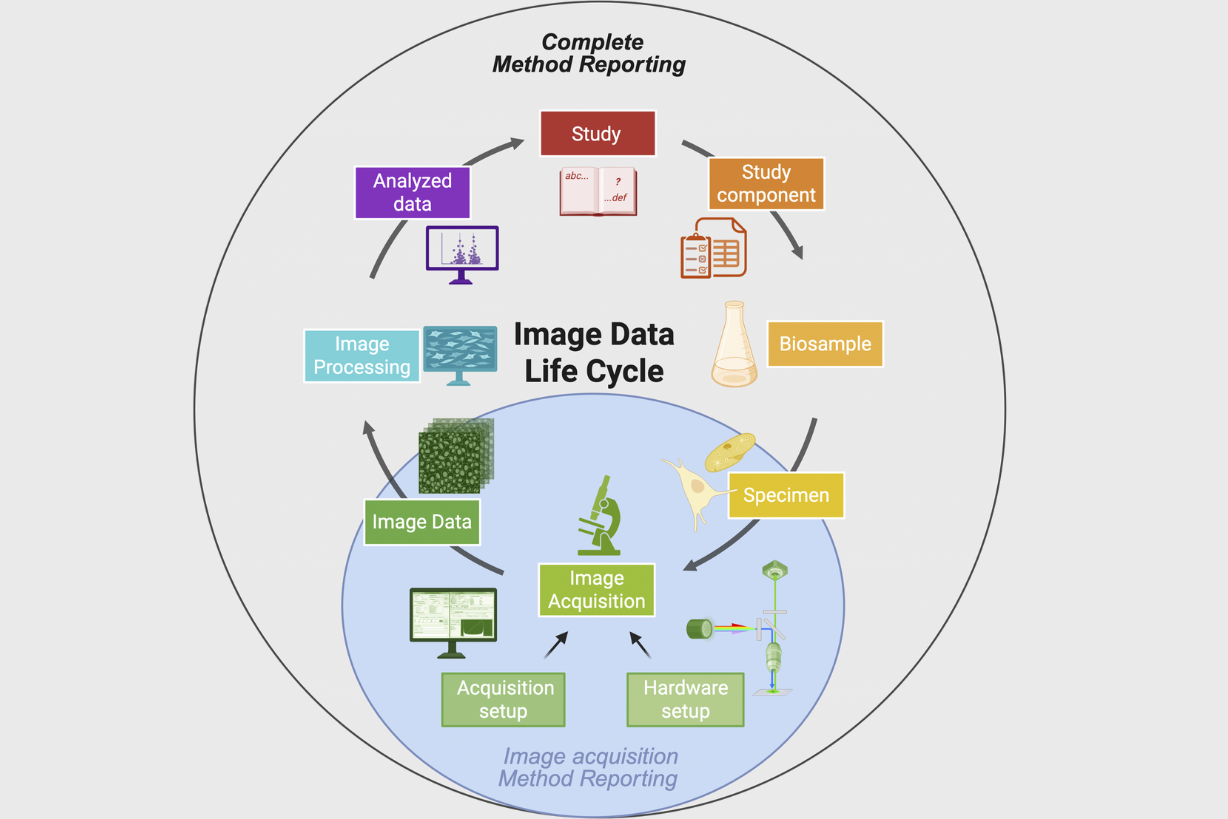
Source: Montero Llopis et al., 2026, Journal of Cell Biology.
What exactly should be included in the Methods section of a paper describing microscopy experiments? For many researchers, the answer has long remained unclear, contributing to broader challenges in reproducibility across the field.
Addressing this issue requires not only technical expertise but also an international consensus on clear and consistent reporting standards.
In a recent publication in the Journal of Cell Biology, members of the QUAREP-LiMi consortium introduced a set of bare minimal reporting requirements for microscopy experiments. The guidelines are designed to help researchers describe essential aspects of their imaging workflows in a detailed, transparent and consistent way.
Dr. Alison North, senior director of the Frits and Rita Markus Bio-Imaging Resource Center (BIRC), is among the contributors to this international effort. “Our goal is to make it straightforward for researchers to know what to report and where to find that information, so that their experiments can be understood and reproduced by others.”
The publication provides practical guidance on what information should be included in the Methods section of a publication, from microscope configuration and acquisition settings to key software parameters. It also includes an educational table that helps researchers identify where this information can be found, whether in instrument hardware, acquisition software or metadata, and how to report it appropriately.
These efforts build on earlier work by the consortium, including a 2024 paper in Nature Methods on which Alison North and Ved Sharma were both co-authors, outlining best practices for describing image data and analysis workflows. Together, these resources aim to establish a shared foundation for transparent and reproducible microscopy research.
Several staff members from Rockefeller’s Bio-Imaging Resource Center are involved in QUAREP-LiMi, participating in an international effort to improve rigor and reproducibility across the field.
For researchers, the impact is immediate and practical. By following these guidelines, investigators can ensure that their experiments are described with sufficient clarity to be understood, evaluated, and reproduced by others.
As microscopy technologies continue to evolve, clear reporting will remain essential. By making experimental details more accessible and consistent, these efforts help ensure that microscopy-based findings can be reliably interpreted, reproduced, and built upon, strengthening the foundation of scientific discovery.
Read the full article here:
https://doi.org/10.1083/jcb.202601032
Reference:
Montero Llopis, P., van Oostende-Triplet, C., Gaudreault, N., Strambio De Castillia, C., Fernandez-Rodriguez, J., Martins, G., North, A., Acevedo, L., Avilov, S., Bertocchi, C., Boehm, U., Cameron, L., Cammer, M., Cleret-Buhot, A., Dietzel, S., Faklaris, O., Gaboriau, D., Guilbert, T., Grunwald, D., … Nitschke, R. (2026). Better reporting is better science: Community-defined minimal reporting requirements for light microscopy. Journal of Cell Biology, 225(3), e202601032. https://doi.org/10.1083/jcb.202601032
To learn more about the Bio-Imaging Resource Center and explore its resources, visit https://www.rockefeller.edu/bioimaging.
To read more news about the Scientific Resource Centers, visit https://www.rockefeller.edu/researchsupport/news-and-announcements.