A new biologic agent—the most potent of its kind so far—is showing early promise as part of a potential new strategy for treating HIV. The drug, known as 10-1074, may also offer a new way to prevent viral infection in people who are at high risk to acquire HIV, the virus that causes AIDS. ...

With the first detailed analysis of a cellular component from a close relative of the pathogen that causes tuberculosis, Rockefeller scientists are suggesting strategies for new drugs to curb this growing health problem. Each year, nearly half a million people around the world are infected with m...

For most people who contract it, dengue fever is a relatively mild-mannered disease—at least the first time around. For some, however, a subsequent infection by the virus unleashes a vicious and potentially deadly illness. New research from a team based at The Rockefeller University has begun t...

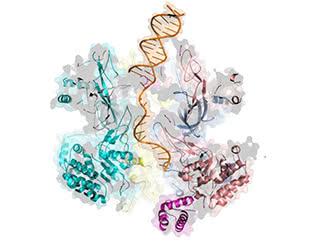
Our DNA contains instructions crucial for virtually all forms of life on this planet. But for life to propagate, this blueprint must be copied and passed on to future generations. New findings describing the structure of a key molecule involved in DNA replication place another piece in the puzzle...

In response to an executive order on immigration issued by President Donald J. Trump Friday, Rockefeller University President Richard P. Lifton today released the following statement: We at Rockefeller University, a world-renowned center for research in the biomedical sciences, oppose both the sp...

Each cell in the body follows a strict protocol for manufacturing the proteins it needs to function. When a cell turns cancerous, however, its protein production goes off script. A new study led by researchers at the Rockefeller University takes a close look at one way in which this procedure goe...

Without antiretroviral drug treatment, the majority of people infected with HIV ultimately develop AIDS, as the virus changes and evolves beyond the body’s ability to control it. But a small group of infected individuals—called elite controllers—possess immune systems capable of defeating the ...

Elaine Fuchs, Rebecca C. Lancefield Professor and head of the Robin Chemers Neustein Laboratory of Mammalian Cell Biology and Development, has been honored with the 2017 McEwen Award for Innovation. The prize, given by the International Society for Stem Cell Research, recognizes groundbreaking wo...
Using a state-of-the-art imaging technology in which molecules are deep frozen, scientists in Roderick MacKinnon’s lab at Rockefeller University have reconstructed in unprecedented detail the three-dimensional architecture of three channels that provide a path for specific types of ions to travel...

Gregory M. Alushin, assistant professor and head of the Laboratory of Structural Biophysics and Mechanobiology, has been chosen by President Obama as one of 102 researchers to receive the Presidential Early Career Award for Scientists and Engineers, the highest honor given by the U.S. government ...