For musically inclined scientists, similarities between music and science yield benefits for both
 COPY LINK
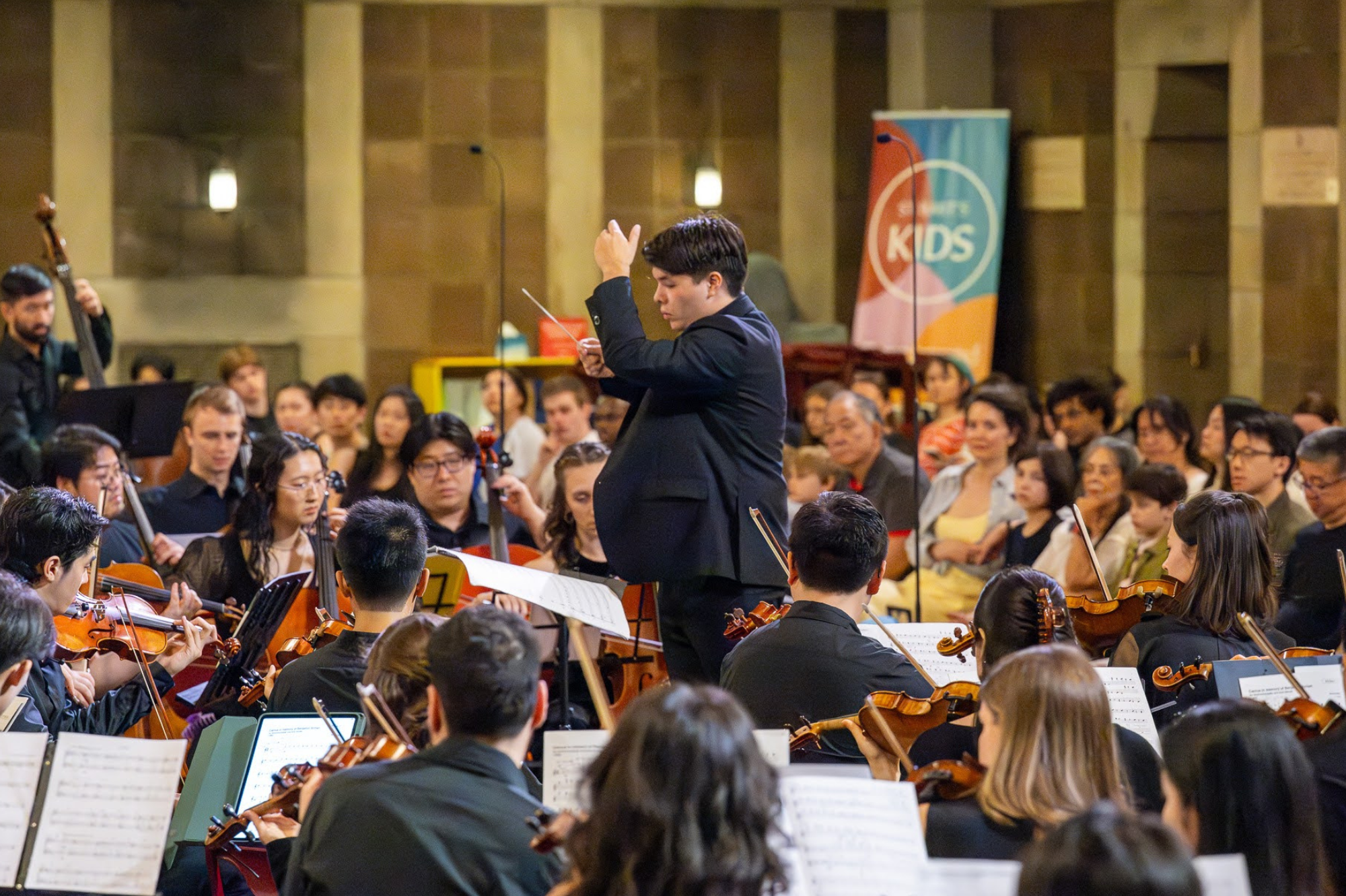
The Music & Medicine orchestra performing at Saint Bartholomew’s Church last spring (Credit: Ritwik Baidya)
A research team in a lab and an orchestra on stage aren’t so different. Whether conducting a successful experiment or playing a complex symphony, each group requires collaboration, technique, a range of instruments, good timing, and creativity in order to produce good results, whether that’s new data or a thrilled audience.
“In the lab, we’re constantly repeating the same experiments with little tweaks to ask new questions, and when playing an instrument, we’re playing the same notes over and over again but also making decisions about the mood we want to convey in a piece, which might require switching up the technique or creating a new arrangement,” says Charlotte Bell, a classical cellist and a Ph.D. student in Elaine Fuchs’ lab, where she compares skin stem cell gene expression during different phases of life.
Bell is one of the founders of the Rockefeller Chamber Music group, which has given two performances on campus and has more planned for the future. She and her musical collaborators are among the many scientists at Rockefeller who are also committed musicians. Some are HOLs, such as pianists Seth Darst, Shai Shaham, and Gabriel Victora, but many are students and postdocs. Several form bands and concert groups, play in orchestras and symphonies, and entertain patients in hospitals.
Playing music with colleagues affords them not only the opportunity to express themselves creativity and fine tune their musical chops but also to build community and form new friendships, Bell says. “It’s allowed me to connect with people that I wouldn’t necessarily cross paths with because they’re in different labs. It’s been really amazing to begin these relationships through music and gain an appreciation for them as people, but then also be able to circle back to science. They’re now some of my closest friends.”
Music and Medicine
Many of the classical musicians on campus met through Music & Medicine, a student-led orchestra based at Weill Cornell that is open to members of the Tri-I community. The Covid pandemic put a hold on the group’s twice-yearly performances at the historic Saint Bartholomew’s Church, but that tradition was revived in May 2025 with a program that included Jean Sibelius’s Symphony No. 2 and a Haydn Cello Concerto featuring Giacomo Glotzer, a graduate student in Daniel Kronauer‘s lab (and Bell’s stand partner in the orchestra).
“The first two years I was at Rockefeller, I barely played at all, so the Music & Medicine orchestra has really helped me to pick it up again,” says flutist Yixuan Zhao, a Ph.D. student in Michael Young’s lab, where she’s researching how the circadian clock first starts ticking. “Now we have about six to eight very serious musicians who regularly play together in our chamber music group. It’s coalesced into a community, which is really nice.”
Glotzer spearheaded programming for the group’s 2025 concert, including securing support from the Dean’s Office and the Development Office for the free use of Caspary Auditorium and its signature piece, a Steinway grand piano.
“Because we had this great hall and this great piano, I thought it was really a perfect opportunity to try to put something together,” he says. “And because the piano isn’t used much, the Dean’s Office generously paid for it to be tuned as well.”
At the first Rockefeller Chamber Music Concert, held in June 2025, the group played Brahms, Mendelssohn, and Tchaikovsky. Their second, in December 2025, featured compositions by Franz Schubert, David Popper, Philippe Gaubert, and Johannes Brahms.
The enthusiastic turnout of close to 200 people for each event convinced the Dean’s Office to continue its support for two concerts a year to be held in spring and winter.
“It’s been really exciting to see so many people come and enjoy the music with us,” Bell says.
Art and science
But classical music isn’t the only genre that draws Rockefeller scientists. Trombonist Will Doyle plays in the Music & Medicine classical orchestra, but his real love is jazz, so he just joined a newly formed jazz ensemble offshoot of Music & Medicine.
Doyle, who researches cysteine residues in the Mycobacterium tuberculosis proteome in Jeremy Rock’s lab, says, “I have so much fun playing jazz, because there’s so much latitude in it. Music and science both require a balance between doing something the right way, while also having the creativity to explore within that. That’s how you make novel music that doesn’t just sound like noise—and it’s also how you make breakthroughs in science.”
Violinist Hana Burgess finds that playing music improves her ability to move more fluidly between different modes of thinking in the lab. “It can be hard to shift between the details and the big picture, but both are needed to produce good data—and good music,” says Burgess, who is a Ph.D student in Charles Rice’s lab, where she studies genome variation in the replication cycle of the hepatitis B virus, and in Chris Mason’s lab at Weill Cornell.
“I think that music is ultimately an expression of a kind of energy that everyone needs to let loose,” says Glotzer. “For some of us, that energy comes out through writing or singing or running. But for me, it’s through music. It can be a really great source of inspiration and community bonding. And sometimes it’s just relaxing—almost meditative.”
Of course, they also play for the benefit of their audience. Several of the musicians regularly offer the soothing power of song through Weill Cornell’s Music on Call program, where they volunteer to play at the bedside of patients at NewYork-Presbyterian/Weill Cornell Medical Center.
“We go from room to room in different departments—the ICU, cardiology, pediatrics, geriatrics, palliative care—wherever we’re requested to be,” Burgess says. “A lot of the work I do at Rockefeller is basic science oriented, but I hope that eventually there will be some kind of clinical impact, so I really appreciate getting to directly interact with patients.”
“Once I was playing for a woman in hospice care, and her son and his girlfriend had an impromptu wedding right there in the room,” Glotzer says. “It was very sweet. I felt really privileged to be a part of that.”
The spring concert of Music & Medicine will be held on May 2 at St. Bart’s and will feature Jean Sibelius’s Finlandia and Ludwig van Beethoven’s Symphony No. 9, accompanied by a full chorus. (Several of the singers are from Rockefeller.) The next Chamber Music Concert will follow soon after in Caspary, on May 12; among the compositions will be parts of Franz Schubert’s Cello Quintet in C major and Brahms’ Piano Quartet No. 1 in G minor.