Physicist Konstantin Goulianos, professor emeritus, has died
 COPY LINK
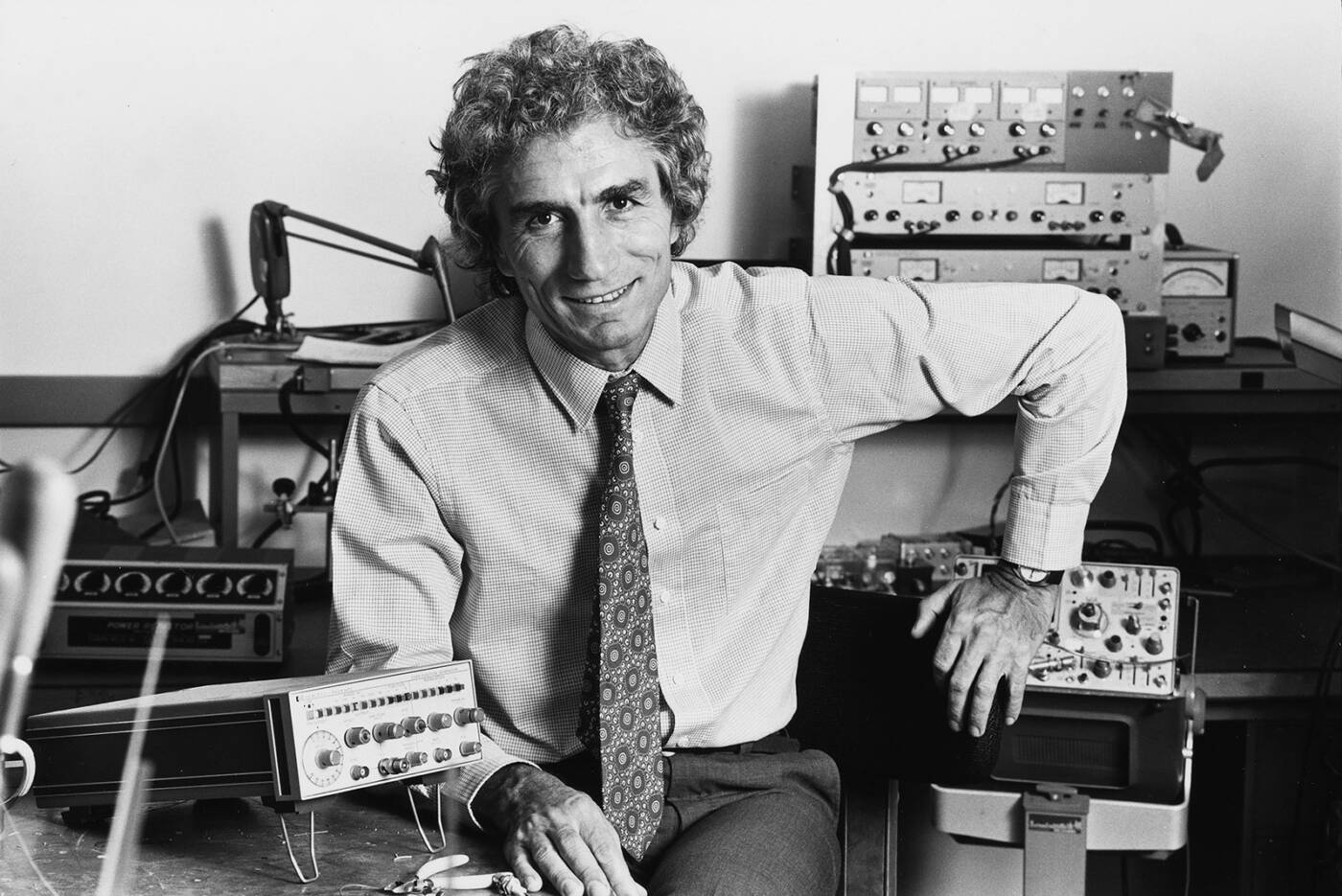
Goulianos in 1981. Photo by Ingbert Grüttner.
Konstantin Goulianos, emeritus professor and head of the Laboratory of Experimental High Energy Physics, and a renowned particle physicist who contributed to the discovery of fundamental building blocks of matter, has died. Goulianos, 90, was a member of the Rockefeller community since 1971.
As a graduate student at Columbia University, Konstantin—Dino, as he was widely known—helped build a detector at Brookhaven National Laboratory that confirmed the existence of the previously theorized muon neutrino. In 1988, he traveled to Stockholm with his thesis advisors when they accepted the Nobel Prize in Physics for the discovery.
Over many decades, Goulianos conducted experiments on subatomic particles using the world’s most powerful accelerators in both the U.S. and abroad, and he and his lab designed and built exquisitely sensitive instruments that made this kind of work possible. With his colleagues, Goulianos carried out experiments that helped establish the theoretical framework that spells out the elementary components of matter and the interactions between them, known as the Standard Model. His work with the Collider Detector at Fermilab (CDF) contributed to the 1995 discovery of the top quark, the heaviest and last of the quarks to be experimentally confirmed.
Goulianos’ lab also contributed to the international Compact Muon Solenoid (CMS) experiment at the Large Hadron Collider at CERN and participated in the 2012 discovery of the Higgs boson and field which gives mass to elementary particles. The Higgs discovery marked the end of a half-century’s search by thousands of scientists around the world, and was recognized with the Nobel Prize in Physics in 2013.
Goulianos was also highly regarded for his research on diffractive scattering, in which one or both colliding particles remain intact. He made numerous important measurements on diffraction in experiments at both Fermilab and CERN, and established a phenomenological model to describe this type of interaction at high energies in hadron colliders.
Born in Thessaloniki, Greece, on November 9, 1935, Goulianos received his undergraduate degree in chemistry from the University of Thessaloniki. He attended Columbia University on a Fulbright Scholarship and went on to become an assistant professor at Princeton University in 1964. In 1971, Goulianos was invited to join The Rockefeller University by the pioneering particle physicist Rodney Cool as part of a newly founded group of experimental physicists recruited under President Frederick Seitz.
“Surrounded by biologists, Dino embraced his outlier role and participated fully in the Rockefeller community, where he was known as a warm, outgoing colleague who carried his brilliance lightly,” says Richard P. Lifton, Rockefeller’s president. He was an avid runner, rower, swimmer, snowboarder, and skier and he spoke many languages including Greek, German, Italian, English, Russian, and Chinese.
Goulianos is survived by his wife Karen Grahn-Goulianos.