Researchers gather to investigate the building blocks of social behavior
 COPY LINK
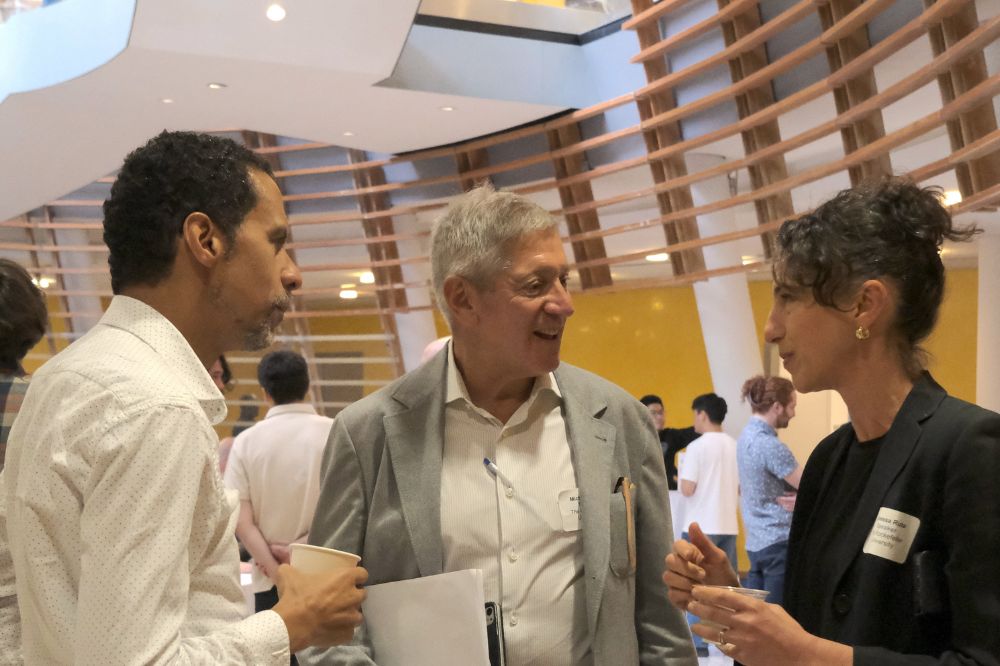
Erich D. Jarvis who heads the Laboratory of Neurogenetics of Language; Michael J Price, a Rockefeller trustee and philanthropist; and Vanessa Ruta who directs the Price Family Center for the Social Brain. (Photo credit: Athena Lackides)
Three years after its founding, the Price Family Center for the Social Brain at Rockefeller has made many noteworthy advances. In a joint symposium with Columbia University’s Zuckerman Institute, last month, scientists from across New York City gathered in the Carson Family Auditorium to share new insights on vocal learning, mate choice, and more—advancing the center’s mission to deepen our understanding of social behavior and foster interdisciplinary collaborations.
Directed by Vanessa Ruta, the Center for the Social Brain was established with a $10 million gift from Michael and Vikki Price. Its mission is to illuminate the neuronal, cellular, and molecular underpinnings of social behavior. “Social interactions are at the heart of our human experience,” says Vanessa Ruta, who also heads the Laboratory of Neurophysiology and Behavior at Rockefeller. “The Price Center supports research into the basic building blocks of social behavior, laying the foundation to understand the function of social brain networks and how they underlie our ability to connect and communicate.”
The recent symposium included presentations of ongoing research in the Freiwald, Jarvis, Kronauer, Rajasethupathy, Ruta, and Vosshall laboratories at Rockefeller, as well as complementary work taking place at Columbia. Designed to spark informal interactions, especially among early-career scientists, the symposium featured talks from faculty and trainees across both institutions. The day’s lectures spanned species and disciplines, from mosquito mate choice and ant brain wiring to primate social memory and dopamine-driven learning. Researchers discussed how vocal learning shapes auditory circuits, how hormones and genes influence social behavior, and how behaviors become established through experience.
“The symposium presented a fascinating range of work,” says Michael Price. “In just three years, the Center has generated profound new insights into the neuroscience of social behavior and, through its Fellows program, is cultivating a new generation of leaders in the field who embody the Center’s mission to pursue bold, interdisciplinary science. Vikki and I are encouraged by the commitment of the Center researchers to uncover the fundamental building blocks of the social brain and ways to translate their discoveries into better diagnostics and novel therapeutics for social brain disorders.”
It was a novel format for the center, which had previously held symposia that showcased the work of leaders in the field from around the world. “Hearing about new science and perspectives is inspiring, but it doesn’t immediately build collaboration within a community,” Ruta says. “This year’s symposium was meant to catalyze interactions between researchers interested in the social brain on campus and colleagues across town.”
But the symposium is just one expression of a broader strategy. In the three years since the center was founded, it has made several investments to advance the study of the social brain.
The Price Fellows Program currently supports four early-career scientists embedded in Price Center laboratories: Tiphaine Bailly of the Kronauer lab, Juliana Rhee of the Ruta lab, Jacopo Razzauti of the Vosshall lab, and Santiago Otero Coronel of the Friewald and Vaziri labs. Among their accomplishments, these fellows are accelerating discovery and building community through a monthly data club focused on trainees, providing a forum where they can present experimental challenges and receive constructive feedback from peers.
The center has also awarded four high-risk, high-reward grants, each of which supports collaborations across different laboratories, both within and outside of Rockefeller. And the center has taken significant steps toward meeting a key challenge in studying social interaction—quantification. To that end, the center is helping to develop an in-house data team at Rockefeller, which is currently creating general algorithms for precise tracking and analysis of complex social behaviors, which can be applied to diverse model organisms, from flies to songbirds.
Ultimately, the center’s efforts are rooted in the conviction that understanding social behavior is essential for understanding the brain itself. We are inherently social creatures,” Ruta says. “Our most sophisticated cognitive capacities are thought to have evolved to serve social needs. Studying the social brain offers a powerful lens into the brain’s core computations.”
At the same time, social isolation is clearly one of the most devastating features of neuropsychiatric and developmental disorders. The COVID-19 pandemic underscored just how vital social connection is. Ruta hopes that the Price Center will lead the charge in applying the tools of modern neuroscience and data science to the foundations of social behavior—and, in doing so, offer new hope for human health. “One of our central aspirations is to develop a framework to explore our social nature.”