RockEDU helps local teachers reimagine classroom research
 COPY LINK
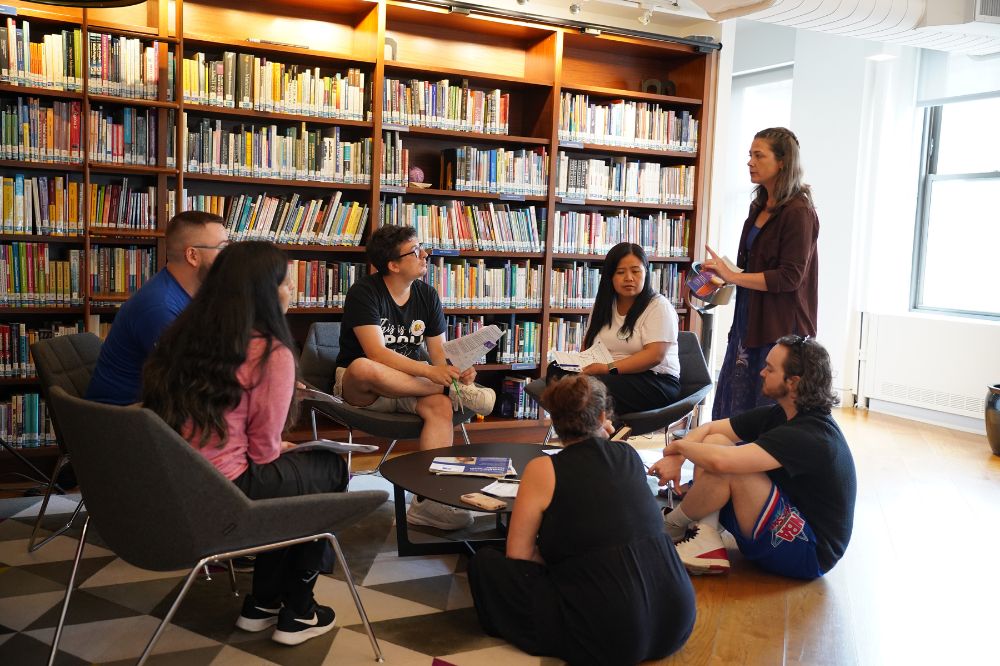
Jeanne Garbarino presenting the RockEDU Sandbox model at Math for America’s Summer Think conference.(RockEDU)
On a summer morning at Rockefeller University, high school students huddle over lab benches, cultivating stem cells, testing water samples from New York Harbor, or designing diagnostic tools for cancer. They’re forming hypotheses, building technical skills, and working through the messy, creative process of scientific discovery.
This is the heart of the RockEDU Sandbox, a framework developed by RockEDU, Rockefeller’s outreach team, to guide open-ended exploration in a structured environment. In it, a teacher or mentor introduces a theme—such as stem cell growth—and students take the lead, designing experiments to investigate those scientific concepts.
Now in its fifth year, the method draws on the expertise of graduate students and postdocs who develop and lead themed research projects in the university’s Summer Science Research Program (SSRP).
“This sandbox approach to science education gives students room to pursue their own ideas but with guardrails,” said Jen Bohn, who directs the RockEDU Fellows program. “If every student follows a completely different path, it becomes overwhelming for mentors to provide meaningful support. A shared theme keeps the experience manageable while still leaving space for curiosity and creativity.”
Inside the box
Though originally developed specifically for SSRP, the sandbox approach has begun attracting attention beyond Rockefeller’s gates. For instance, in July, Bohn and her colleagues introduced the model at Math for America’s (MfA) Summer Think conference, a three-day professional development event for New York City science and math teachers. While the team has shared elements of the approach before, MfA represented their first opportunity to present a comprehensive rollout to a broader audience of educators.
Bohn opened her presentation by showing a photo of children in a literal sandbox. “I asked participants what it evokes,” she said. “The words that came up are play, creativity, collaboration, and a supportive environment. That’s what we want to bring into science education.”
That same spirit carries into the classroom. In sandbox science, students investigate real scientific questions but with plenty of room to follow their own curiosity.
“They’re all working on the same topic,” said Jeanne Garbarino, executive director of RockEDU, “but they take it in different directions based on what sparks their interest.”
During a recent summer lab, for example, students wondered how ingredients like caffeine or sugar substitutes, common in energy drinks, might affect stem cell growth. With guidance from mentors, they designed experiments to find out.
Adapting the sandbox for schools
In 2023, Garbarino and her team hosted a summit for 60 local teachers, in which many voiced a desire for new methods for incorporating hands-on exploration, she says. In response, earlier this year RockEDU held a sandbox workshop with a group of educators from the New York Performance Consortium. Now RockEDU sees an opportunity to further extend its impact beyond Rockefeller’s SSRP. Bringing their model to the MfA Summer Think conference marked a key step in that effort: a chance to put a lab-tested approach into the hands of educators citywide.
“We’re helping teachers build their own sandboxes,” said Garbarino.
Educators like Nicole Beall, a veteran science teacher at Lyons Community School in Brooklyn and Math for America fellow, who spent her sabbatical year with RockEDU mentoring in “pop-up” labs on campus and helping adapt the sandbox learning environment for classroom use.
She worked alongside Rockefeller trainees to observe how students engaged with open-ended investigations and offered feedback on how the model could translate to public school classrooms. “What stood out to me,” Beall said, “was how the mentors offered structure without shutting down creativity. I started thinking differently about how to help my own students take ownership of their work.”
At the conference, Beall led the final day of the workshop, guiding teachers as they imagined how the model might work in their own schools. She focused on middle and high school settings where students are ready to begin developing independent research ideas. Teachers brainstormed themes, considered classroom constraints, and mapped out the skills students could build through hands-on inquiry.
Supporting future educators
For Rockefeller’s scientific trainees, the RockEDU Sandbox isn’t just a way to help the next generation fall in love with science; it also offers them a chance to learn leadership skills. “For our postdocs, it feels like a low-stakes environment to figure out what it’s like to be the head of a lab,” said Bohn. “They get to design the experiments, manage students, troubleshoot. It’s a great learning space for them, too.”
As the model evolves, the RockEDU team is focused on building a lasting community of practice. They’re continuing to bring teachers into the design process, offering mentoring and professional development, and looking for ways to support classroom pilots, like the one Beall plans to run this fall.
For Beall, the summer lab experience changed how she thinks about teaching science. “This year gave me a new way of thinking about what science class can be,” she said. “I want my students to feel that same joy and wonder—like their ideas matter.”