Joseph L. Goldstein , M.D.
RECIPIENT OF THE DAVID ROCKEFELLER AWARD FOR EXTRAORDINARY SERVICE
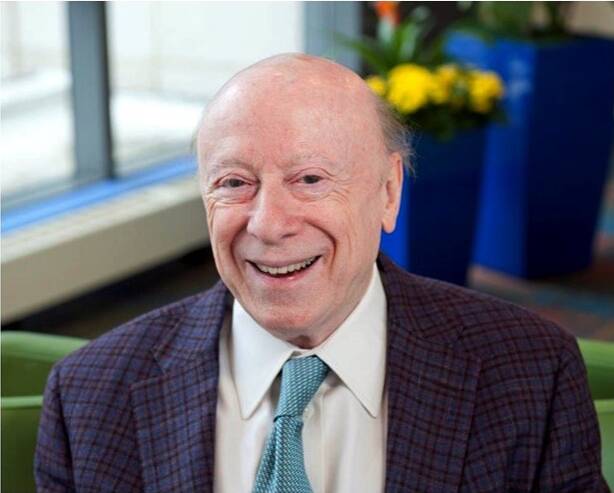
In Kingstree, South Carolina, where Joseph L. Goldstein grew up, the Sunday New York Times arrived midweek in the mail. Joe’s dad selected words from the paper on which to quiz his son. The youngster enjoyed these vocabulary-expansion exercises. His mother, too, savored language, and he borrowed books from her that were beyond the reach of most children his age. His precocious curiosity and intellect blossomed as he grew.
Dr. Goldstein graduated as valedictorian from Washington and Lee University with a bachelor’s degree in chemistry. He continued to medical school at the University of Texas (UT) Southwestern Medical Center and onward to an internship and residency at Massachusetts General Hospital. There he met classmate Michael S. Brown with whom he shared a fierce interest in the detailed mechanisms of illness. Dr. Goldstein then gained entry to the prestigious NIH Clinical Associate Training Program.
At the NIH Clinical Center, Dr. Goldstein encountered a child with familial hypercholesterolemia (FH), a disease characterized by exorbitant quantities of blood-borne low-density lipoprotein (LDL) cholesterol and heart attacks that killed patients before adulthood. Its underlying genetic defect was unknown, and that conundrum captivated Dr. Goldstein. After a postdoctoral fellowship in medical genetics at the University of Washington, he joined the UT Southwestern faculty, and dug into the FH puzzle with Michael Brown, who had also accepted a position there.
Their FH work launched a new era in cell biology. They discovered the LDL receptor, which imports cholesterol from the bloodstream into cells, and they illuminated how it governs cholesterol homeostasis. Their findings cracked open the fields of receptor-mediated endocytosis, receptor recycling, and feedback regulation of receptors—phenomena that touch multiple physiological processes. Goldstein and Brown’s advances led to the development of life-saving drugs called statins. The duo has continued to make groundbreaking findings; for instance, they discovered the SREBP family of transcription factors and demonstrated how these molecules govern the synthesis of cholesterol and fatty acids through a previously unknown process.
In 1985, Drs. Goldstein and Brown received the Albert Lasker Basic Medical Research Award and the Nobel Prize in Physiology or Medicine. Dr. Goldstein is a member of the U.S. National Academy of Sciences, the American Philosophical Society, and the National Academy of Medicine, and he is a Foreign Member of the Royal Society. He is Chair of the Albert Lasker Medical Research Awards Jury; a member of the Board of Trustees of the Howard Hughes Medical Institute; and a Life Trustee of The Rockefeller University.