Pickleball mania comes to Rockefeller
 COPY LINK
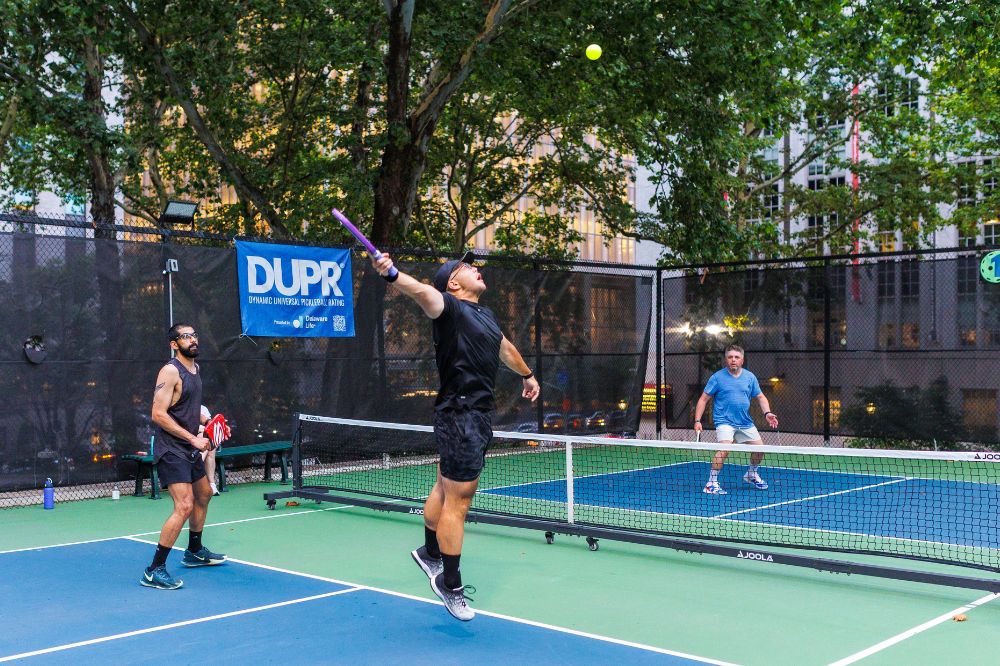
From left to right: Mark Gad, Daniel Oh, and Alex Kogan (Credit: Juan Rodriguez)
With nearly 20 million players, pickleball is widely considered the fastest-growing sport in the United States. That’s certainly the case at Rockefeller.
What started off as a trickle of players—many of them trying the sport for the first time—has grown into a community of hundreds who keep the courts, classes, and tournaments on campus busy year-round.
“I think that’s largely because it’s accessible to so many people, no matter their age, athletic ability, or experience with racket sports,” says Fitness Manager Tim Blanchfield, who oversees all things pickleball at Rockefeller. “It’s slower than tennis, and games tend to last only about 15 minutes.”
The game debuted on campus in spring 2023 on the newly refurbished multisport court. Incorporating the lines of the pickleball court (which is smaller than a tennis court) into the playing area came at the suggestion of Alex Kogan, associate vice president of Plant Operations & Housing, himself an avid player.
Today there are five courts (one indoor) that are bookable from 7 am to 10 pm every day. Bookings are made through the online reservation system, and they fill up fast, especially for post-4 pm slots. There are also popular weekly classes, regular skills workshops, and competitive tournaments with four divisions.
Invented 60 years ago on an island off the coast of Seattle, the game combines elements of tennis, badminton, and table tennis.
“Pickleball is more physically demanding than table tennis, but in comparison to court tennis, it’s relatively easy to become competent,” says Brian Fabella, a research specialist in the Hudspeth lab and highly committed pickleballer. “Yet it’s still challenging enough to develop skills and strategies if you want to play more advanced competition.”
How to pick up pickleball
Most games are played like doubles tennis, with two players on each team. The serve is held by one team until it loses a volley, and then it switches to the other. Points are only scored by the serving team, and the game is played to 11.
There are many more rules, but that’s about all anyone needs to know to join an introductory pickleball Skills & Drills class, which takes place in Weiss every Monday at 4–5 pm. Additional intro classes are occasionally held on the outdoor courts as well.
That’s what Dan Oh did. A graduate student in the Darnell and Heintz labs, Oh took the class as soon as pickleball came to campus. Though he had never played a racket sport before, he quickly got hooked, and he has played in every tournament ever since.
Qiulei Hu, the lab administrator of the Alushin lab, has a similar story. “I had zero experience in pickleball—or any sport—before learning to play in one of Tim’s intro classes two years ago,” she says. “When I first started, my only goal was to get the ball over the net. Over time, I realized it’s a game full of strategy, almost like chess. Points aren’t usually won with one big shot, but by carefully setting up a series of plays. Pickleball is both fun and challenging, regardless of your level. I also love the collaborative side of the game, since we mostly play doubles.”
Hu made quick strides to the advanced intermediate level, where she and her partner, Ursula Sze, a senior investment analyst in the Investment Office, form the team Dynamic Q-U-o.
More experienced players can improve their serves, dinks, and bangers while learning to avoid fly swatters, falafels, and faults (all pickleball terms) in the Advanced Skills & Drills class, which is held in Weiss on Wednesdays at 11:30–12:30. Blanchfield teaches all the classes, which take place year-round.
Joining the competition
When a player has gained enough experience to be competitive, they can join “open ladders,” which are held on Monday and Wednesday evenings and Saturday morning on the outdoor courts. Ladders are a series of games that teams rotate in and out of based on their wins and losses.
They can also enter tournaments, which regularly take place on select Monday and Wednesday evenings from spring through late fall. There are four divisions: novice, intermediate, advanced intermediate, and open, the highest level. While most people enter the tournaments as a team, single players regularly sign up as well, and Blanchfield pairs them with players at a similar skill level.
Each tournament is a round robin, so every team plays every other team, and the top two pairs face off for the title. The winning team from each division must move up a level for the following tournament. He explains, “If you win the intermediate division, the next time you play in a tournament, you will be playing in the advanced intermediate. This keeps any one team from dominating a division.”
But team movement can occur in the other direction as well. “If you come in last, you’re dropped down to the lower division,” he adds. “It’s like you’re getting sent back to the minor leagues to improve your game.”
Spectators regularly show up to watch. “I think the open division probably gets the most spectators, because all the lower divisions want to see the better players play,” Blanchfield says.
The finale of the current tournament will take place on October 8 at 5 pm. Oh and his partner Mark Gad, a graduate research fellow in the Birsoy lab (aka team Oh Gad!!!), battle Borderline Red—Blanchfield and Jared Ramsey, a graduate fellow in the Kapoor lab—for the open division title.
A consolation final, or the fight for third place, will also take place that evening, when Alvaro Hobbs, a grad student in the Victora lab, and Tacio Waldeterio, a technician in the Nussenzweig lab, face off against Rice lab postdoc Yingpu Yu and Vikas Singh, a senior research associate in the Tarakhovsky lab.
Registration is now open for the last tournament games of 2025, which will be held on November 5, 7, 10, and 12.
The winners don’t just get bragging rights—they also receive prizes, which have ranged from movie tickets to T-shirts.
The community
A core group of around 100 players form Rockefeller’s Pickleball Club. They enter their matches on DUPR, a scoring site, which also rates the players.
Beyond game play, the club connects for social events, most recently holding a BBQ on campus on September 14. About 50 people attended.
“I was the grill master, combining my two hobbies of pickleball and grilling,” Oh says.
Despite being a fierce tournament competitor, Oh appreciates the social aspect of the sport above all. “Playing pickleball has been a great way to meet new people and make new friends, especially people I would normally not get the chance to meet—anyone from HOLs, to employees, to other students,” he says.
“Tim has done an amazing job creating a pickleball universe here at RU and has grown the community by organizing year-round events,” says Fabella. “As long as I have time and my body permits it, I try to participate in everything.”
Hu hopes more members of the Rockefeller community join them. “Right now, most of our tournament players are men, and it would be great to have more balance. I’d love to see mixed doubles, women’s doubles, and men’s doubles at the tournaments,” she says. “So just pick up a paddle and come to an intro class—I promise it’s a lot of fun.”