Svetlana Mojsov promoted to Research Professor
 COPY LINK
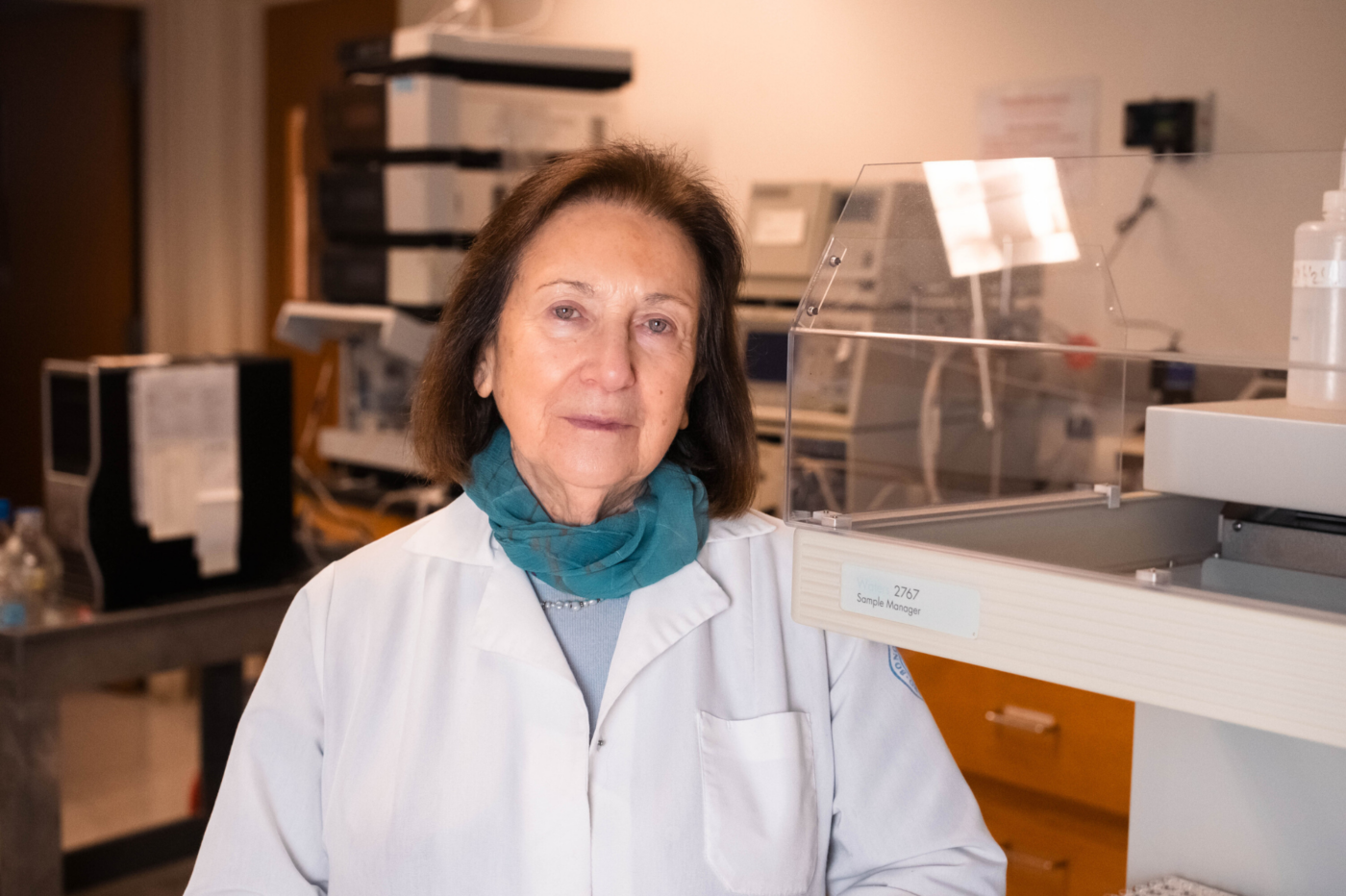
Svetlana Mojsov.(Credit: Lori Chertoff)
Svetlana Mojsov, whose research led to the development of revolutionary obesity drugs, has been promoted. She is now Rockefeller’s Lulu Chow Wang and Robin Chemers Neustein Research Professor. This promotion recognizes her extensive and ongoing contributions to science and to the university’s mission.
Svetlana began her scientific journey as a graduate student in Bruce Merrifield’s Rockefeller laboratory in the early 1970s, where she trained in solid phase peptide synthesis and became interested in the peptide hormone glucagon and its role in regulating glucose metabolism. She developed novel methods enabling the first synthesis of glucagon and its crystallization.
She moved to Massachusetts General Hospital in 1983 as an instructor and founding director of the HHMI peptide synthesis facility at MGH. Concurrent with her move, DNA copies of the RNAs encoding mammalian glucagon were cloned, and surprisingly showed that the glucagon peptide was embedded in a longer precursor protein from which it was clipped. Most interestingly, there were two additional putative peptides embedded in the same protein, however the precise sites of cleavage liberating the mature peptides were uncertain. Multiple labs guessed incorrectly and concluded these additional peptides had little or no biological function. Mojsov’s experience led her to correctly deduce the cleavage sites and the sequence of active GLP-1, and showed that it was made in the intestinal L cells and released in response to food intake. By synthesizing large quantities of pure GLP-1, she, in collaboration with Gordon Weir and Joel Habener, demonstrated that GLP-1 increased pancreatic insulin secretion. This established GLP-1 as a long-sought incretin hormone, released in response to food consumption and stimulating insulin secretion. With David Nathan, Svetlana went on to show GLP-1 safely lowered blood glucose in diabetic individuals.
Novo Nordisk licensed Mojsov and Habener’s patent on GLP-1. Over many years of protein modification, the company succeeded in prolonging the half-life of GLP-1 in the blood from 1-2 hours to 1 week, enabling production of long-lasting high levels of GLP-1. Remarkably, at high concentrations, this drug, semaglutide – marketed as Ozempic or Wegovy – not only provided safe blood sugar lowering in diabetics, it produced dramatic weight loss in obese individuals, gaining FDA approval for weight loss in 2017. GLP-1s are revolutionizing the treatment of obesity and mitigating its clinical consequences, reducing heart attacks, kidney failure, sleep apnea, heart failure, fatty liver and many cancers. It is estimated that 12% of U.S. adults – 33 million people- are currently taking GLP-1s.
Mojsov returned to Rockefeller in 1990 where she continued to work on peptides associated with glucose regulation, including GLP-1 and PACAP-38, an intestinal neuropeptide that influences pituitary hormone release and modulates the neuroimmune system, as well as the G-protein coupled receptors for GLP-1. In the 2010s, she studied the function of GLP-1 in fish, which have different metabolic pathways than mammals. Today, her laboratory works to understand interactions between glucagon/GLP-1 and G-protein coupled receptors.
Her work has been recognized with the world’s most prestigious scientific prizes, including the 2024 Pearl Meister Greengard Prize, Time Magazine’s top 100 most influential people of 2024, the 2024 Tang Prize, the 2024 Princess of Asturias Award for Technical & Scientific Research, the 2024 Lasker-DeBakey Clinical Medical Research Award, the 2025 Warren Triennial Prize from Massachusetts General Hospital, the 2025 Breakthrough Prize in Life Sciences, the 2025 Distinguished Medical Science Award from the National Library of Medicine, and the 2026 King Faisal Prize in Medicine, as well as election to the National Academy of Sciences in 2025.