Hess Center for Research on Women’s Health and Biomedicine holds its inaugural symposium
 COPY LINK

Rockefeller University President Richard P. Lifton, university trustee Marlene Hess, and center head Agata Smogorzewska (Credit: Athena Lackides)
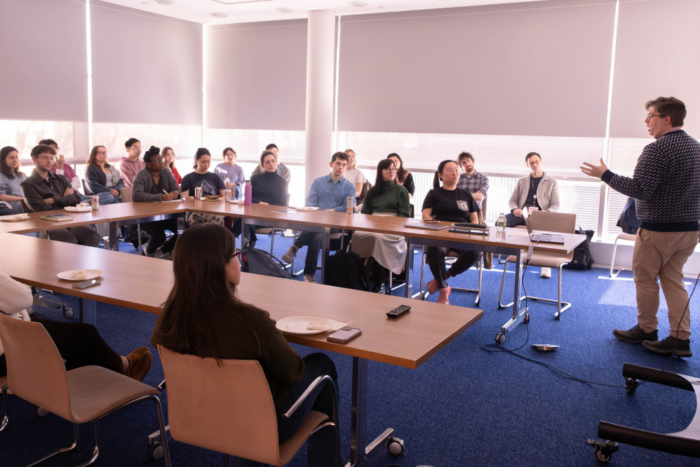
Only one year since its launch, the Marlene Hess Center for Research on Women’s Health and Biomedicine is already yielding compelling discoveries. At its inaugural symposium this fall, researchers from laboratories across Rockefeller convened in the Carson Family Auditorium to exchange findings on topics from osteoarthritis to autism—furthering the center’s goal of examining health and biology through the lens of sex differences.
Led by Agata Smogorzewska, the Center was founded through a generous donation from Rockefeller Trustee Marlene Hess. Building on Rockefeller’s strengths in the research of cancer, cardiovascular and metabolic disorders, immunity, and neuroscience, the center has already provided funding to 16 investigators, with the goal of driving collaboration and innovation toward more precise medical care. “While many clinically oriented women’s health centers exist across the country, few are positioned to integrate world class basic science research to illuminate the fundamental drivers of biological sex-related health differences,” says Smogorzewska, who also heads the Laboratory of Genome Maintenance at Rockefeller. “We are uniquely positioned to lead this effort.”
At the recent symposium, researchers from the Darnell, Vinogradova, Rice, Kapoor, Zhao, Tavazoie, Friedman, Liu, Gilbert, Young, Cohen, Roeder, and Fuchs labs showcased their latest findings. The event was structured to encourage cross-lab conversation and collaboration. Presentations covered a wide scientific range—from inflammation that worsens arthritis in women and sex-linked differences in brain cells to genetic factors driving breast cancer spread and new insights into autism in females. All this work is shedding light on how biological sex influences health, aging, and disease.
“Bringing together this remarkable scientific talent within a center focused on women’s health and sex differences is fostering new conversations, collaborations, and innovative research,” Smogorzewska says. “This will ultimately lead to more precise diagnoses, more effective treatments, and improved overall health outcomes in women and men.”
Hess, the center’s founder, has served on the Rockefeller Board of Trustees for more than two decades and recently received an honorary degree from the university. Her philanthropy has strengthened many facets of the institution—from establishing the Leon Hess Professorship, held by Sohail Tavazoie, to supporting the construction of the Hess Academic Center, which now houses the president’s and dean’s offices. Through the Center for Research on Women’s Health and Biomedicine, Hess’s generosity has funded Idea Grants of $150,000 per year for two years, and pilot grants of $50,000 per year for two years. Recipients of the Idea Grants gave oral presentations and pilot grant recipients presented their work at poster sessions during the symposium.
The inaugural symposium marks an early milestone, as the Hess Center transitions into its second year having already begun to establish the scientific foundation needed to transform how sex differences are understood across biomedicine. As new collaborations take shape and additional discoveries emerge from its growing community of investigators, the center is poised to accelerate progress toward better diagnostics, better therapies, and better outcomes for all.