Konstantin A. Goulianos, Ph.D. (1935-2026)
Professor Emeritus
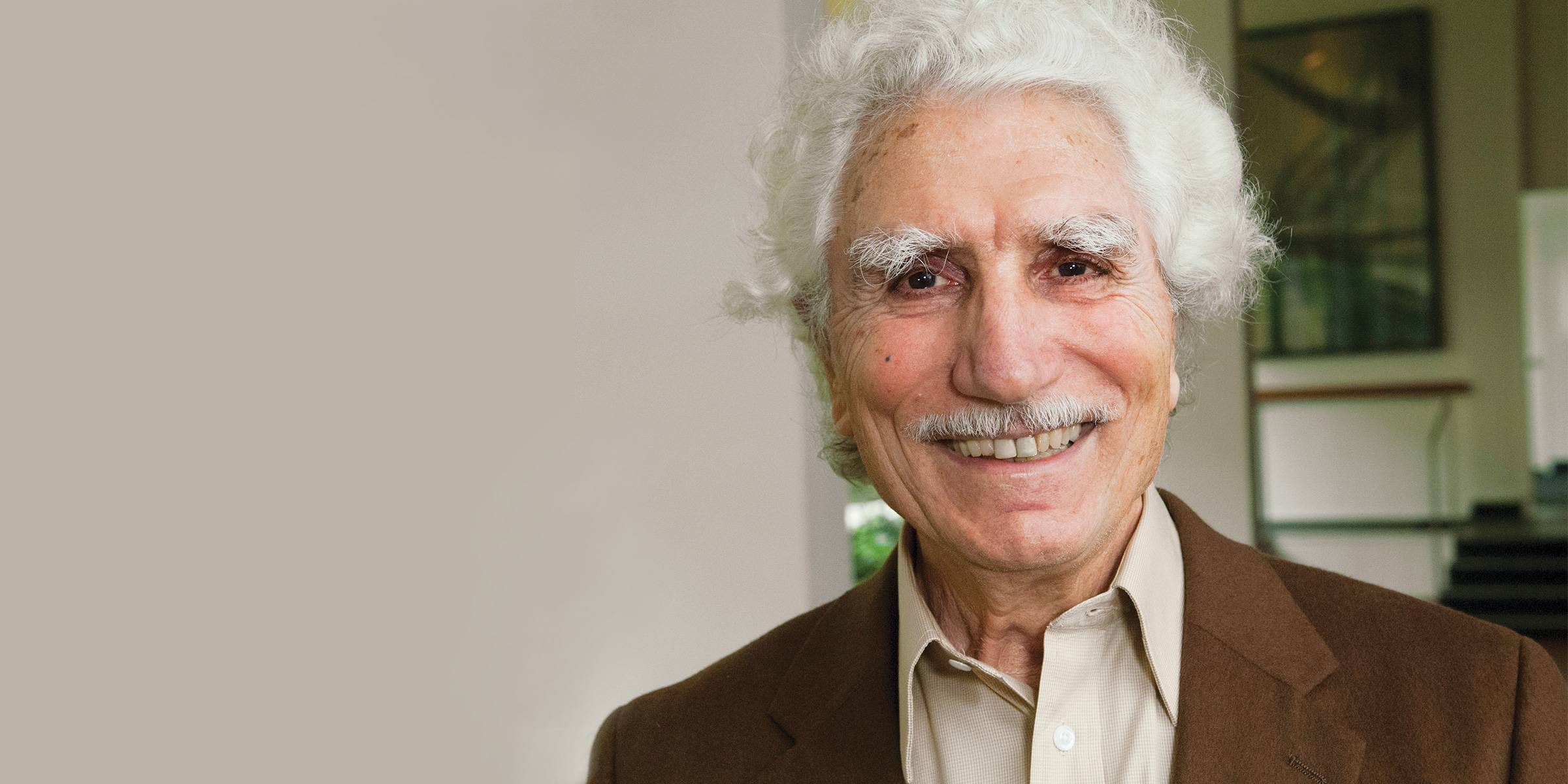
Aiming to understand the creation and evolution of the universe, Goulianos and his colleagues study the basic constituents of matter by analyzing data from collisions of sub-atomic particles accelerated to very high energies. Their research is currently conducted at CERN in Geneva, Switzerland, using the Large Hadron Collider, the world’s largest sub-atomic particle accelerator.
A large fraction of the energy in particle collisions is converted into a variety of new particles flying away from the collision like exploding fireworks. Most of the created particles have an ephemeral existence, decaying after a brief period of time into more stable ones. Detailed studies of all known particles have revealed an inner order that has been coded into a theoretical framework known as the Standard Model. Matter in all its forms, from stars to living organisms, is described in terms of twelve fundamental particles, six quarks and six leptons, interacting by exchanging force particles—gluons, photons, or W and Z bosons—following strict mathematical rules based on symmetry principles.
The Goulianos laboratory has made substantial contributions to establishing the Standard Model as the premier theory of particle physics. Their experiments at the Intersecting Storage Rings at the European Organization for Nuclear Research (CERN) provided early evidence for the existence of quarks. In other experiments conducted at the Brookhaven National Laboratory, they discovered and measured the rate of neutrino-proton elastic scattering, confirming the neutral-current interactions predicted by the Standard Model. In the collider detector at Fermilab (CDF) experiment, which used proton-antiproton collisions from the Tevatron machine, the Goulianos laboratory contributed to the discovery of the top quark.
The Goulianos team currently participates in the international collaboration of the Compact Muon Solenoid (CMS) experiment at the Large Hadron Collider at CERN. On July 4, 2012, CMS and ATLAS, another CERN experiment, announced the discovery of the Higgs particle, which could explain the diversity of quark masses. This result was corroborated by a CDF measurement. The Higgs discovery marks the end of a half-century’s hunt for its existence by thousands of scientists around the world and motivates the effort to conduct higher precision experimental tests to look for violations that might come from new physics.
Other physics activities of the Goulianos team at CDF and CMS have included working on phenomenological models aimed at accommodating gravity in the Standard Model and explaining dark matter and dark energy. Presently, the team is studying diffractive phenomena, which provide a window to a component of the Standard Model important for understanding the structure of particles like the proton.
Carrying over the experience gained at the Tevatron to their research at the Large Hadron Collider, Goulianos and his team are uniquely positioned to make new discoveries in areas of physics beyond the Standard Model to advance “Scientia Pro Bono Humani Generis.”