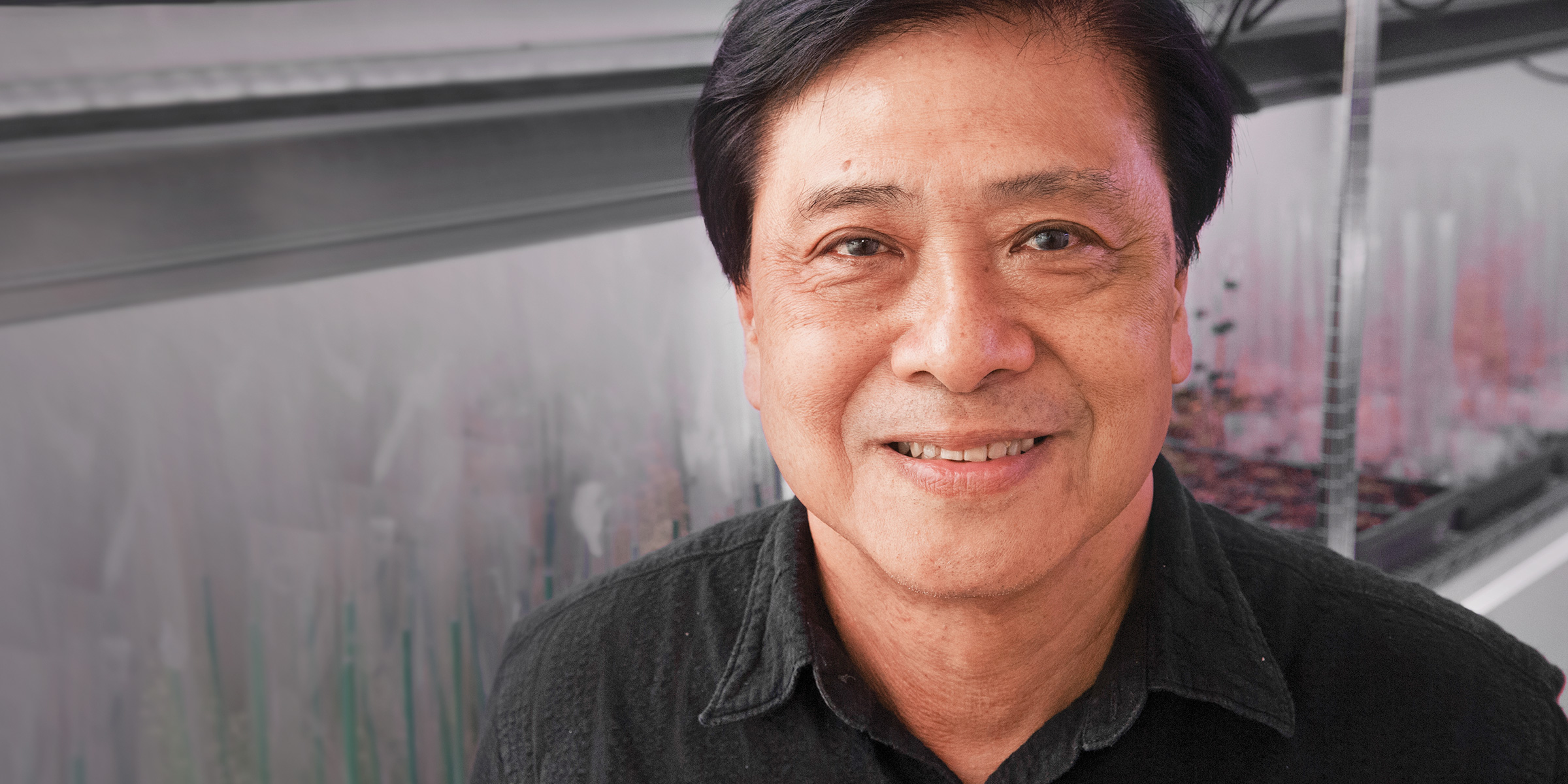
Heads of Laboratories
Andrew W. Mellon Professor
Laboratory of Plant Molecular Biology
Nam-Hai.Chua@rockefeller.edu
Because they can’t pick up and move, plants must react rapidly to changes in their environment. To do this requires a complex network of signaling pathways, and Dr. Chua is working at the molecular level to understand how some of these pathways work — particularly those involved in responding to light and viral infection.
Using Arabidopsis as a model, Dr. Chua’s lab employs a combination of genetic, molecular and biochemical techniques — including mutant screens and analysis of transgenic plants — to look for different components of signal transduction pathways involved in a plant’s response to light, abiotic and biotic stresses and fertilizer deprivation.
Light is one of a plant’s most important environmental stimuli, and light signal transduction pathways are central to the regulation of its development. Plants perceive discrete wavelengths of light through photoreceptors, such as phytochromes and cryptochromes, and the signaling pathways enable information about the direction, intensity and duration of specific wavelengths to be amplified and coordinated, resulting in complex physiological and developmental responses throughout a plant’s life cycle. Members of the Chua lab are focusing on the identification of signaling intermediates that promote phytochrome A and B signal transduction.
Additional areas of focus in the Chua laboratory include investigation into the role of long noncoding RNAs (lincRNAs) and natural antisense transcripts (NATs) in plant stress responses and fertilizer use efficiency. Recently, Dr. Chua’s lab has found that the Arabidopsis genome encodes around 8,000 lincRNAs and 36,000 NATs whose functions await identification. Current effort is directed toward the characterization of genes involved in the biogenesis and regulation of lincRNAs and NATs and the elucidation of the functions of these noncoding RNAs.
Prior work in Dr. Chua’s lab established several of the basic tools necessary to conduct molecular research in plants. One of those tools is a highly controllable and chemically inducible plant gene expression system that allows researchers to turn transgenes on and off as desired. Using this system, Dr. Chua found key proteins involved in the plant’s response to the light/dark transition. Dr. Chua’s research has also identified proteins that play a role in a plant’s reaction to drought. The lab has constructed different transgenic mutants that are more tolerant of drought conditions and can resume growth when water is no longer a limiting factor.
Learning how plants’ protein intermediates act and understanding the roles of their modifications in signaling will lead to strategies by which scientists may manipulate plant genetics in order to fortify crops against viral infection, drought, flood, pests and other suboptimal conditions. The knowledge generated by Dr. Chua through the use of Arabidopsis can be applied toward crop improvement to reduce hunger around the world as well as to create sustainable agriculture in portions of the world that are today poorly suited to it.
CAREER
Dr. Chua was born in Singapore and earned his B.S. in botany and biochemistry from the University of Singapore in 1965 and his A.M. and Ph.D. from Harvard University in 1967 and 1969, respectively. He was a lecturer in biochemistry at the University of Singapore Medical School from 1969 to 1971. Dr. Chua joined Rockefeller in 1971 as a research associate in cell biology and was named assistant professor in 1973, associate professor in 1977, professor in 1981 and Andrew W. Mellon Professor in 1988.
Dr. Chua was awarded the Lawrence Bogorad Award for Excellence in Plant Biology Research by the American Society for Plant Biologists in 2010, the International Prize in Biology from the Japan Society for the Promotion of Science in 2005, the Singapore Public Administration Gold Medal in 2002 and the Singapore National Science and Technology Gold Medal in 1998. Dr. Chua is an elected member of the Academia Sinica (Taiwan), a fellow of The Royal Society and a foreign member of the Chinese Academy of Sciences. He is an honorary member of the Japan Biochemical Society and the Japanese Society of Plant Physiologists.
|
|
| Return to full listing |
|
|

